

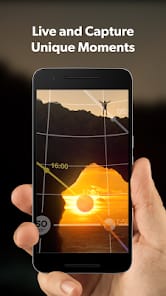
Bottom Line: PhotoPills is a brutal, brilliant masterclass in data density that turns the chaotic movement of the cosmos into a predictable, shootable schedule. It is an uncompromising tool that rewards the diligent and ignores the casual.
To understand PhotoPills, you have to understand the logic of the hunt. Most photography apps focus on the capture or the edit. PhotoPills focuses on the reconnaissance.
The Geometry of Light
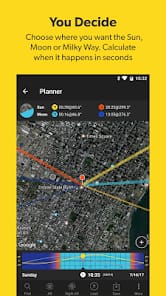
The 2D Planner is where the heavy lifting happens. The interface is a multi-layered stack of information: a map, a timeline, and a series of "pills" (data modules) that display azimuth, elevation, and time of day. The genius here is the interconnectivity of data. When you move the timeline, the lines on the map shift in real-time. If you’re trying to align a full moon with a lighthouse, you aren't guessing; you are solving a geometry problem. The app handles the spherical trigonometry, leaving you to decide if the composition actually looks good. This level of precision is intoxicating, but it exposes the app’s biggest hurdle: information density. There is a lot of "noise" on the screen, and the iconography isn't always intuitive. You don't "explore" PhotoPills; you study it.
Ghost in the Machine: The AR Overlay
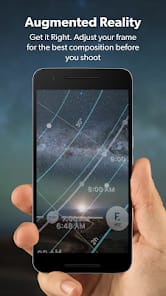
If the 2D Planner is the brain, the Augmented Reality (AR) mode is the eyes. It is the most visceral part of the experience. Standing in a dark field at 2:00 AM, you can hold your phone up and see exactly where the Milky Way will be at 4:00 AM. It feels like magic, but it’s actually a stress test for your hardware. The AR mode relies heavily on the device's magnetometer and gyroscope. On some devices, you’ll encounter "drift," where the celestial path slides away from the actual horizon. PhotoPills includes calibration tools to mitigate this, but it’s a reminder that the app’s accuracy is often at the mercy of the phone’s sensors. When it works, it is the ultimate "Aha!" moment in photography planning.
The Gatekeeper: Friction and Mastery
We need to talk about the onboarding friction. PhotoPills makes no apologies for its complexity. The developers have built a literal "Academy" within the app—a library of tutorials and videos—because they know you’ll get lost. This is a rare instance where a steep learning curve is actually a badge of honor. By forcing the user to learn the terminology (azimuth, NPF rule, hyperfocal distance), the app actually makes you a better photographer. It isn't just providing a service; it's providing an education. However, for the casual shooter who just wants to know when "golden hour" starts, this is massive overkill. There are simpler apps for that. PhotoPills is for the person who wants to know the exact minute the sun will hit the bottom of a specific sea cave.