
Bottom Line: A Dark Room is less a game and more a masterclass in narrative design, using extreme minimalism to build a world of crushing dread and surprising depth. It’s a stark, brilliant, and unforgettable experience that proves imagination is the most powerful graphics card.
"A Dark Room" is an exercise in masterful restraint. Its design is a statement, arguing that the most profound worlds are not rendered on screen, but constructed in the player's imagination. The game weaponizes curiosity, turning the simple act of discovery into its central, driving mechanic.
The First Spark: Onboarding as Mystery
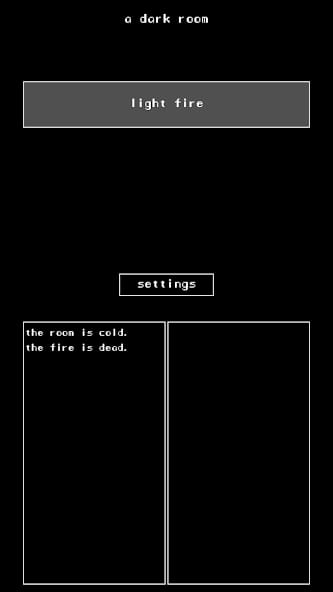
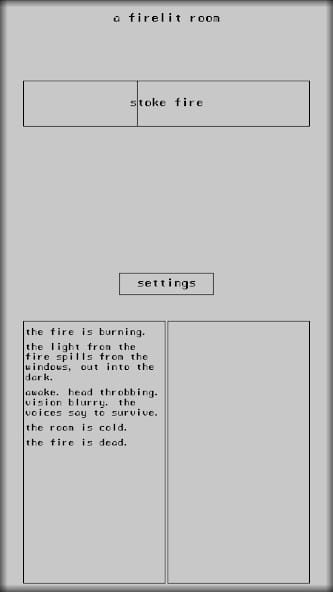
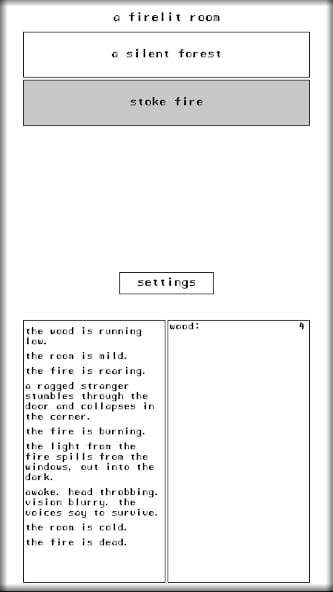
The opening minutes of the game are legendary for their austerity. "the room is cold. // light fire". Tapping the "light fire" button makes the text "fire is burning" appear. That's it. There's no tutorial, no pop-up, no character creation. The game's initial friction is the point. It forces the player to slow down, to observe, to experiment. When a "gather wood" button eventually appears, it feels less like a new feature and more like a personal revelation. This slow, deliberate unfolding of mechanics serves as a perfect onboarding system. The game teaches you its rules by making you the one to discover them. The arrival of the first stranger is a pivotal, startling event, precisely because the game has conditioned you to an experience of absolute solitude. The interface, sparse as it is, becomes your entire world.
The Village: The Burden of Leadership
With the stranger's help, the game pivots from a solitary survival simulation to a nascent society builder. You are no longer just a survivor; you are a leader. The core loop expands. You’re no longer just gathering wood for yourself; you're building huts, managing traps, and assigning villagers to tasks like hunting and tanning. The game’s resource management becomes a delicate balancing act. The "builder" is a demanding, enigmatic figure. Her requests for more wood, more traps, and more huts drive your industry. The narrative remains submerged, hinted at through the descriptions of resources ("cured meat," "leathery skin") and the eventual crafting of weapons. A sense of unease begins to creep in. Why are we building this small, isolated village? What are we preparing for? The game provides no easy answers, and this ambiguity is where its narrative genius lies. The player, desperate for context, begins to fill in the blanks, projecting their own fears and assumptions onto the spartan text.
The Dusty Path: A World in Ruins
The game’s most significant turn is the moment you craft a compass and venture out onto "a dusty path." The screen changes, revealing a map of sorts—a grid of characters representing forests, mountains, and abandoned towns. The game transforms again, this time into a tense, turn-based roguelike. You move, consume resources (water, cured meat), and encounter enemies. Combat is as minimalist as everything else: a series of text descriptions and a measure of your health. Yet, it's incredibly effective. Stumbling upon a "ruined city" and fighting off "feral claws" with nothing but text to guide you is more terrifying than any fully-rendered monster. This is where the game’s environmental storytelling shines. You piece together the history of this broken world through a few stark sentences. The scale of the player's industry in the first act is re-contextualized. You weren't just building a village; you were building an engine for conquest in a dead world. It's a stunning, gut-punch of a reveal.