
Overview
In a gaming landscape saturated with fleeting mobile distractions, LilithGames’ AFK Arena has carved out a formidable niche as a tactical team-based gacha RPG. Launched for iOS and Android on April 9, 2019, it quickly asserted itself as a cornerstone in the idle genre, thanks to a compelling blend of passive resource generation and active strategic engagement. The game posits players as commanders tasked with assembling an eclectic roster of heroes, drawn from a range of factions and classes, each endowed with unique abilities. These heroes are the linchpin of a system designed to navigate expansive campaign maps, dismantle formidable bosses, and assert dominance in both cooperative guild endeavors and competitive PvP arenas. Its market positioning is clear: capture the player who desires depth and progression without the relentless time commitment typically demanded by traditional RPGs. The “AFK” moniker is the core tenet, promising continuous advancement even when the device is pocketed. Yet, beneath this veneer of accessibility lies a sophisticated, often demanding, ecosystem that, while visually appealing and strategically rich, constantly negotiates the delicate balance between player convenience and developer revenue. The title’s longevity, despite its polarizing design choices, speaks to its execution—or perhaps, to the evolving patience of the mobile gaming populace.
Key features
- AFK Progression System: The game’s defining characteristic, allowing players to accumulate vital resources and experience points passively, even when not actively engaged. This mitigates the grind often associated with RPGs, fostering a sense of continuous progress for time-constrained players.
- Deep Hero Collection & Synergy: Players collect and upgrade a diverse array of heroes, each belonging to specific factions and classes. Strategic team composition, leveraging hero synergies and counter-picks, is paramount for success in various game modes, offering significant tactical depth.
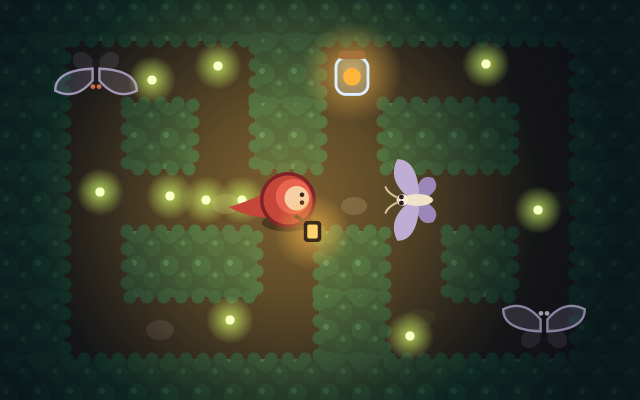
- Visually Distinct Art Style: AFK Arena boasts a highly stylized, almost storybook-esque aesthetic with well-designed characters and detailed environments. This unique visual identity contributes significantly to the game’s immersive quality and stands out against more generic mobile offerings.
Analysis
AFK Arena presents a fascinating dichotomy. On one hand, it delivers an accessible, largely passive gaming experience that genuinely respects the player’s time. On the other, it erects formidable barriers to progress, subtly (and not-so-subtly) nudging players towards monetary investment. The core gameplay loop is simple on the surface: players log in, collect accumulated AFK rewards, manage hero upgrades, and then deploy their optimized team into campaign stages, boss battles, or PvP encounters. Success hinges less on twitch reflexes and more on astute team composition and hero synergy. Understanding the intricate relationships between factions, hero classes, and individual skill sets—for instance, a specific tank’s crowd control synergizing with a damage dealer’s ultimate—is critical. The strategic depth here pushes players to constantly adapt their roster and formations against increasingly complex AI and player opponents.
However, this strategic engagement is frequently overshadowed by the game’s aggressive monetization structure. AFK Arena is a gacha game, and the pursuit of higher-tier heroes and necessary duplicates for ascension forms the primary long-term objective. While the passive AFK rewards provide a baseline of progress, particularly in the early to mid-game, players inevitably encounter “progression walls.” These are points where their current hero power simply isn’t sufficient to advance, demanding either extensive grinding—often weeks or even months of waiting for resources—or, more conveniently for the impatient, opening the wallet for in-app purchases. The game’s ecosystem is carefully engineered to make these purchases appear as logical, almost necessary, accelerants to overcome stagnation. For the casual player, this can be a slow burn of frustration, but for those with a competitive streak, especially in PvP, the “pay-to-win” criticisms become acutely relevant. Maintaining pace with top-tier players often requires significant financial outlay, transforming the tactical challenge into an economic one.
The user experience flow is generally well-designed, with intuitive menus and clear objectives. Onboarding friction is minimal, allowing new players to quickly grasp the core mechanics. However, the sheer volume of daily tasks, events, and sub-modes, while offering variety, can occasionally feel overwhelming, morphing from engaging content into a series of mandatory chores required to maximize resource generation. This constant pressure to “check in” despite the “AFK” promise creates a peculiar tension, where passive gain is balanced by active expectation. LilithGames has demonstrated a commitment to regular content updates, introducing new heroes, game modes, and seasonal events, which keeps the meta fresh and offers new strategic avenues for players to explore. This constant evolution is key to its sustained player base, ensuring that even veteran players have new challenges to overcome and new heroes to covet, thereby perpetuating the gacha cycle.
Monetization & Player Psychology
The psychology behind AFK Arena’s monetization is carefully tuned to modern mobile gaming habits. The “AFK” mechanic itself is a hook, reducing the perceived cost of engagement. But as progression slows, the game subtly preys on impatience and the desire for efficiency. Limited-time offers, VIP levels that grant increasing benefits, and various subscription models present a continuous stream of opportunities for players to bypass the grind. This model creates a significant divide between free-to-play and paying players, particularly in competitive modes. While casual players can certainly enjoy the game for extended periods without spending, the optimal experience, and any hope of high-tier competitive play, is inextricably linked to monetary investment, a common pitfall in the free-to-play mobile market.
Visuals & performance
AFK Arena distinguishes itself with a visually appealing and highly polished art style. The hand-drawn aesthetic, reminiscent of classic fantasy illustrations, gives the game a timeless quality. Character designs are imaginative and distinct, each hero possessing a unique silhouette and animation set that clearly communicates their role and faction. The environments, while often static during battle, are richly detailed and contribute to the overall fantasy ambiance. UI design is functional, if occasionally cluttered, with a clear hierarchy of information. As a stylized 2D title of modest technical scope, it is light on hardware demands by design, which suits its mobile-first audience well.
Platform nuances
As a mobile-first title, AFK Arena is built around touch controls on both iOS and Android. The interface relies heavily on taps and swipes, making hero deployment, menu navigation, and ability activation intuitive. The vertical orientation of the game is well suited for one-handed play, catering to the casual, on-the-go nature implied by its “AFK” mechanic. The design decision to keep the core loop simple and touch-friendly ensures the game translates cleanly across the diverse mobile ecosystem, avoiding the pitfalls of complex controls that often plague games ported from other platforms.
Final verdict
AFK Arena occupies a curious space: a polished, strategically engaging idle RPG that perpetually battles its own aggressive commercial underpinnings. LilithGames has crafted a compelling world with memorable characters and a gameplay loop that can captivate. The AFK mechanic is clever, a genuine innovation in player retention and time management. Yet, the persistent pressure to spend, the grind to overcome engineered progression bottlenecks, and the inherent randomness of its gacha system hold it back. We rate it a mixed proposition: a game that excels in many facets of design and engagement, only to be undermined by the very monetization strategies that fund its continued development. For those with iron wills against in-app purchases or ample patience, it offers a rich, long-term experience. For most others, it’s a constant reminder of mobile gaming’s inherent friction between entertainment and commerce.
Reviewed by the Rankeno Strategy & Sim Desk. Scores are out of 10; the overall score is the desk’s editorial judgement, informed by the four sub-scores above. How we review