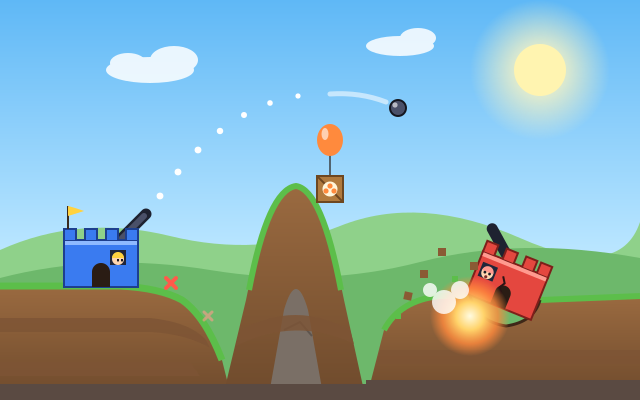
Overview
Spiderling Studios’ Besiege defies conventional game genres, refusing the iterative sequels and safe design choices common elsewhere. Released on February 18, 2020 after a long early access refinement, it presents a seemingly simple premise: construct medieval siege weaponry to achieve diverse, often absurd, objectives. Yet beneath this veneer of straightforward destruction lies a sophisticated physics engine and a canvas for boundless ingenuity. It is a design built around the impulse to build, test, and, inevitably, watch intricate contraptions spectacularly fall apart, with castle-dismantling as just one outcome. Its market positioning is distinct; it doesn’t compete directly with real-time strategy titles or traditional builders. Instead, Besiege carves out its own niche, appealing to those who relish problem-solving, experimentation, and a healthy dose of digital chaos. The game demands patience, an understanding of basic mechanical principles, and a willingness to iterate, often through many failed designs before one finally clicks. This core loop—ideate, construct, test, fail, refine—is the essence of its appeal, transforming potential frustration into a compelling feedback mechanism. It’s a creative tool wrapped in a puzzle game, daring players to push the boundaries of what virtual timber, gears, and springs can achieve.
Key features
- Physics-Based Construction: Design elaborate machines using an extensive array of blocks, from simple wooden beams to complex hydraulic systems and explosives, all interacting within a realistic physics engine.
- Varied Objectives: Conquer diverse challenges, ranging from annihilating fortresses and armies to navigating intricate obstacle courses and solving physics puzzles, often with multiple viable solutions.
- Sandbox Mode: Unleash unconstrained engineering potential in a dedicated sandbox, free from objective limitations, allowing for pure creative expression and experimentation.
- Campaign Progression: Tackle a robust single-player campaign featuring numerous levels that progressively introduce new mechanics and escalate the complexity of objectives.
- Extensive Modding (PC): The PC version supports extensive modding, vastly expanding the game’s block palette, scenarios, and overall longevity.
Analysis
Besiege is not a game for the faint of heart or the impatient. Its core gameplay loop is an exercise in iterative design and engineering principles, often disguised as medieval warfare. Players begin with a clean slate, confronted by an objective – perhaps destroying a cluster of windmills, or transporting a fragile payload across treacherous terrain. The beauty, and often the maddening frustration, lies in the complete freedom afforded to construct a solution. There are no predefined paths, no “correct” answers; only the immutable laws of virtual physics.
This freedom is Besiege‘s greatest strength and its most significant barrier to entry. Onboarding friction is real. The early game is a steep learning curve, a crash course in structural integrity, kinetic energy, and rudimentary automation. Early designs are bound to collapse under their own weight, explode prematurely, or careen off a cliff with all the grace of a brick. Yet it’s in these glorious failures that the game truly shines. Each catastrophic collapse provides invaluable data, informing the next design iteration. The satisfaction of finally crafting a machine that precisely, elegantly, or even clumsily achieves its goal is immense. It’s a primal joy rooted in problem-solving and seeing an abstract idea manifest into a functional, if often ludicrous, reality.
The game’s interface, while initially overwhelming with its myriad of blocks and tools, is built to become intuitive with practice. The drag-and-drop system for components, coupled with granular control over rotational axes, power, and delay mechanisms, allows for truly sophisticated designs. This level of detail makes Besiege a genuine engineering simulator rather than a toy. The community-driven aspect, particularly on PC, is a critical component of its longevity. The sharing of contraptions, the modding scene that introduces entirely new parts and gameplay modifiers, ensures that the well of creative challenges never runs dry. This dynamic ecosystem transforms Besiege from a finite product into an ever-expanding platform for innovation.
However, the pursuit of engineering perfection can occasionally devolve into tedious fine-tuning. A single misplaced block or an imperceptible imbalance can demand lengthy debugging and re-testing. While this is inherent to the game’s premise, it can occasionally feel less like engaging gameplay and more like genuine work. The minimalist sound design, while perhaps intended to keep focus on the mechanical symphony of destruction, risks leaving the experience feeling a touch sterile, lacking the impactful audio cues that would give the chaos more punch.
Ultimately, Besiege‘s value proposition isn’t in its narrative or character development; it’s in the satisfaction derived from mastering its complex systems. It’s about the iterative dance between vision and execution, the understanding that failure is not an end but a crucial step in the design process. It rewards ingenuity and persistence, making every successful launch or demolition a hard-won triumph.
Visuals & performance
Visually, Besiege opts for a distinctive, almost toy-like aesthetic that complements its physics-driven gameplay. The blocky, medieval-inspired components are rendered cleanly, with enough detail to differentiate parts without visual clutter. The real triumph lies in the destruction physics and particle effects. Castles crumble with satisfying realism, timber splinters, and explosive charges erupt in plumes of smoke and debris. These visual cues are integral to the feedback loop, clearly illustrating points of failure or success in a contraption’s design. A 3D physics game of this scope is light on hardware by design, though scenes of mass simultaneous destruction are exactly where any engine of this kind is pushed hardest. The UI design, while information-dense, maintains a functional clarity that prioritizes utility over gratuitous flair, allowing quick access to the myriad of building blocks and fine-tuning controls.
Platform nuances
The experience of Besiege varies significantly across its available platforms. On Steam (PC), the game is at its best. The precision of mouse and keyboard controls is indispensable for intricate construction, allowing for rapid component placement and fine adjustments. Crucially, the PC version benefits from a robust multiplayer mode and a thriving modding community, which vastly expand the game’s content and replayability. This ecosystem is a fundamental pillar of Besiege‘s long-term appeal, transforming it into an ever-evolving engineering toolkit.
The Nintendo Switch port, while commendable for bringing the core experience to a portable console, presents a different interaction paradigm. The game maintains its campaign and sandbox modes, with touch screen support—a welcome addition for granular control. However, the absence of multiplayer and a level editor, features integral to the PC version, inevitably detracts from its overall scope. The adaptation of controls for a gamepad, while functional, is inherently less precise for intricate building than mouse and keyboard, and intricate work is where that trade-off shows. These console iterations are solid entry points for new players, but they inevitably offer a distilled version of the full Besiege experience.
Final verdict
Besiege is a standout of niche design, a game that doesn’t just ask players to build, but to think like engineers. It demands patience, rewards ingenuity, and celebrates the spectacular failures that pave the way to success. While the Switch iteration offers a commendable, streamlined experience, the PC version remains the best way to engage with its creative potential, thanks to its vibrant modding scene and multiplayer functionality. It’s a game that challenges, educates, and entertains in equal measure, and a unique entry among physics-based simulators. It’s not for everyone, but for those it resonates with, Besiege offers an experience that is both deeply frustrating and deeply satisfying.
Reviewed by the Rankeno Strategy & Sim Desk. Scores are out of 10; the overall score is the desk’s editorial judgement, informed by the four sub-scores above. How we review