Overview
In an industry too often content with iterative sequels and safe bets, “Bomb Rush Cyberfunk” arrives as a graffiti-splashed jolt of nostalgia and genuine artistic vision. Developed by Team Reptile, this action-adventure platformer is a spiritual successor to Sega’s cult classic “Jet Set Radio,” a love letter penned in vibrant cel-shading and pulsating breakbeats. The game drops players into New Amsterdam, a sprawling, futuristic metropolis ripe for expressive vandalism. The chosen mode of transport—inline skates, skateboards, or BMX bikes—becomes an extension of the player’s will, powered by a mysterious backpack that enables gravity-defying traversal. The core loop revolves around spraying graffiti, not just as an act of rebellion, but as a strategic maneuver to boost a crew’s reputation. This, in turn, allows players to challenge rival gangs for control of the city’s five distinct boroughs. “Bomb Rush Cyberfunk” carves out a unique niche in the contemporary gaming landscape, positioning itself as a direct heir to a bygone era of stylistic rebellion, yet attempting to modernize its arcade sensibilities for a new audience. Its market positioning is clear: a game for those who yearned for a return to the distinctive blend of style, sound, and urban acrobatics that “Jet Set Radio” pioneered, delivering an experience designed to feel both familiar and refreshingly contemporary.
Key features
- Dynamic Traversal System: Players can switch between inline skates, skateboards, and BMX bikes, each offering subtle differences in handling and trick potential. A superpowered backpack allows for impressive verticality and speed, transforming New Amsterdam into a parkour playground.
- Reputation & Territory Control: The central mechanic involves graffiti tagging across the city. Successfully spraying designated spots increases a crew’s reputation, unlocking challenges against rival gangs to claim territory across five distinct boroughs.
- Deep Trick System & Combos: A robust system enables players to execute long combos via grinding, manuals, and aerial tricks. Special Boost Tricks provide score multipliers and temporary bursts of speed, encouraging stylistic play and mastery of movement.
Analysis
“Bomb Rush Cyberfunk” understands its assignment: to evoke the essence of “Jet Set Radio” without simply cloning it. For the most part, it succeeds, establishing a compelling gameplay loop centered around kinetic movement and territorial acquisition. The city is designed as a canvas, an obstacle course, and a battleground all at once. The core appeal of traversing New Amsterdam—grinding through neon-lit streets, wall-running across skyscrapers, and leaping impossible gaps—is the game’s clear highlight. The controls are built to demand precision at first before becoming second nature, rewarding players who master the nuanced trick system. Landing huge combos fuels the boost meter as well as the score, perpetuating a satisfying cycle of speed and expression.
The open world exploration is a highlight. New Amsterdam is a character in itself—dense, vertical, and teeming with secrets. Every borough feels distinct, from the grimy industrial zones to the pristine, futuristic downtown. Hidden graffiti spots, new crew members, and fresh music tracks provide a constant sense of reward and encourage careful, thorough exploration. This world-building, coupled with the distinctive cel-shaded art style, creates an atmosphere thick with urban cool and rebellious energy.
Where “Bomb Rush Cyberfunk” stumbles, however, is in its ancillary systems. The combat system against rival gangs and the ever-present militarized police force is rudimentary, almost an afterthought. What begins as a vibrant dance of speed and evasion can devolve into clumsy melee encounters that break the game’s flow. It’s a stark contrast to the elegance of the movement mechanics, pulling players out of the stylish illusion. Similarly, the narrative, while conceptually intriguing with its focus on identity and corporate control, frequently takes a backseat to the action. It’s serviceable, providing just enough motivation to push forward, but lacks the impactful punch a stronger story could deliver.
The design also leaves room for jankiness: characters can clip through geometry during complex grinds, the camera can struggle in tight spaces, and combat inputs can feel less responsive than the movement system. These are not deal-breakers, but they occasionally detract from the otherwise polished aesthetic and fluid movement.
However, any minor frustrations are often drowned out by the game’s excellent soundtrack. Featuring the legendary Hideki Naganuma alongside a roster of indie artists, the music is a standout. It carries every moment, transforming simple traversal into an auditory feast and amplifying the game’s vibrant, energetic core. The tracks are integral to the experience, a driving force behind the game’s identity.
Visuals & performance
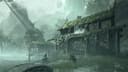
“Bomb Rush Cyberfunk” is a visual treat, leaning heavily into its cel-shaded art style to create a vibrant, comic-book aesthetic. The character designs are sharp and expressive, each crew member and rival gang boasting a distinctive look. New Amsterdam itself is a showcase of environmental design, with layered architecture, dynamic lighting, and a relentless energy that permeates every district. The UI design is functional and stylish, complementing the game’s rebellious vibe without sacrificing clarity. As a stylized 2D-leaning arcade title of this scope, it is light on hardware demands, and its design depends on fluid movement—a priority the game’s technical foundation is built around. Minor visual glitches or pop-in are the kind of blemishes this style of game tends to carry, but they don’t undermine the core design.
Platform nuances
On Steam, the game supports mouse and keyboard alongside gamepad, with the arcadey nature of the movement lending itself naturally to a controller; the choice largely comes down to player preference. On Nintendo Switch, the game’s distinct art style is well suited to the smaller screen, retaining its visual punch in handheld mode. A stylized game of this scope is light on hardware, and the portability of the Switch complements its pick-up-and-play arcade sensibilities. The ability to grind through bustling streets on the go is a significant draw, making the Switch version a strong option despite the platform’s inherent hardware limitations.
Final verdict
“Bomb Rush Cyberfunk” isn’t a perfect game, but it is an important one. It proves there’s still a hunger for unapologetically stylish, movement-focused arcade experiences with a rebellious heart. Team Reptile has crafted a world that begs to be explored, a soundtrack that demands to be heard, and a movement system that is pure joy. While its combat feels like a relic and its story occasionally fades into the background, the kinetic energy and artistic conviction of “Bomb Rush Cyberfunk” carry it past those shortcomings. We rate it a confident, worthwhile return to a beloved style of game—one that delivers on the promise of its spiritual lineage, even if it doesn’t quite perfect it.
Reviewed by the Rankeno Action Desk. Scores are out of 10; the overall score is the desk’s editorial judgement, informed by the four sub-scores above. How we review