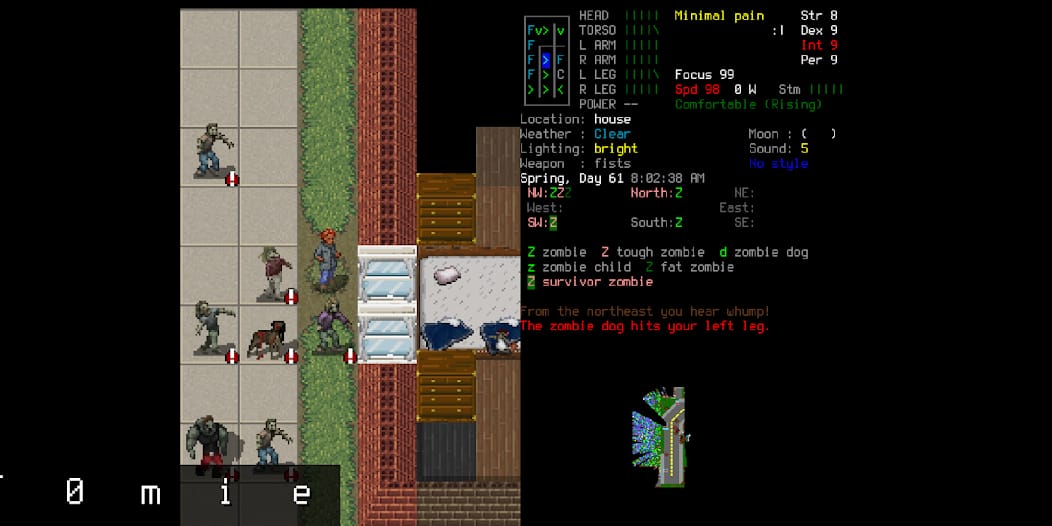



Bottom Line: Cataclysm: Dark Days Ahead stands as a brutal, unapologetically complex roguelike, a digital crucible demanding unyielding dedication from players willing to master its sprawling, emergent simulation of the end times.
The core loop of Cataclysm: Dark Days Ahead is one of perpetual, desperate optimization, a nuanced ballet between immediate survival and long-term viability. Players initiate their journey often with little more than the clothes on their back, thrust into a world teeming with threats. The initial hours are a masterclass in tension, as every decision, from which broken window to approach to how much noise a foraging excursion might generate, carries significant weight. This constant calculation forms the bedrock of its Gameplay Loop: scavenge, secure, craft, upgrade, and explore, all while fending off an ever-evolving ecosystem of horrors. The turn-based nature, while often perceived as dated, is not a limitation but a necessity. It provides the cerebral space required to process the sheer volume of information and tactical choices CDDA constantly presents, allowing for meticulous planning that real-time action would render impossible.
The Survival Mechanics are where CDDA truly distinguishes itself. Hunger and thirst are trivial concerns compared to managing pain, fatigue, morale, various disease states, radiation poisoning, and the intricate details of wounds—from simple cuts to broken bones and debilitating infections. Environmental factors play a crucial role: temperatures fluctuate, weather patterns shift, and the very ground beneath your feet can hide anything from edible fungi to toxic waste. The game's understanding of physics, while simplified, contributes significantly to immersion; a poorly loaded vehicle will handle differently, an unanchored structure can collapse, and fire spreads with ruthless efficiency. This hyper-realistic simulation of cause and effect means that solutions are rarely straightforward. A broken leg isn't solved by a magic potion; it requires splinting, pain management, and a significant period of recovery, profoundly altering immediate objectives and long-term strategy. This depth ensures that every playthrough feels genuinely unique, each emergent narrative a testament to the player's capacity for adaptation against overwhelming odds.
However, this systemic richness comes at a significant cost: onboarding friction. CDDA’s user interface, while functional, is a dense thicket of hotkeys, nested menus, and abstract representations. For newcomers, the initial hours are less about gameplay and more about deciphering the arcane language of its controls and iconography. The game offers little in the way of structured tutorials, instead embracing a sink-or-swim philosophy that expects players to learn by doing, and often by dying repeatedly. This isn't an accidental oversight; it's a deliberate design choice that filters for a specific type of player – one who relishes discovery through experimentation and possesses the tenacity to overcome significant initial barriers. The rewards for persisting are immense: a profound sense of mastery, a virtually endless wellspring of emergent stories, and the satisfaction of bending a truly complex system to one's will. Many modern games hold the player’s hand; CDDA shoves them off a cliff and expects them to build a parachute on the way down.
The vast mod support further extends the game's longevity, allowing the community to introduce new creatures, items, professions, and even fundamental gameplay alterations. This collaborative development model ensures a constantly evolving experience, maintaining relevance and depth long after many commercial titles fade into obscurity. CDDA is not just a game; it is a platform for extreme survival simulation.