

Bottom Line: Cogmind is a brutally challenging yet intellectually rewarding roguelike that elevates the genre through its unparalleled customization and a dynamic, reactive world that feels truly alive.
Cogmind is less a game you play and more a system you learn to manipulate. It demands an intellectual investment far beyond what most modern titles dare to ask, and the dividends it pays are moments of strategic brilliance and emergent storytelling that are simply unavailable elsewhere.
The Core Loop: Survival as Improvisation
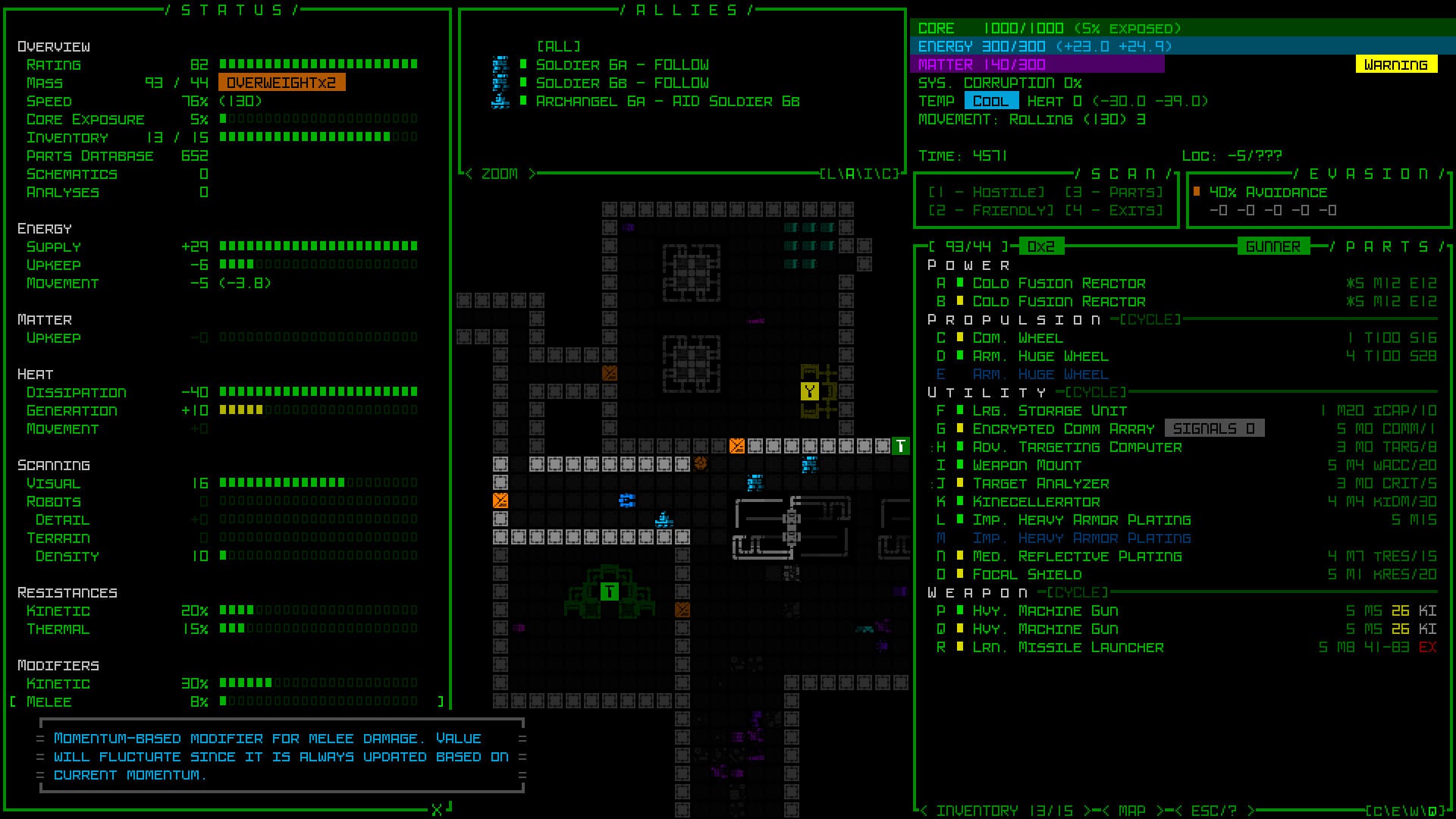
The moment-to-moment gameplay is a relentless cycle of risk and reward. You are perpetually fragile. Your armor can be stripped away, your weapons destroyed, your sensors blinded. The genius of Grid Sage Games was to make this vulnerability the central pillar of the design. Losing a critical component isn’t a fail state; it’s an inflection point. It forces you to immediately reassess the battlefield, scavenge desperately for replacements, and often pivot your entire strategy on a dime. This constant state of flux prevents the game from ever settling into a comfortable, predictable rhythm. You never "solve" Cogmind; you simply get better at reacting to the chaos it throws at you.
This design choice has a profound impact on player psychology. A rare, high-powered cannon isn't just a stat-stick; it's a precious, temporary gift. You become fiercely protective of it, building layers of ablative armor around it, avoiding direct confrontations. When it's inevitably destroyed, the sense of loss is palpable. This creates a far more meaningful connection to your "character" than any pre-written narrative ever could. Your build at any given moment is a physical record of your journey, a patchwork of desperate battlefield acquisitions and hard-won trophies.
A Hostile, Thinking World
The world of Cogmind is not a passive backdrop for your adventure. It is an active, often hostile, participant. The various factions of robots that populate the complex go about their business with or without your intervention. You are an anomaly, an intruder, and the world reacts to your presence with frightening intelligence. A direct assault on a garrison will trigger a large-scale military response. Repeatedly hacking into secure networks will escalate security protocols, making future infiltration exponentially more difficult.
This reactivity makes the environment itself a character in the story. You learn to read its rhythms, to recognize the patrol patterns of different robot types, to understand which skirmishes to join and which to avoid. The AI is remarkably effective, not because it cheats, but because it operates on understandable logic. Grunts will call for backup. Heavily-armed bombardiers will stay at range. Your own tactics must evolve in response. A strategy that worked flawlessly on one floor may be a death sentence on the next, as the complex deploys new, more advanced units to counter your escalating threat.