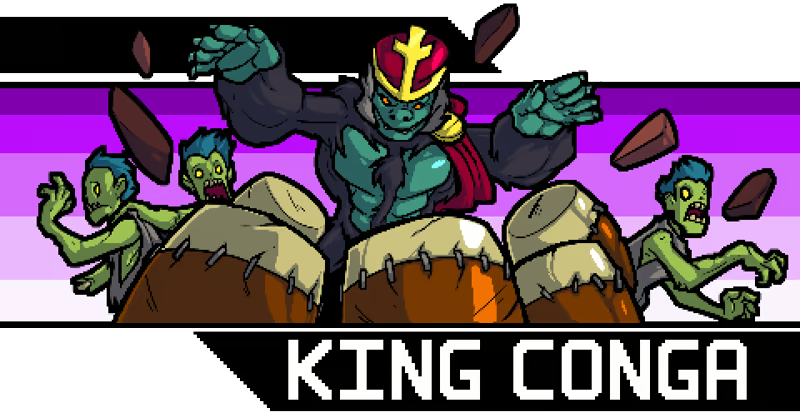

Bottom Line: Crypt of the NecroDancer is a masterclass in genre fusion, a brilliantly punishing marriage of the roguelike and the rhythm game that is as demanding as it is rewarding. It's a landmark indie title that turns every dungeon run into a high-stakes dance with death.
The central thesis of Crypt of the NecroDancer is that rhythm is a resource, a constraint, and a weapon. Most games empower the player; NecroDancer begins by shackling you to the tyranny of the beat. The game's pulse, displayed at the bottom of the screen, is your constant warden. Fail to keep time, and your punishment is immediate. This creates an initial period of onboarding friction that is severe, even for seasoned gamers. You don't just learn this game; you have to internalize its cadence until it becomes second nature.
The Core Loop: A Punishing Pulse
The moment-to-moment gameplay is a frantic, high-stakes puzzle. You are not just fighting monsters; you are dancing with them. Each enemy type has a distinct "tell," a predictable movement pattern synchronized to the music. A skeleton moves every other beat. A zombie shuffles forward every beat. Learning this choreography is the first layer of mastery. The second is applying that knowledge under immense pressure. When you enter a room filled with four different enemy types, the mental calculus required to track multiple patterns, maintain your own rhythm, and navigate the environment without missing a single beat is exhilarating. It achieves a state of "flow" that few games can match, where conscious thought recedes and instinct takes over. But the penalty for failure is absolute. A single misstep can cascade into a chain of disasters, wiping out a run that took 30 minutes of flawless play to build. This high ceiling for both skill and failure is the game's defining characteristic.
Strategic Depth Beyond the Beat
To dismiss NecroDancer as a mere rhythm game would be a profound misjudgment. Beneath the rhythmic surface lies a deep and strategically rich roguelike. Itemization is critical. A broadsword that attacks a three-tile arc completely changes your positioning strategy compared to a dagger's single-tile poke. A Ring of Courage, which grants invincibility while your score multiplier is maxed, encourages aggressive, high-risk play. The game's cast of characters moves beyond simple statistical changes to fundamentally rewrite the rules. The Monk dies if he touches gold. The Bard moves in any direction, unchained from the beat, which paradoxically makes the game harder by removing the rhythmic guardrails you've grown accustomed to. This is where the game's brilliance truly shines—it establishes a rigid rule set and then methodically, creatively, and intelligently breaks it, forcing the player to constantly adapt.