
Overview
Amid today’s vast, open-world epics and heavily rendered character models, IronOak Games’ For The King pushes back against the trend. This isn’t a sprawling, photorealistic fantasy; it’s a carefully crafted digital board game that posits an intriguing question: what if Dungeons & Dragons met a roguelike, then underwent a minimalist art direction facelift? Set in the beleaguered realm of Fahrul, players are thrust into an adventure born from regicide, tasked with avenging a murdered king. Whether venturing forth solo or, more crucially, with up to two companions in local or online co-op, the game leverages its blend of turn-based RPG, JRPG-esque combat, and the relentless pressure of permadeath to forge an experience that feels both intimately familiar and refreshingly novel. Its low-poly aesthetic, far from being a limitation, enhances the tactile, almost handcrafted feel, drawing immediate comparisons to physical board games and miniatures. This strategic positioning allows For The King to bypass direct graphical comparisons with AAA titles, instead leaning into a stylized charm that prioritizes gameplay mechanics and systemic depth over raw visual fidelity. It demands a different kind of appreciation, one rooted in strategic foresight and the willingness to adapt to constant, often brutal, procedural challenges.
Key features
- Genre Synthesis: For The King weaves together elements from turn-based RPGs, roguelikes, and tabletop board games, creating a distinct and challenging gameplay loop that is more than the sum of its parts.
- Procedural Generation & Replayability: Every run offers a unique world map, quests, and events due to robust procedural generation, ensuring high replayability and demanding constant strategic adaptation.
- Cooperative Multiplayer: Designed with co-op as the central focus, the game facilitates shared strategic decision-making and collective problem-solving, turning individual struggles against Fahrul’s harshness into a communal endeavor.
Analysis
The strategic heart of For The King beats with a relentless, often unforgiving rhythm. Players navigate a hexagonal overworld map, each move a conscious expenditure of resources, forcing a constant calculus between exploring new territories, pursuing quests, or retreating to safer havens. This is not a game where resources are plentiful; every gold piece, every potion, every inventory slot must be considered a critical asset. The “three-strikes-and-you’re-out” mechanic for movement and action points per turn necessitates careful planning, particularly when managing proximity to party members for shared endeavors or critical escapes.
The Dice Roll Dilemma
Combat, a staple of any RPG, takes on a distinct JRPG-inspired, turn-based structure, but with a crucial tabletop twist: dice rolls. Every attack, every ability check, every attempt to disarm a trap is filtered through a probability system that can feel simultaneously exhilarating and maddening. While character stats influence success rates, the random number generator (RNG) is an ever-present, often capricious overlord. This commitment to chance, while frustrating at times, injects a palpable tension into every encounter. A perfectly planned turn can be undone by a string of failed rolls, leading to the rapid unravelling of a carefully constructed strategy. This high degree of randomness is a core tenet of the roguelike genre and For The King embraces it fully, demanding players not just optimize their builds, but also manage risk and adapt on the fly when the dice inevitably turn against them. It’s a design choice that actively rejects comfort, instead fostering a sense of emergent narrative as parties recount tales of improbable escapes and devastating ambushes.
The Cooperative Crucible
Where For The King truly distinguishes itself is in its cooperative multiplayer. While a solo run is perfectly viable, the game design actively encourages and rewards shared responsibility. Coordinating movement, pooling resources, and strategizing combat encounters with up to two friends transforms the individual struggle against Fahrul into a communal effort. The shared gold economy, the ability to pass items, and the necessity of reviving fallen comrades raise the stakes. A player’s mistake jeopardizes the entire party’s progress, creating a potent mix of camaraderie and tension. This emphasis on interdependence mitigates some of the harshness of the RNG, as collective decision-making and redundant skill sets can sometimes absorb the shock of a bad roll. It is within these cooperative dynamics that the design shines, fostering communication and tactical discussion that transcends simple button presses.
The game’s difficulty curve is less of a curve and more of a jagged mountain range. It is brutal, punishes complacency, and rewards deep strategic thinking. Permadeath means that even late-game failures reset progress, but the meta-progression system, unlocking new classes, items, and cosmetic options, provides a tangible sense of advancement even after a crushing defeat. This feedback loop of failure and incremental improvement is classic roguelike design, executed here with precision. However, this unwavering commitment to challenge also forms the basis of its primary critique: the barrier to entry can be steep, and the initial learning curve, exacerbated by mechanics that aren’t always explicitly explained, can deter some players.
Visuals & performance
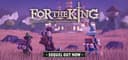
For The King commits to a distinct low-poly art style that is fundamental to its identity. This aesthetic evokes the charm of physical board games and miniatures, transforming the digital world of Fahrul into a vibrant, almost tangible playspace. Characters, monsters, and environments possess a blocky, yet expressive quality, lending a timeless appeal that sidesteps the rapid obsolescence of hyper-realistic graphics. The UI design is functional, if occasionally dense, providing necessary information without completely breaking the immersion of the board game feel. There are minor instances of interface ambiguity, particularly around less common mechanics, though these are the kind of rough edges that familiarity smooths over. The stylized graphics are also light on hardware by design, a sensible fit for a game of this scope and a natural match for the Switch. This visual approach is a strong suit, proving that graphical prowess isn’t solely about polygon count, but about cohesive artistic vision.
Platform nuances
On Steam, For The King is well matched to mouse and keyboard input, which suits its grid-based movement and tactical combat. Navigating inventory, targeting abilities, and managing the overworld map are built for that precision. For the Nintendo Switch, the game translates well to a console experience. While the precision of a mouse is naturally absent, the controller mapping is intelligent, making menu navigation and combat selection manageable. The Switch’s portability makes it a natural platform for quick pick-up-and-play sessions, or for local co-op on the go, reinforcing its board game inspirations by encouraging shared screen play. The compromise in interface fluidity is a minor trade-off for the inherent flexibility of the platform. The core experience remains intact across both, a credit to its robust underlying design, though the PC version is the more natural fit for input precision.
Final verdict
For The King is not for the faint of heart, nor for those seeking a guided, narrative-driven fantasy. It is a crucible of strategic decision-making, where every dice roll is a moment of high tension and every step across the map carries consequence. IronOak Games has delivered a potent and often brutal digital board game, strengthened by its cooperative implementation. While its RNG can occasionally feel like a cosmic joke, and its initial onboarding demands patience, the emergent stories and shared triumphs that arise from its challenging design are genuinely compelling — even if the steep difficulty and rough edges keep it from broader appeal. We recommend it to the right audience: players who want their victories earned, and who will find satisfaction in elegantly unforgiving systems.
Reviewed by the Rankeno Strategy & Sim Desk. Scores are out of 10; the overall score is the desk’s editorial judgement, informed by the four sub-scores above. How we review