
Bottom Line: An infuriatingly brilliant exercise in digital masochism, Getting Over It is less a game and more a brutal, philosophical meditation on failure disguised as a physics puzzler. It is masterfully designed to break you, and in doing so, reveals something profound about why we persevere.
The Agony and Ecstasy of the Hammer
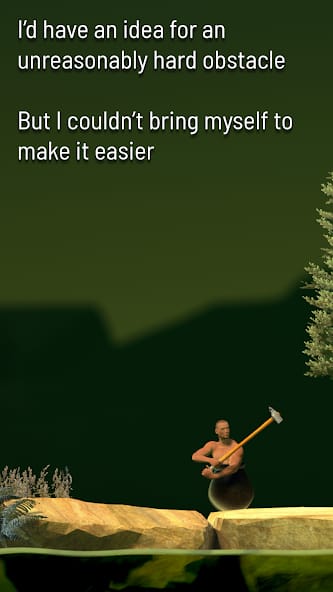
To play Getting Over It is to enter into a deeply adversarial relationship with your own motor skills. The physics-based hammer control is the game's soul. It is both your only tool and your greatest enemy. Every movement is a deliberate, calculated act. A gentle push to scale a small ledge, a furious circular swing to launch across a chasm—each requires a precise command of momentum and a feel for the hammer's grip that can only be learned through agonizing trial and error. There is no tutorializing, no hand-holding. The game presents its core mechanic and silently dares you to master it.
This process is brutally difficult. The hammer snags on unseen edges. Your cauldron slips on a seemingly flat surface. A perfectly planned swing loses its grip at the last possible nanosecond, sending Diogenes plummeting back to the very start. The rage this induces is palpable and intentional. Yet, within that frustration lies the game's genius. When a difficult maneuver finally succeeds, the feeling is not just relief; it's a surge of genuine, hard-won triumph. The game forces you to earn every inch of progress, and that effort makes each small victory feel monumental. This isn't the manufactured dopamine hit of a daily login bonus; it's the raw satisfaction of overcoming a real, tangible challenge you previously thought impossible. The gameplay loop is a masochistic, repetitive, and utterly compelling engine for creating these moments.
A Philosophical Sledgehammer
Bennett Foddy’s narration is what elevates the experience from a mere technical challenge to a piece of performance art. As you struggle, he speaks to you. Not as a game developer, but as a fellow traveler in the world of frustration. He quotes Nietzsche, discusses the disposable nature of modern media, and even commiserates with you when you suffer a particularly devastating fall. At times, his words are soothing, almost encouraging. At other times, they are maddeningly smug, especially when a poorly-timed quote about perseverance plays just as you slide off the mountain for the dozenth time.
This constant commentary serves a critical function: it reframes the player's struggle. Your anger is no longer just blind rage at a piece of software; it's a data point in Foddy's ongoing experiment. He is actively studying your frustration and talking you through it. This creates a bizarre, intimate connection between developer and player. It forces introspection. Why are you still playing? What are you hoping to achieve? Is the satisfaction of reaching the top worth the mental anguish? The game isn't just asking you to climb a digital mountain; it's asking you to confront your own relationship with failure, patience, and the arbitrary goals we set for ourselves. It’s a therapy session conducted via sledgehammer.