Overview
Gorogoa, the brainchild of solo developer Jason Roberts and published by Annapurna Interactive, arrived on the scene not with a bang, but with the hushed reverence of a library revealing a secret passage. In a market saturated with high-octane action and complex role-playing systems, Gorogoa is an act of defiance. It is a narrative puzzle game constructed from hand-drawn panels, presenting itself as a living, breathing storybook. The developer, operating under the name Buried Signal, spent years crafting this intricate machine, and the effort is visible in every frame.
The premise is simple: players are presented with a two-by-two grid where they can place, stack, and zoom into illustrated panels. The goal is to find connections between them. A doorway in one illustration might align perfectly with a blank wall in another, creating a path. The pattern on a bowl might suddenly become a map when overlaid onto a different scene. This isn’t a game of logic puzzles in the traditional sense; there are no riddles to solve or complex patterns to memorize. Instead, it demands observation, imagination, and a willingness to see the world from a different angle. It positions itself less as a game to be beaten and more as an object of contemplation, an elegant contraption to be understood. Its audience isn’t the competitive gamer, but the art enthusiast, the design aficionado, and anyone seeking a short, meditative experience that lingers long after the credits roll.
Key features
- Panel-Based Reality Warping: The core mechanic involves manipulating up to four illustrated panels. Players can move them around a grid, zoom in and out of them, or layer them to create new, interactive scenes.
- Wordless Narrative: The story unfolds entirely through visuals. Following a boy’s journey through a strange and beautiful world, the plot is driven by symbolism and the player’s own interpretation of the connected images.
- Art-Driven Puzzles: Solutions are not found in text or explicit clues, but within the art itself. The puzzles are about aligning visual motifs, connecting lines, and using perspective to bridge gaps between seemingly unrelated scenes.
Analysis
The Core Mechanic: A Tactile Illusion
Gorogoa’s central mechanic is so distinctive, and executed with such care, that describing it feels like trying to explain a magic trick. The panels are not static images; they are windows. Some are windows into a boy reading a book in a city ravaged by war. Others are windows into a desert, a lush garden, or the interior of a study. The genius is that these windows can be moved, and their contents can bleed into one another.
A player might zoom into a star on a door, and suddenly that star becomes a gear in a machine. A panel showing a hallway might slide over a panel showing a ladder, and suddenly the boy can walk from one to the other. This is the gameplay loop: observe, hypothesize, and manipulate. The “aha!” moment in Gorogoa is not one of logical deduction but of sudden, startling connection. It’s the feeling of discovering a secret language that the world speaks only to the player.
The interface is so minimal it’s practically non-existent. There is no inventory, no heads-up display, no score. The game’s four-panel grid is the world, and a cursor (or finger) is the only tool. This removes all friction between the player and the puzzles, making the experience feel direct and tactile. It feels less like playing a game and more like manipulating a delicate, skeuomorphic artifact from another dimension. It’s an illusion, and a well-constructed one.
A Wordless, Evocative Narrative
Many games have attempted wordless storytelling, but few succeed with such grace. Gorogoa’s narrative is an ambiguous but emotionally resonant weave of recurring symbols: a young boy, a divine monster, five colorful fruits, and a journey of pilgrimage and reconstruction. By solving the puzzles, the player pieces together this life story, drawing the connections that define a journey of obsession, creation, and perhaps, peace.
The lack of dialogue forces a deeper level of engagement. What does the monster represent? Is it a god, a memory, or an allegory for the atomic bomb glimpsed in one panel? The game provides no easy answers. Instead, it offers a quiet space for contemplation. The story is a puzzle in itself, and its solution is whatever meaning the player constructs from the beautiful, haunting imagery Jason Roberts has laid out. It’s a bold choice that respects the player’s intelligence, trusting them to find their own story within the art.
Visuals & performance
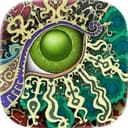
Gorogoa is a strikingly beautiful game. Every panel is a work of art, a detailed, hand-drawn illustration reminiscent of 19th-century engravings and the works of M.C. Escher. The color palette is rich and deliberate, shifting from the muted tones of a war-torn city to the vibrant hues of a fantastical landscape. The animation is subtle but effective, bringing life to the static images as they are manipulated. The UI is the epitome of elegance—form and function are one. Technically, a 2D game of this scope is light on hardware, and its simple presentation is well suited to running cleanly across platforms.
Platform nuances
The game is available on multiple platforms, and the experience varies with the input method.
- iOS: The touch interface is arguably the definitive way to play. Directly dragging, dropping, and pinching the panels with fingers has a tactile satisfaction that feels perfectly aligned with the game’s storybook metaphor. It feels personal and intuitive.
- Steam (PC/Mac): A mouse offers precision but feels one step removed from the action. The point-and-click interaction is perfectly functional but lacks the organic feel of the touch-based versions. It’s a colder, more clinical interaction.
- Nintendo Switch: The Switch offers the best of both worlds. In handheld mode, the touchscreen controls should be just as good as on a tablet. In docked mode, a controller is a serviceable, if slightly clumsy, alternative. The analog sticks feel less precise for this kind of manipulation.
Final verdict
Gorogoa is a triumph of design and imagination. It is a game that trusts the player’s intelligence, rewards their curiosity, and leaves them with a sense of wonder. While its brevity and price point are valid concerns for those seeking hours of content, that feels like criticizing a poem for not being a novel. Gorogoa is a short, sharp, and memorable experience that pushes the boundaries of what interactive entertainment can be. We rate it highly, and it deserves to be played.
Reviewed by the Rankeno Puzzle & Casual Desk. Scores are out of 10; the overall score is the desk’s editorial judgement, informed by the four sub-scores above. How we review