
Bottom Line: Human Resource Machine cleverly disguises a rigorous introduction to computer logic as a charming, satirical puzzle game. It’s a brilliant, and occasionally brutal, primer on the fundamentals of programming.
The Gameplay Loop
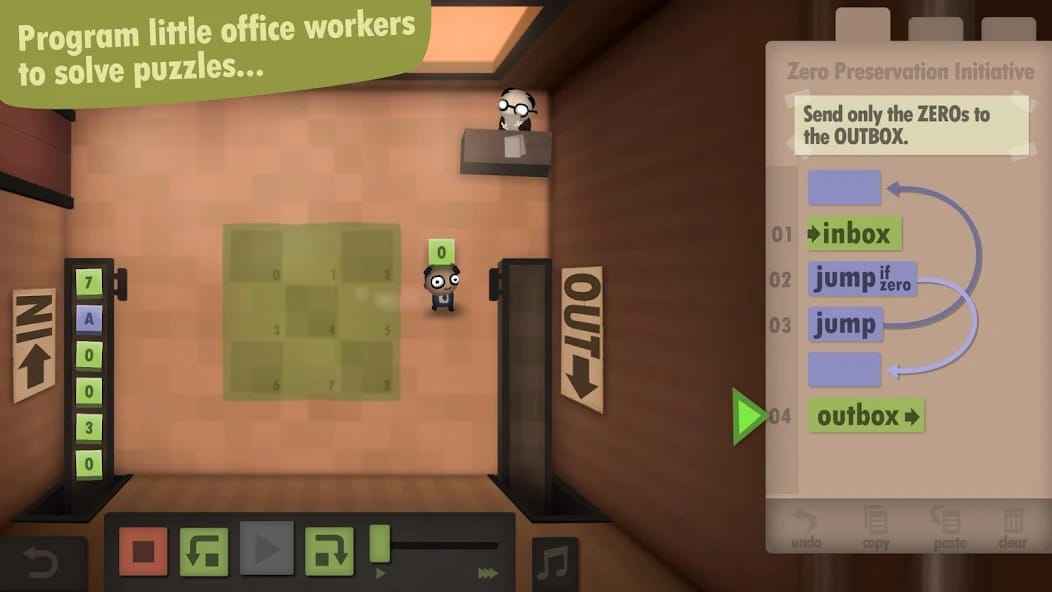
The loop in Human Resource Machine is hypnotic and, for a certain mindset, intensely addictive. Each level presents a clear objective on a corporate memo: "Take everything from the inbox, and send only the zeroes to the outbox." You look at your available commands, drag them into a sequence, and hit "play." Your little on-screen avatar then executes your instructions, step by step. It will almost certainly fail the first time.
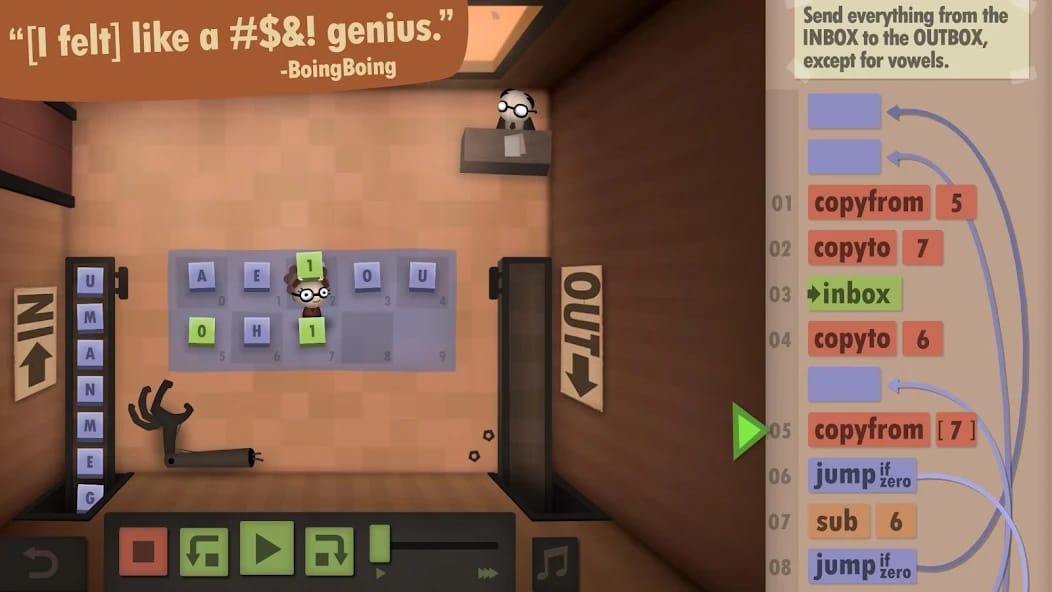
This is where the game reveals its genius. The debugging process is visual. You watch your character run through your flawed logic, step by numbered step, and see exactly where things went wrong. The inbox was empty, but you told him to grab something anyway. He copied a value to a floor tile, overwriting the crucial data you needed. It’s a direct, one-to-one feedback mechanism that makes abstract logical errors feel concrete. There's no intimidating console spitting out error codes; there's just you, your list of instructions, and the observable failure of your little corporate drone. The iteration cycle—tweak, run, debug, repeat—is the very soul of programming, and this game has distilled it to its purest form.
The Unspoken Curriculum
Human Resource Machine never explicitly states its goal is to teach you programming. It's a puzzle game, first and foremost. But the curriculum is baked into its very structure. The puzzles are a guided tour through the history of computer science. You are, in effect, inventing solutions to problems that drove the first decades of computing. You build a multiplication algorithm without a multiply command. You design a sorting program from scratch.
The optional optimization challenges are where the game transitions from a simple puzzle experience to a true engineering challenge. Any brute-force solution can solve a level, but can you do it in half the steps? Can you use three fewer commands? This secondary objective forces a deeper understanding of efficiency and algorithmic elegance. It’s the difference between a rambling paragraph and a single, perfectly chosen word. For players who engage with this system, the "aha!" moments are profound, mirroring the small victories that keep real-world programmers hunched over their keyboards late into the night.