Bottom Line: Jet Lancer is a masterclass in kinetic momentum, stripping the flight-sim of its baggage and replacing it with pure, unadulterated adrenaline and a surprisingly sharp wit.
The Kinetic Feedback Loop
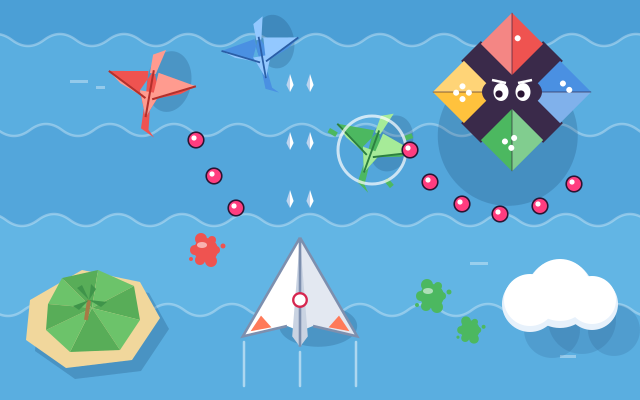
The brilliance of Jet Lancer lies in its central verb: dodging. In most shooters, the dodge is a defensive retreat. Here, it is an offensive maneuver. By tying your survival to a precise, 360-degree dodge-roll, Code Wakers forces the player into a high-stakes dance with death. The windows are tight, the feedback is instant, and the resulting flow state is intoxicating. When you successfully weave through a "cacophony"—scratch that—a hailstorm of missiles at supersonic speeds, the game rewards you with a sense of agency that few 3D simulators can match.
The flight model is remarkably responsive. There is a weight to the jet that feels substantial without being sluggish. You aren't just a cursor on a screen; you are a projectile. This distinction is critical during the game’s 11 boss battles. These "mechanical monstrosities" aren't just bullet sponges; they are puzzles. Solving them requires you to manipulate their AI, baiting out specific attacks just so you can find the gap in their armor. It’s a rhythmic experience, underpinned by the high-energy soundtrack from Fat Bard that pulses in sync with your thrusters.
Customization and Strategic Friction
The 28 weapon and component combinations provide a necessary layer of strategic depth. It would have been easy to give the player a single, "best" loadout, but Jet Lancer encourages experimentation. Some missions demand the long-range precision of a railgun to pick off snipers, while others require the chaotic coverage of drones or heavy payloads to thin out swarms. This modularity prevents the 30-mission campaign from feeling repetitive, though it must be said that some missions—specifically those focused purely on high-score chasing—feel like slight regressions compared to the exhilaration of the boss fights.
Accessibility as a Design Pillar
One of the most insightful aspects of the game’s design is its approach to difficulty. Jet Lancer is hard—brutally so at times—but it refuses to be exclusionary. The inclusion of robust accessibility options, such as adjustable invincibility frames and anti-fatigue controls, is a sophisticated move. It acknowledges that while the "hardcore" audience craves the punishment of a bullet hell, the game’s vibrant world and story should be accessible to everyone. This doesn't cheapen the victory; it expands the audience for a genre that often prides itself on being impenetrable.
Narrative and Personality
Then there’s Lem, the talking cat. It sounds like a gimmick, a desperate grab for "quirky" indie points, but it works. The banter between Ash and her feline technician adds a layer of humanity to the mechanical carnage. It gives the player a reason to care about the world they are defending, providing a necessary breath of air between the high-G maneuvers. The narrative doesn't overstay its welcome, but it provides enough friction to make the progression feel earned rather than arbitrary.