
Overview
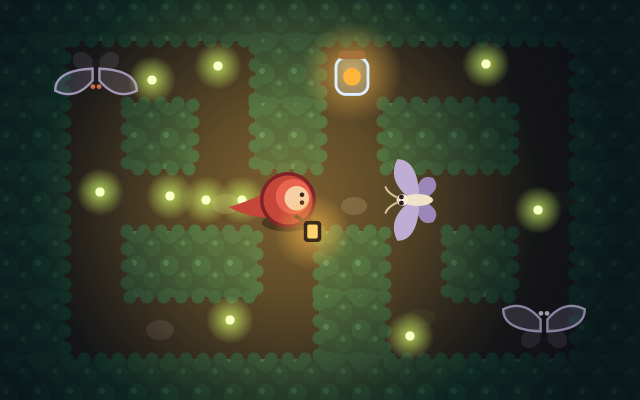
Against the backdrop of sprawling open worlds and hyper-realistic graphics, Last Time I Saw You carves out a distinct niche built on focused storytelling and evocative artistry. Developed by the relatively nascent Maboroshi Artworks and published by Chorus Worldwide Games, this title positions itself not as a technical marvel, but as an intimate, emotionally resonant journey. It transports players to the picturesque yet subtly menacing backdrop of 1980s rural Japan, immersing them in the quest of Ayumi, a 12-year-old boy entangled in a search for a mysterious girl and the grim curse afflicting his village. The quest becomes a poignant exploration of burgeoning love, the intricate web of familial relationships, and the often-turbulent path to self-discovery. The market today is replete with indie darlings, but Last Time I Saw You, released October 10, 2024, distinguishes itself through its unapologetically artistic vision, opting for a hand-drawn aesthetic that feels both nostalgic and timeless. It’s a game that gently demands emotional investment, inviting players to slow down and absorb its carefully crafted world. It enters a competitive space but leverages its unique blend of cultural immersion and heartfelt narrative to stand apart from the bombast of AAA offerings, appealing directly to those who value narrative depth over raw processing power.
Key features
- Captivating Hand-Drawn Art Style: Each frame of Last Time I Saw You is a lovingly rendered piece of art, creating a cozy 2D exploration experience that evokes both nostalgia for a bygone era and the timeless charm of classic animation.
- Mythology-Infused Narrative: The game’s story weaves in elements of Japanese mythology, featuring an eclectic cast of characters including formidable samurai crows and mischievous kappas, grounding its fantasy in a rich cultural tradition.
- Blended Gameplay Mechanics: Beyond its narrative core, the title incorporates light action elements, environmental puzzles, side quests, and a collection of collectibles, aiming for a varied player experience.
Analysis
Last Time I Saw You arrives with a premise brimming with potential: a coming-of-age story against a backdrop of supernatural intrigue and cultural depth. Maboroshi Artworks largely capitalizes on this, crafting an experience that, at its best, feels like stepping into an animated film. The moment Ayumi sets foot into his cursed hometown, the hand-drawn visual language establishes a melancholic yet inviting atmosphere. This choice is fundamental to the game’s identity, softening the edges of a genuinely ominous narrative and inviting a contemplative pace.
The gameplay loop, while not revolutionary, appears well-suited to its genre. Players navigate 2D environments designed to be dense with detail and hidden pathways. The environmental puzzles are built around observation and a gentle push of logic rather than obtuse solutions. They serve as natural extensions of the narrative, revealing more about the world and its inhabitants rather than feeling like arbitrary roadblocks. This integration of puzzle-solving with the unfolding story is a hallmark of strong narrative design, preventing the game from devolving into a mere visual novel.
Where Last Time I Saw You aims to shine is in its narrative construction. The themes of first love, the often-fraught nuances of family dynamics, and the universal journey of self-discovery are handled with a maturity and sensitivity rarely seen. Ayumi’s quest transcends the immediate goal of finding the mysterious girl; it becomes a catalyst for personal growth, forcing him to confront not only external threats but also his own internal landscape. The supporting cast, inspired by Japanese mythology, are not mere caricatures. The samurai crows are presented with a stoic gravitas, while the kappas inject a welcome dose of traditional trickery, each character contributing to the authenticity and magical realism of the setting. The dialogue is sharp, concise, and often poignant, avoiding the excessive exposition that can plague story-driven games.
However, the game’s “light action elements” are precisely that — light. While they serve to break up the pace, they rarely demand significant mechanical skill or strategic depth. For players accustomed to more robust combat systems, this aspect may feel underdeveloped. The commitment to a focused narrative translates into a linearity that, while intentional, limits the sense of player agency. While side quests and collectibles offer diversions, the core path remains steadfast, offering little room for diverging exploration or significant narrative choices. This isn’t a flaw for its intended audience, but a crucial distinction for players seeking open-ended experiences. The user experience flow is designed to be intuitive, with a clean, unobtrusive UI that prioritizes immersion. Onboarding friction is minimal, letting players connect with Ayumi’s plight without being bogged down by complex mechanics. The game reads as handcrafted, a labor of love, and that care translates into a satisfying if somewhat guided, journey. The exploration, while “cozy,” rewards those who take their time to interact with every detail and uncover every secret, making the world feel lived-in and quietly mysterious.
Visuals & performance
The visual aesthetic of Last Time I Saw You is arguably its most striking feature. The captivating hand-drawn art style is the very fabric of its identity. Each background, character sprite, and environmental detail is rendered with a painterly touch, imbuing the 1980s rural Japanese setting with an almost tangible sense of nostalgia and quiet beauty. The character designs, from Ayumi to the mythical creatures, possess a distinct charm and expressiveness that enhances the emotional beats of the story. The UI design is commendably understated, melting into the background to allow the artwork and narrative to take center stage. There are no garish overlays or intrusive HUD elements; information is conveyed elegantly and minimally. As a 2D game of this scope, it is light on hardware demands, and its stylized graphics are built for an uninterrupted dive into its world.
Platform nuances
On Steam, Last Time I Saw You supports mouse and keyboard controls for navigation and interaction, offering a familiar and comfortable setup for PC gamers. Playing on a larger monitor should enhance the appreciation for its detailed hand-drawn visuals. Its Metacritic score of 80 suggests a generally favorable critical reception. For Nintendo platforms, the game’s cozy 2D exploration and puzzle-solving nature lend themselves well to portable play, and the charming visuals are well suited to the Switch’s screen, making it a natural companion for travel or relaxed evenings. The genre often benefits from touch controls, which would be a natural fit for the Switch’s handheld mode.
Best for
Players who cherish narrative-driven experiences with a strong emphasis on character development and emotional depth. Ideal for those who appreciate unique art styles and are drawn to stories steeped in cultural folklore, particularly fans of Japanese mythology and coming-of-age tales. Well suited to a cozy, contemplative gaming session.
Final verdict
Last Time I Saw You isn’t attempting to reinvent the wheel; it’s refining a specific, cherished art form. Maboroshi Artworks has delivered a game that aims to resonate on an emotional frequency, using its striking visuals and a carefully constructed narrative to transport players to a world both familiar and wondrously strange. While the action elements serve more as punctuation than core gameplay, and the journey is largely predetermined, these choices reinforce the game’s commitment to its story. It’s a solid, affecting journey — one we recommend to narrative-minded players, even if it falls short of essential.
Reviewed by the Rankeno RPG & Adventure Desk. Scores are out of 10; the overall score is the desk’s editorial judgement, informed by the four sub-scores above. How we review