

Overview
Happy Juice Games’ “Lost in Play” stands out in the increasingly crowded independent game landscape, delivering a point-and-click puzzle adventure that defies easy categorization. It’s an intricately designed experience, a digital fable woven from the raw, imaginative fabric of childhood. “Lost in Play” chronicles the fantastical escapades of siblings Toto and Gal, who, through a series of increasingly elaborate daydreams, find themselves adrift in a surreal world born entirely from their boundless creativity. The journey to simply “find their way back home” becomes a vibrant odyssey populated by quirky characters and challenging environmental conundrums.
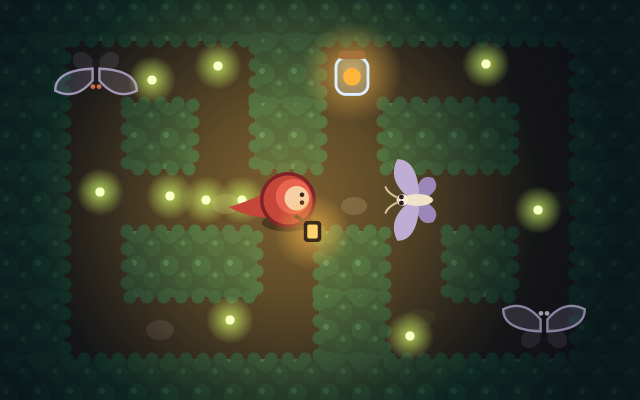
What immediately distinguishes “Lost in Play” is its striking, hand-crafted aesthetic. This is a full embrace of classic animation, reminiscent of the golden era of Cartoon Network or Studio Ghibli, infused with a distinct European flair. Every frame feels painstakingly rendered, every character brimming with personality through expressive animation alone. The developers have committed to a bold vision: a narrative conveyed entirely without dialogue, relying instead on nuanced visual cues, universal gestures, and an immersive sound design. This decision, far from being a limitation, makes the storytelling profoundly accessible, allowing players of all ages and linguistic backgrounds to connect with Toto and Gal’s predicament and triumphs. The critical reception has been strong, with a Metacritic score of 82 reflecting careful execution. Critics laud its vibrant visuals, ingenious puzzles, and the sheer imaginative scope that transports players back to a time when a backyard could become a goblin kingdom and a pet dog, a majestic griffin. “Lost in Play” is a sophisticated homage to the inherent magic of youthful perspective, presented through a lens of polished interactive design.
Key features
- Dialogue-Free Narrative: The game tells its entire story through highly expressive animations, environmental details, and a unique “gibberish” voice acting. This bold choice fosters universal accessibility and deepens immersion by allowing players to interpret emotions and plot points visually.
- Hand-Crafted Art Style & Animation: Featuring a distinctive visual identity that evokes classic animated cartoons, every scene and character is rendered with exceptional detail and fluid motion. This vibrant aesthetic is integral to the game’s whimsical charm and effectively communicates its imaginative premise.
- Varied & Intuitive Puzzle Design: “Lost in Play” integrates a wide array of puzzles and mini-games into its narrative progression. These challenges range from inventory-based conundrums characteristic of the genre to clever logic puzzles and interactive sequences, all designed to feel organic to Toto and Gal’s fantastical world.
Analysis
The core gameplay loop of “Lost in Play” adheres faithfully to the established tenets of the point-and-click adventure genre: explore carefully crafted environments, interact with objects and characters, collect items, and apply them (often in delightfully unexpected ways) to solve puzzles that advance the narrative. However, Happy Juice Games is refining familiar ground with an artistic sensibility and an ingenious approach to puzzle integration that carries the experience beyond simple nostalgia.
The genius here lies in the game’s dialogue-free storytelling. Where exposition often clutters game narratives, “Lost in Play” trusts its visual language implicitly. Toto and Gal’s expressions, their body language, and the intricate reactions of the world around them convey everything from exasperation to pure joy. The narrative beats—whether it’s helping a melancholic goblin king reclaim his prized possession or figuring out how to hitch a ride on a gargantuan griffin—are communicated with crystal clarity through pantomime and visual cues. This universal appeal ensures that the whimsy isn’t lost in translation, a critical design decision for a game aiming to capture the essence of imagination itself. The accompanying “gibberish” voice acting, far from being annoying, is expertly designed audio, perfectly underscoring the cartoonish charm and adding another layer of personality to its eclectic cast of characters without ever needing concrete words.
Puzzle design, the heartbeat of any adventure game, is where “Lost in Play” truly shines. The challenges are remarkably varied, preventing the monotony that can plague less inventive titles. Players will encounter classic inventory puzzles requiring logical (or delightfully illogical) combinations of items, but these are frequently punctuated by engaging mini-games—think rhythm-based challenges, memory tests, or even small arcade-style sequences. Crucially, these puzzles never feel tacked on; they are organically woven into the narrative fabric, making sense within the context of Toto and Gal’s imaginative world. For example, obtaining a necessary item might involve winning a game of cards against a gruff frog, or navigating a complex contraption to retrieve a lost trinket for a fantastical creature. The difficulty curve is generally well-judged, offering enough challenge to feel rewarding without resorting to obtuse moon-logic that frustrates rather than entertains. There’s a tangible satisfaction in deciphering the visual clues and piecing together the solutions, reinforcing the sensation of childlike discovery. The overall pacing is brisk, moving through a series of imaginative vignettes, each distinct in its charm and challenge, ensuring engagement rarely wanes. This careful attention to detail in both narrative presentation and gameplay mechanics ensures that “Lost in Play” is a genuinely engrossing interactive journey as well as a visual spectacle.
Interface & User Experience
The user interface is minimal and intuitive, a critical aspect for a game designed for broad appeal. Interactions are primarily contextual, indicated by clear visual cues when Toto or Gal are near an actionable object or character. Inventory management is streamlined, keeping the focus on exploration and puzzle-solving rather than cumbersome menu navigation. This design choice prevents “onboarding friction,” allowing players to immediately immerse themselves in the world without a steep learning curve. The smooth flow from exploration to puzzle-solving speaks volumes about the developers’ understanding of player psychology.
Visuals & performance
“Lost in Play” is, without hyperbole, a visual feast. The art direction is a foundational pillar of the game’s identity. Every background is a vibrant, hand-drawn tableau, brimming with intricate details that invite lingering exploration. The character designs are unique, instantly memorable, and animated with a fluidity that rivals many traditionally animated films. The game’s color palette is rich and expressive, shifting with Toto and Gal’s emotional states and the tone of their fantastical adventures. This carefully rendered aesthetic ensures that the game’s whimsy is palpable from the first frame. Technically, a 2D game of this scope is light on hardware, and the clean, hand-drawn art style is well suited to consistent presentation across platforms.
Platform nuances
On Steam, the game offers the classic point-and-click experience, with the precision of a mouse cursor ideally suited for pixel-perfect interactions. Navigating environments and selecting inventory items is a natural fit for this setup, making it the definitive way to play for genre purists. The game’s vibrant visuals are best appreciated on a larger monitor, where the intricate details of its hand-crafted world can shine.
On Nintendo Switch, the game is well suited to portable play. The Joy-Con controls translate reasonably well for movement and interaction, and the option for full touch-screen input in handheld mode is a significant advantage, allowing for direct, intuitive interaction with the game world that mirrors the precision of a mouse. The Switch’s versatility makes it an excellent option for those who prefer to play on the go, albeit with a slight compromise on the ultimate precision offered by a mouse.
Final verdict
“Lost in Play” is a carefully crafted animated film that demands interaction. Happy Juice Games has delivered a triumph of imaginative design, proving that profound storytelling doesn’t require a single spoken word and that engaging gameplay can emerge from simple, elegant mechanics. Its vibrant world, endearing characters, and consistently clever puzzles make it essential for adventure fans. This is a game that doesn’t just entertain; it reminds players of the boundless potential of a child’s mind and the enduring power of play. It’s an artistic and technical achievement that earns a place among the genre’s modern classics, and we rate it as one of the very best point-and-click adventures in recent memory.
Reviewed by the Rankeno RPG & Adventure Desk. Scores are out of 10; the overall score is the desk’s editorial judgement, informed by the four sub-scores above. How we review


