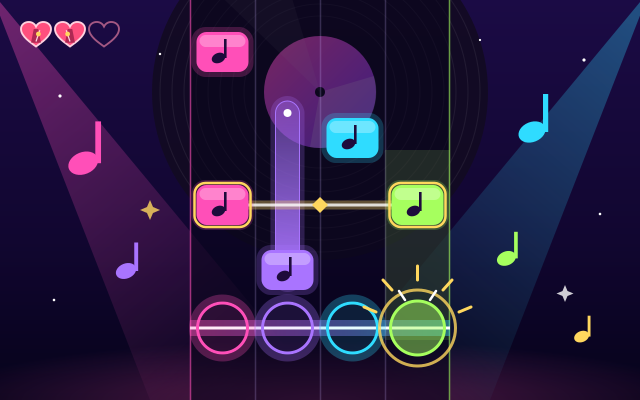
Bottom Line: A masterclass in sensory-driven puzzle design that feels as vital and addictive today as it did on the PSP in 2004. It is quite simply the purest expression of "flow" in the medium.
To understand Lumines, you have to understand the Timeline. In most puzzle games—Tetris, Columns, Bejeweled—the moment you complete a match, the game rewards you by removing the pieces immediately. Lumines rejects this instant gratification. You drop 2x2 blocks of alternating colors to form larger squares, but those squares sit on the board until the Timeline sweeps over them.
The Rhythm of Decision Making
This delay is where the genius lies. It creates a high-stakes gambling loop. If the Timeline is halfway across the screen, do you scramble to build a massive combo before it hits the right edge, or do you play it safe to avoid a layout-ruining overflow? Because the Timeline moves in sync with the song's BPM, the game's difficulty isn't just about block speed; it’s about musical tempo. A slow, ambient track gives you an eternity to build complex structures, but you have to live with your mistakes longer. A high-energy trance track clears the board rapidly, demanding twitch reflexes and short-term planning. It is a brilliant bit of design that forces the player to listen to the music, not just hear it.
The Synesthetic Loop
The game doesn't just feature a soundtrack; it is the soundtrack. Every rotation of a block, every drop, and every cleared square contributes a rhythmic "chirp" or "beat" that fits perfectly into the current track. You aren't just playing a game; you are remixing a record. As you progress through the Challenge Mode, the skins transition seamlessly. One moment you are submerged in the underwater chill of "Shinin'," and the next, you are jolted into the neon-soaked urgency of "Cyber 5." This constant shift in audiovisual context prevents the "puzzle fatigue" that plagues lesser titles. It resets your brain every few minutes, keeping the experience fresh for hours.
Depth Beyond the Surface
While the core loop is simple, the ceiling for mastery is skyscraper-high. Advanced players aren't just making 2x2 squares; they are "chaining" blocks across the entire width of the board, creating massive clear-outs that send the score multiplier into the stratosphere. The inclusion of Puzzle and Mission modes provides a necessary change of pace, forcing you to think logically rather than rhythmically. However, the lack of online multiplayer remains a glaring omission in this "Remastered" package. While local VS is functional and frantic, the absence of a global matchmaking system feels like a missed opportunity to build a modern community around such a legendary title. That said, the leaderboard chase is still potent. Watching your name climb the global ranks after a 45-minute marathon session is as rewarding now as it was twenty years ago. The game respects your time by offering different lengths of "Time Attack," acknowledging that sometimes you want a five-minute hit and other times you want to get lost in the trance for an hour.