


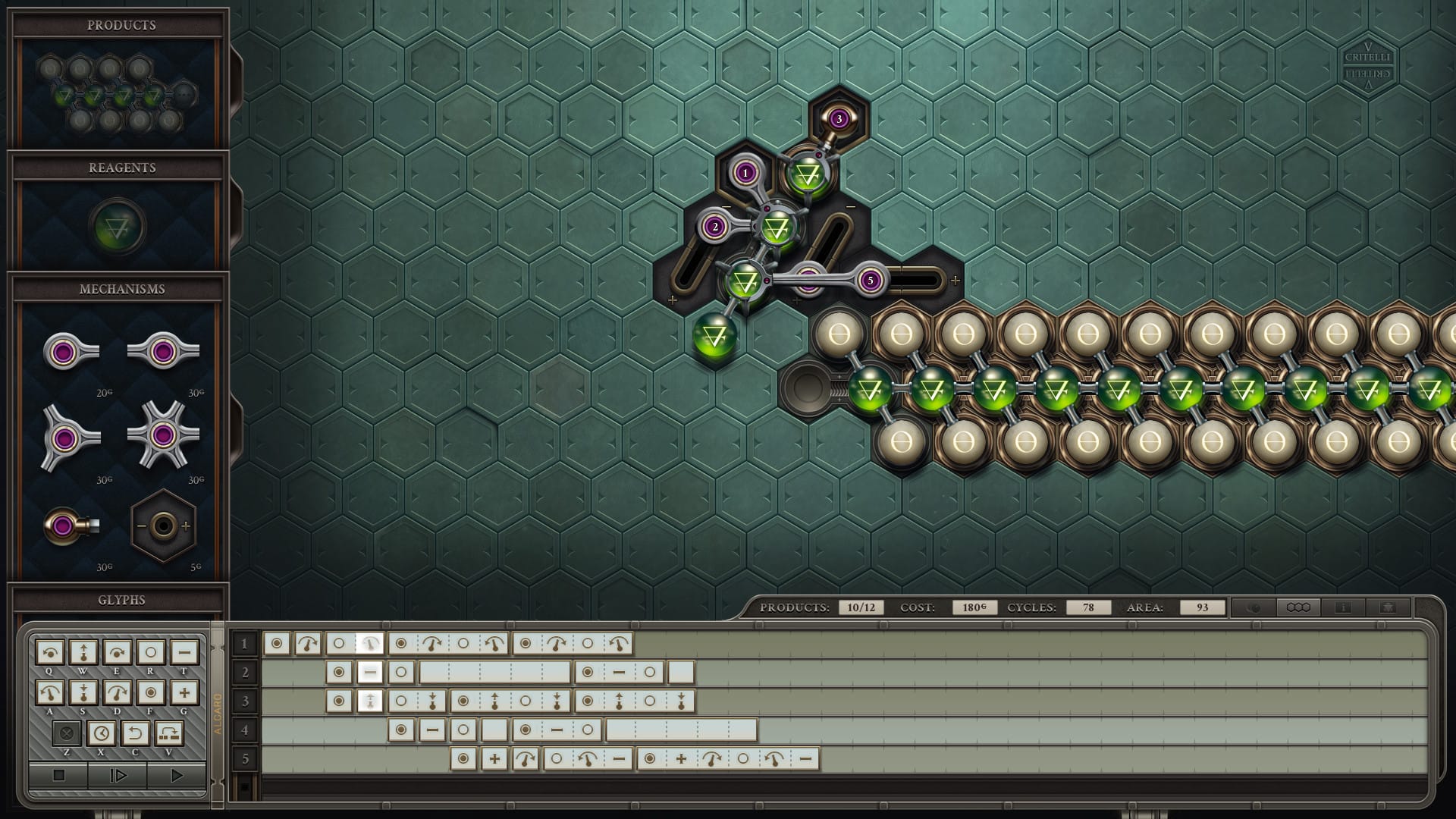

Bottom Line: Opus Magnum isn't just a puzzle game; it's a beautifully realized engineering sandbox that trades explosive action for the deep, satisfying click of a perfectly designed machine. It's a masterpiece of intellectual craft.
Playing Opus Magnum is a unique cognitive experience. It's a slow, deliberate burn, a game of inches and cycles. The core gameplay loop is hypnotic: you receive a contract, study the atomic structure of the target product, and then begin the practical, ground-level work of mechanical design. Your first solution is almost always a clumsy, sprawling monstrosity. It works, sure, but it's hideously inefficient. The arms swing wildly, the cycles tick into the hundreds, and the cost is astronomical. The "level complete" screen appears, but it feels like a hollow victory.
This is where the genius of Zachtronics' design reveals itself. Immediately, you see the leaderboards. You see that someone, somewhere, solved the same problem in a quarter of the time, using half the parts, in a footprint the size of a postage stamp. And so you dive back in. You tear the whole thing down and start again. This iterative process of refinement—the optimization loop—is the entire point.
The Engineering Mindset
The game doesn't just encourage this thinking; it demands it. You find yourself shaving a single cycle off a loop by rotating an arm clockwise instead of counter-clockwise. You redesign a machine's entire chassis to save a few gold pieces on track segments. The "aha!" moments don't come from finding a hidden key, but from realizing a more elegant sequence of grabs and pivots. It feels less like playing a game and more like actual engineering work, complete with the same frustrations and the same profound satisfaction when a complex system finally executes flawlessly. The game's greatest strength is its ability to make you feel smart, not because it tells you so, but because you have the intricate, looping, animated proof of your own ingenuity running right in front of you.
Interface and Flow
The user interface is a model of clarity. It is sparse, functional, and gets out of the way, allowing the player's mechanical creation to be the star. Programming the arms is done via a timeline at the bottom of the screen that is a masterclass in usability. You drag instructions into a sequence, and the machine executes them. It's a simple, powerful abstraction that makes the complex task of choreographing a dozen moving parts manageable. The game's onboarding is also deceptively gentle, teaching you one component at a time before letting you loose on the more formidable late-game challenges.