Bottom Line: Rhythm Doctor is a staggering achievement in minimalist design that proves a single button, when wielded with rhythmic intent, is more expressive than a thousand-key orchestra. It is quite possibly the most essential rhythm game of the decade.
The Geometry of the Seventh Beat
Most rhythm games treat the "hit" as a destination. In Rhythm Doctor, the hit is a conclusion to a psychological process. The core mechanic—pressing a button on every seventh beat—creates a mental loop that is deceptively easy to start but remarkably difficult to maintain when the game begins to layer complexity. By the time you reach the mid-game, you aren't just counting to seven; you are managing multiple patients simultaneously, each with their own syncopated rhythms.
The brilliance of the gameplay loop lies in how it handles "latency" in the player's own brain. When the game introduces polyrhythms—asking you to track two different heartbeat signatures at once—it isn't testing your fingers; it is testing your ability to compartmentalize audio streams. This is high-level music theory masquerading as a pixel-art indie game. The "Onboarding friction" is virtually non-existent, but the skill ceiling is stratospheric.
Blind Faith: The Anti-Visual Aesthetic
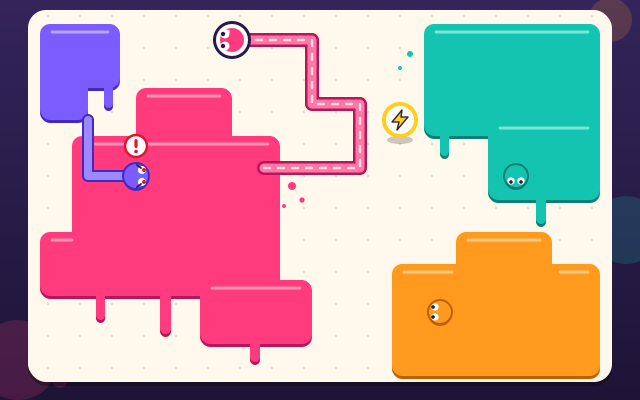
We are conditioned to trust what we see. Rhythm Doctor exploits this biological bias through its "Virus" system. At key moments, the game effectively attempts to gaslight the player. The screen might flicker with static, the UI might rotate, or—in its most daring technical feat—the actual game window will shrink and dance across your desktop.
This is more than just a gimmick; it is a fundamental subversion of how we interact with digital media. By sabotaging the visual feedback loop, the game forces a transition to "blind play." You find yourself closing your eyes, nodding your head, and trusting your pulse. It’s a profound moment when a "video" game convinces you that looking at the screen is your biggest liability. This design choice elevates Rhythm Doctor from a simple reaction-tester to a meditative, almost transcendental experience.
Clinical Empathy through Pulse
While the mechanics are the skeleton, the patients are the soul. The narrative isn't delivered through long-winded dialogue trees but through the rhythm itself. A patient’s stress level isn't just a stat; it’s reflected in a jagged, irregular heartbeat that you must stabilize. There is a tangible sense of empathy baked into the code. When you finally nail a difficult track for the "stressed-out barista," the satisfaction isn't just about the high score; it’s about the successful "treatment." 7th Beat Games has managed to make the act of rhythm gaming feel like an act of care, which is a tonal pivot most developers wouldn't even attempt, let alone succeed at.