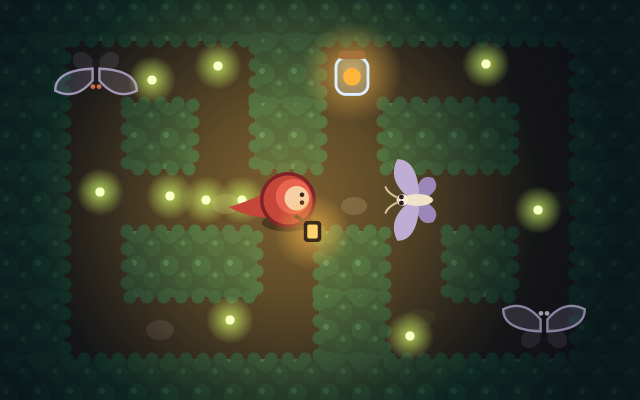
Overview
In an industry saturated with booming explosions and sprawling open worlds, Amanita Design continues to carve out its niche with quiet confidence. With titles like Machinarium and Botanicula, the Czech studio established itself as a leading light of the handcrafted adventure, creating intricate worlds that speak without uttering a single word. Samorost 3, released September 1, 2016 for iOS and Steam at $9.99, takes that legacy and refines it. This is a studio working at the height of its artistic powers, delivering an experience that feels less like a game and more like a playable, interactive diorama forged from cosmic dust and forgotten attic treasures.
The premise is simple: a small, white-clad gnome discovers a magical flute that falls from the sky and decides to trace its cosmic origins. This quest propels him—and the player—across a series of nine bizarre, beautiful, and utterly alien worlds. There is no dialogue, no inventory management in the traditional sense, and no explicit narrative to guide you. The story is an ambient one, told through the delightful animations of the world’s inhabitants and the ethereal soundtrack that binds the experience together. It positions itself not against other games, but as an alternative to them. It doesn’t demand quick reflexes or complex strategy; it demands patience, curiosity, and a willingness to simply exist in its space, to poke and prod its strange ecosystems to see what wonders they reveal. It is a confident declaration that gameplay can be gentle, that narrative can be implicit, and that art can be the primary engine of engagement.
Key features
- Wordless Storytelling: The entire narrative unfolds through exquisite animation and environmental cues. Character motivations and plot points are conveyed with a universal clarity that transcends language.
- Integrated Sound Puzzles: The gnome’s magical flute is a core mechanic, used to listen to and replicate the “voices” of the environment. Sound is a fundamental part of the gameplay loop, not background dressing.
- Surrealist Art Direction: Samorost 3 employs a stunning visual style that blends photorealistic textures of moss, wood, and rusted metal with whimsical, hand-drawn creature and environmental designs, creating a world that feels both organic and utterly alien.
Analysis
The Point-and-Click, Re-Imagined
Samorost 3 is a point-and-click adventure, but it sheds the genre’s clunkier conventions. The friction of classic adventure games—pixel hunting, combining arbitrary inventory items—is mostly absent. Instead, interaction is fluid and intuitive. The cursor highlights interactive points, and the gameplay loop is one of observation and experimentation. You are not solving abstract riddles; you are learning the rules of a tiny, self-contained ecosystem. A puzzle might involve figuring out the sequence to wake a family of space-faring turtles or orchestrating a chorus of singing insects. The joy comes not from a “eureka!” moment of logical deduction, but from the emergent delight of causing a reaction in the beautifully rendered world. It is a tactile experience that encourages the player to touch everything, not to find a solution, but simply to see what happens.
Puzzle Design: Between Genius and Frustration
The puzzles in Samorost 3 are at their best when they are intertwined with the game’s audio-visual language. The sections that require the flute to replicate sounds are sublime, turning puzzle-solving into a form of musical communication with the environment. These moments feel less like challenges and more like collaborations.
However, the game’s rejection of explicit guidance is a double-edged sword. On several occasions, the path forward is frustratingly opaque. The logic can feel so alien that the only recourse is to revert to the one thing the game seems to discourage: clicking on everything until something works. A handful of puzzles lack the intuitive grace found elsewhere, feeling less like organic interactions and more like arbitrary sequences that must be stumbled upon through trial and error. These moments are the only significant cracks in an otherwise accomplished facade, briefly pulling the player out of the immersive world and reminding them that this is, in fact, a game with set solutions.
A Symphony of Silence
To discuss Samorost 3‘s gameplay without praising its presentation is to miss the point entirely. The art and sound are not complementary features; they are the core experience. Each of the nine worlds is a marvel of environmental design, packed with a remarkable density of detail. The technique of grafting animation onto real-world textures gives the game a tangible, almost photoreal quality that grounds its most surreal creations.
The sound design, coupled with a magnificent score from frequent collaborator Tomáš “Floex” Dvořák, is arguably the game’s greatest achievement. The world hums, clicks, and sings with a life of its own. Using the flute to “listen” to an object and hear its inner music is a stroke of genius, transforming mundane objects into sources of melody and narrative. It’s through this sonic exploration that the silent story finds its emotional resonance. Here the soundtrack is the game.
Visuals & performance
The aesthetic is singular and expertly executed. Amanita’s signature style has rarely been so vibrant or detailed. Animations are fluid and full of character, imbuing even the smallest creature with a believable personality. Every screen is a potential wallpaper, a rich composition of texture, light, and imagination. And as a 2D game of modest technical demands, it is the kind of experience that should run comfortably on most hardware—a good thing, since so much of it depends on sustaining an immersive atmosphere.
Platform nuances
The game’s simple interaction model translates well across platforms, but with subtle differences in feel.
- On Steam (PC/Mac): The precision of a mouse is ideal. The cursor allows for deliberate exploration of the dense environments without a hand obscuring the view. On a large monitor, the intricate artwork can be fully appreciated, making this the definitive visual experience.
- On iOS: The touch interface creates a more direct, tactile connection to the world. Tapping on a creature to prompt a reaction feels more intimate than clicking on it. However, the “fat finger” problem is inherent to the design; on smaller iPhone screens, tiny interactive points are harder to hit cleanly, a minor frustration that is less of an issue on an iPad.
Final verdict
Samorost 3 is a rare and precious creation. It is a quiet game in a loud medium, one that finds its power not in conflict or complexity, but in beauty, curiosity, and the joy of discovery. While the occasional lapse into opaque puzzle design is a real blemish, it does little to detract from the considerable artistic achievement. Amanita Design has crafted more than a game; they have built a world, a beautiful, humming interactive poem. We rate it a clear recommendation for anyone who believes games can, and should, be art—with the caveat that its brevity and occasional opacity demand patience.
Reviewed by the Rankeno Puzzle & Casual Desk. Scores are out of 10; the overall score is the desk’s editorial judgement, informed by the four sub-scores above. How we review