
Overview
Every so often, a piece of software arrives that defies easy categorization. It challenges the very vocabulary used to define digital experiences. Simogo’s Sayonara Wild Hearts is precisely that—a project that feels less like a traditional game and more like a fever dream set to a synth-pop score. Billed as a “pop album video game,” it’s an audacious concept. Rhythm-action titles have existed for decades, but few integrate the medium and the music with such singular, uncompromising vision. This isn’t a game with a good soundtrack; this is a soundtrack that has become a game.
Released December 12, 2019 by Annapurna Interactive, Sayonara Wild Hearts is an artifact of the modern indie development scene. It’s a short, hyper-polished, and intensely focused work from a small team with a potent aesthetic. The developer, Simogo, has a history of creating stylish, narrative-driven mobile titles, and this is their most ambitious work. The game follows a heartbroken young woman, whose spirit, The Fool, journeys through a surreal, neon-drenched landscape to restore harmony to the universe by defeating a series of divine adversaries. The narrative is communicated entirely through visuals and music, using the symbolism of tarot cards as a loose framework. It’s abstract, beautiful, and secondary to the kinetic thrill of the ride itself. This is an experience built for the age of shareable, high-impact moments—a campaign of roughly an album’s length that feels dense with replayable, score-chasing encounters. It confidently rejects the sprawling open worlds and deep progression systems that dominate the industry, opting instead for the focused intensity of a classic arcade cabinet.
Key features
- Playable Pop Album: The game’s structure is its most defining feature. The campaign is a series of back-to-back levels, each one a unique song on the album. The music is the foundation, with every gameplay beat, enemy appearance, and environmental shift synchronized to the soundtrack.
- Rapid-Fire Genre Shifting: No single mechanic overstays its welcome. One moment the player is in a high-speed motorcycle race, the next flying through a forest in a shoot-‘em-up sequence, then engaging in sword-fighting dance battles. It all coheres through a simple, unified control scheme and a consistent artistic direction.
- Score-Chasing & The Zodiac Riddle: While finishing the campaign is straightforward, the real longevity comes from mastery. Each level awards a rank (Bronze, Silver, Gold) based on score. Achieving Gold ranks unlocks Zodiac Riddles—meta-puzzles that challenge the player to perform specific, often cryptic, feats within the levels, demanding a deep understanding of each track.
Analysis
Sayonara Wild Hearts operates on a simple, brilliant principle: never break the flow. From the moment the first track kicks in, the game is a relentless, forward-moving assault on the senses. The primary input in most sequences is simply moving the character left or right to collect hearts and dodge obstacles. A single button press handles context-sensitive actions, from jumping to sword fighting. This deliberate simplicity is the glue that holds its disparate genres together. Because the player is never burdened with learning complex new systems, the rapid shifts from 2D side-scrolling to 3D flight feel exhilarating rather than disorienting.
The Rhythm-Action Loop
This is not a punishing rhythm game that demands perfection. Instead, it uses music as a guide for its action setpieces. Missing a beat or crashing into a wall is a minor setback; the game instantly rewinds a few seconds, the music barely hiccups, and the action resumes. This low-friction design is a core pillar of its philosophy. The goal isn’t to create a steep challenge but to make the player feel cool—an extension of the impossibly stylish avatar on screen. The true test of skill is reserved for the score-chasers. Weaving through obstacles, hitting every beat, and finding secret pathways to maximize score is where the mechanical depth reveals itself. It’s an elegant difficulty curve, welcoming to all but built for perfectionists to dissect.
Interactive Music Video
The game’s true innovation lies in how it merges its identity as a music album and an interactive experience. The levels are set to music and are the music, visualized. A chorus might be a soaring flight sequence, a bridge a tense battle, and a verse a hypnotic motorcycle ride through a cityscape. This transforms the act of playing into a form of musical participation. The player is living the album. The campaign’s brevity—comparable to a feature film or a classic vinyl record—initially reads as a potential flaw, but on reflection it’s one of its greatest strengths. It’s designed to be consumed in a single, potent sitting and then replayed for mastery, just as a favorite album gets put on repeat.
Visuals & performance
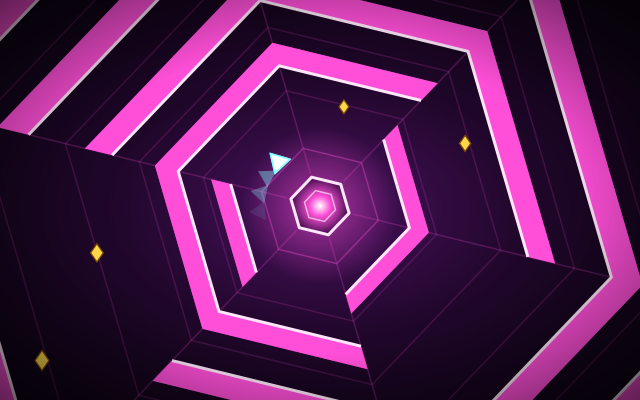
Visually, the game is a striking achievement in minimalist, high-contrast art direction. It’s a world of cel-shaded polygons, bathed in searing neon pinks, cyans, and purples. The aesthetic is clean, bold, and readable even at breakneck speeds. Character designs are archetypal and cool, rendered with just enough detail to be iconic. The UI is practically non-existent during gameplay, ensuring nothing distracts from the audiovisual spectacle. A 2D-styled game of this scope is inherently light on hardware, and the design’s total reliance on timing and motion makes a steady framerate a technical necessity—any stutter would shatter the illusion, and the engine appears built with that priority in mind.
Platform nuances
- iOS: The touch controls are designed to be effective. Swiping a thumb across the screen to guide the character suits the game’s simple input scheme, which appears designed with mobile in mind from the start.
- Steam: A controller is the optimal choice here. The analog stick provides the nuanced control needed to weave through tight patterns for a Gold-rank run. Keyboard controls are functional but lack that crucial tactile connection.
- Nintendo Switch: This feels like the game’s spiritual home. The vibrant colors suit a handheld screen, making for an intensely personal and immersive experience. Docked to a large TV with the audio cranked up, it becomes a room-shaking cinematic event.
Final verdict
Sayonara Wild Hearts is a bold, confident declaration that games can be more than just systems and mechanics; they can be pure, unadulterated feeling. Simogo set out to create a playable pop album and largely succeeded. It’s a whirlwind of color, sound, and motion, and while its simplicity and brevity are real reservations, we recommend it without hesitation to anyone drawn to its vision of music and gameplay intertwined.
Reviewed by the Rankeno Action Desk. Scores are out of 10; the overall score is the desk’s editorial judgement, informed by the four sub-scores above. How we review