
Overview
In an industry fixated on photorealistic worlds and sprawling open-ended sandboxes, Sabotage Studio swims against the current. With Sea of Stars, the developer behind the critically acclaimed The Messenger, delivers not a revolution, but a refinement. This is a turn-based role-playing game that feels like a direct descendant of the SNES-era titans—Chrono Trigger, Final Fantasy VI—resurrected with two decades of design evolution. It’s a love letter, written not with the blind nostalgia of a fan, but with the sharp, discerning eye of a craftsman. The game follows Valere and Zale, two Children of the Solstice, whose intertwined sun and moon powers are the world’s only hope against the arcane abominations of a villain known simply as The Fleshmancer.
The premise is archetypal, a well-worn path of chosen ones and cosmic evil. Yet, Sea of Stars distinguishes itself not through shocking narrative twists, but through an unwavering commitment to quality in execution. Sabotage Studio has clearly dissected the anatomy of a classic RPG, identified every point of friction, and smoothed it over. Random encounters are gone, replaced by visible enemies on the map. The need to grind for experience is eliminated, with progression tied directly to the narrative arc. Traversal is fluid and dynamic, a far cry from the static, grid-based movement of its ancestors. The result is a game that feels both instantly familiar and remarkably fresh. It positions itself as a premium, single-player experience in a market saturated with live services and microtransactions, a confident statement that a well-told story and tightly designed mechanics are still a powerful combination. It honors its inspirations without being imprisoned by them, creating an experience that feels less like a retro throwback and more like a lost classic from an alternate timeline where the 16-bit era never ended, it just kept getting better.
Key features
- Modernized Turn-Based Combat: A dynamic system that blends classic turn selection with active participation. Players must execute timed hits to amplify damage and reduce incoming attacks, use multi-character combo attacks, and strategically break enemy “locks” to prevent powerful moves.
- Unhindered Traversal: The world is a playground, not a corridor. Players can swim, climb, vault over ledges, and jump across gaps with a freedom rarely seen in the genre, making exploration a core, engaging pillar of the experience.
- A World of Diversions: Beyond the main quest, the game is rich with activities. Players can go sailing, cook meals for status buffs, engage in a surprisingly deep fishing mini-game, or challenge NPCs to “Wheels,” a tactical, board-game-like diversion.
Analysis
Sea of Stars doesn’t ask for your patience. It earns your attention. In a genre that has historically treated the player’s time as an infinite resource to be consumed by repetitive grinding, Sabotage Studio’s core design philosophy feels like a radical act of respect. The entire experience is engineered to be a smooth, forward-moving adventure.
The Combat Loop
The combat is where the game’s claim to modernization is most rigorously tested, and the design holds up well. On the surface, it’s a familiar turn-based affair. Players select attacks, skills, and items from a menu. The innovation lies in the layer of active participation built on top. A well-timed button press as an attack lands adds extra damage; a press just before an enemy strike raises a shield to mitigate it. This single mechanic transforms battles from passive calculations into active, rhythmic engagements. It demands sustained focus, rewarding players who learn the distinct animation timings for every character, enemy, and spell.
This is deepened by the “locks” system. Powerful enemies telegraph major attacks by displaying a series of icons—the locks—each corresponding to a damage type (slashing, blunt, sun, moon, etc.). The player has a limited number of turns to break these locks by hitting the enemy with the required damage types. Success cancels the enemy’s attack entirely. It is a constant strategic puzzle that dictates the flow of every significant encounter. It forces players to think about party composition and resource management, turning boss battles into frantic, rewarding scrambles to break the locks before doom arrives. It’s a smart system that makes strategy about far more than simply depleting a health bar.
Exploration and Narrative
The narrative, a tale of friendship and destiny, is charming and heartfelt, if not revolutionary. The protagonists Valere and Zale are earnest and likable, and their journey is filled with memorable characters and poignant moments. However, the story follows the classic RPG playbook closely, and those looking for a deconstruction of the genre or a truly groundbreaking plot may find it predictable.
Where the game truly excels is in weaving this narrative into the world itself. The freedom of movement makes every screen an invitation to explore. Ledges are platforms to be climbed, not decoration. Gaps beg to be jumped. This verticality and interactivity turn exploration from a means to an end into a reward in itself. The world is dense with hidden paths, treasure chests, and small environmental puzzles that make poking into every corner a delight. This design is bolstered by the deliberate exclusion of grinding. Enemy encounters are finite and strategically placed, providing just enough experience to keep players appropriately powerful for the challenges ahead. The game wants players to see the story, to explore the world, not to run in circles fighting low-level monsters for hours on end.
Visuals & performance
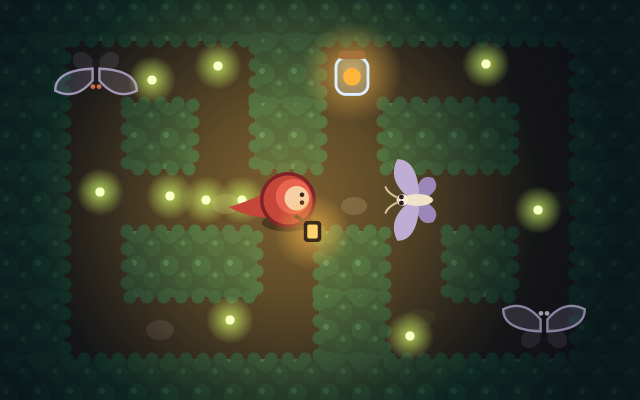
To call Sea of Stars “pixel art” is to do it a disservice. This is not a simple exercise in nostalgia but a display of real mastery over the form. The art is vibrant, detailed, and fluid. Dynamic lighting is the standout feature; spells cast a shifting glow across the environment, and the transition from day to night paints the world in entirely new hues. Character animations are expressive and packed with personality, far exceeding the limited sprite work of the games it honors. It’s a style that uses the limitations of pixels as a foundation for artistic expression, not as a crutch. The result is one of the more visually striking games of recent years—proof that artistry, not polygon count, is a true measure of graphical excellence. And since the combat hinges on split-second timing, the lightweight 2D presentation is a sensible match for the hardware it runs on.
Platform nuances
Sea of Stars is designed to play consistently across platforms, a credit to its careful design, but each has its own character.
- Steam: On PC, the game’s high-resolution pixel art sings on a large monitor, and the precision required for timed hits is well suited to a controller—the recommended input—though a keyboard works too.
- Nintendo Switch: This feels like the game’s natural home. The bite-sized nature of individual encounters and exploration segments is a perfect match for portable play, and the vibrant color palette and dynamic lighting are well served by the OLED screen.
- Android: The translation to a touch-only interface introduces friction. Menu navigation is straightforward, but the split-second timing needed for combat is a challenge on a glass screen, where an errant thumb-slip can mean the difference between a perfect block and a major hit. It’s functional, but for a game that prizes timing, the tactile feedback of physical buttons is sorely missed. A Bluetooth controller is close to a necessity for the optimal experience.
Final verdict
Sea of Stars is a triumph of execution. It set out to modernize a beloved formula, and it has largely succeeded on every front. While the narrative may not tread new ground, it is told with warmth and sincerity that make it easy to be swept away. Every mechanic, from the active combat to the fluid traversal, is polished with care, working in harmony to create an experience that is consistently engaging and respectful of the player. Sabotage Studio has crafted more than just a tribute; they have delivered a game that stands proudly alongside the very titles that inspired it—and one we recommend, with the caveat that its story treads familiar ground.
Reviewed by the Rankeno RPG & Adventure Desk. Scores are out of 10; the overall score is the desk’s editorial judgement, informed by the four sub-scores above. How we review