


Bottom Line: Shadows of Doubt is a breathtakingly ambitious detective simulation that offers moments of investigative freedom unlike anything else. However, its brilliant, complex simulation is frequently undermined by performance issues and a frustrating lack of depth.
The experience of playing Shadows of Doubt oscillates between moments of pure, unadulterated genius and bouts of profound frustration. At its best, the game is a revelation. You accept a case, perhaps a murder in a grimy apartment complex. There’s no glowing objective marker, no checklist. There is only a crime scene. You begin by casing the apartment, finding the victim's address book, a discarded work ID, or a suspicious footprint. You head to their workplace, a sterile corporate office, and hack into their computer terminal, discovering a series of threatening emails. A name. Now you have a lead. You cross-reference the name in the city directory, find an address, and spend the next hour staking out their building, waiting for them to return home so you can confront them—or break in while they're out.
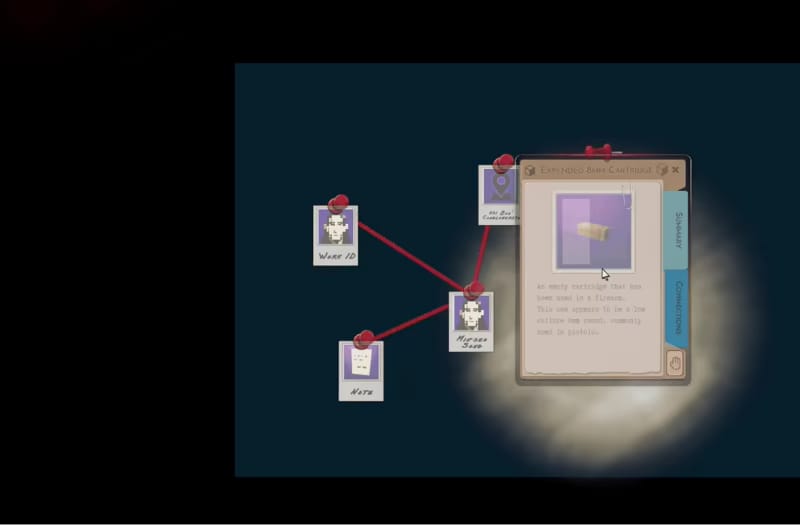
When these systems coalesce, the gameplay loop is utterly intoxicating. It makes you feel like a true detective, piecing together a puzzle with no pre-written solution. The corkboard, where you manually pin evidence and link it with red string, is a masterstroke of design, externalizing the messy, beautiful process of deduction that is happening inside your own head. This is not a game about finding the one right answer; it's about building a case, theory by theory, until you have enough evidence to point the finger.
The Simulation's Cracks
Unfortunately, for every moment of emergent brilliance, there is a technical hiccup or a systemic limitation that shatters the illusion. The simulation, while broad, can feel disappointingly shallow. Citizens follow their routines, but their lives are simple loops. They rarely interact in meaningful ways unless a case forces them to. The procedural generation, while ensuring variety, can also produce cases that are either maddeningly obtuse or trivially simple. After your tenth case, the patterns begin to feel familiar, the veneer of infinite possibility wearing thin.
The most significant issue, and the one clearly reflected in its recent 'Mixed' reviews, is the game's technical state. Performance can be erratic, with frame rates plummeting for no discernible reason. Bugs are common, ranging from minor visual glitches to case-breaking errors that halt your progress entirely. In a game so reliant on immersion, seeing a citizen walk through a wall or having a critical piece of evidence fail to spawn is not a small problem; it's a catastrophic failure that pulls you out of the world and reminds you that the city isn't a living entity, but a fragile piece of code.