Overview
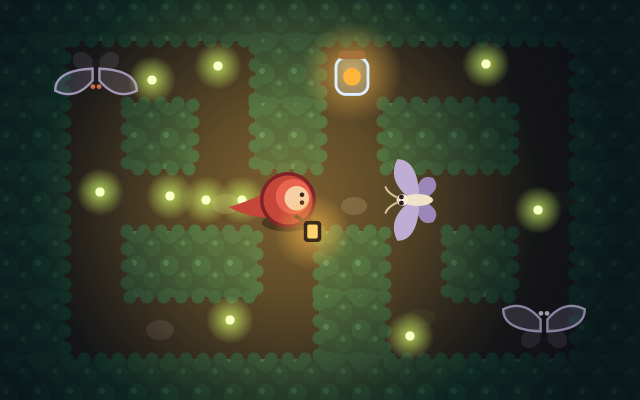
From thatgamecompany, the celebrated studio behind Flower and Journey, comes Sky: Children of the Light—less a game and more a persistent, explorable digital ecosystem built on the tenets of kindness, altruism, and connection. Positioned as a direct thematic successor to its acclaimed predecessors, Sky transcends the typical confines of the MMO genre. It jettisons conventional mechanics like combat, intricate stats, and competitive leaderboards in favor of a serene, ambient social experience. Players assume the role of the titular Children of the Light, tasked with returning fallen stars to their constellations by exploring seven dreamlike realms. The core journey is one of flight, discovery, and wordless collaboration.
The game’s market positioning is a quiet rebellion against the high-octane, often-adversarial nature of mainstream online gaming. It carves a niche for itself among players who crave meaningful, low-pressure interaction and the simple joy of exploration. Its design philosophy is centered on inspiring human connection. The gameplay loop is intentionally gentle: glide through stunning vistas, solve simple environmental puzzles, and organically encounter other players. These interactions are mediated through a limited palette of emotes and gestures, a design choice that fosters a universal language of cooperation. Progression is not tied to power, but to expression, revolving around collecting cosmetic items and participating in seasonal content. This live-service model ensures a constantly evolving world, inviting players to return for new stories and shared experiences, making it as suitable for brief daily visits as it is for long, immersive sessions with friends.
Key features
- Ambient Social Gameplay: Sky pioneers a form of “ambient multiplayer” where players phase in and out of each other’s worlds. Collaboration is encouraged through design—doors that require two people to open, for instance—but is never forced, creating a soft, opt-in sense of community.
- Gesture-Based Communication: All interaction is non-verbal. Players use a rich library of emotes to communicate, from simple waves to complex expressions of gratitude or direction. Holding hands allows one player to guide another, forming an implicit, temporary bond of trust.
- Dynamic, Traversal-Focused Exploration: The primary mode of engagement with the world is through flight. Players have a winged cape that allows for soaring and gliding through vast, cloud-filled environments. The mechanic is expressive and freeing in itself, central to the game’s contemplative tone, rather than mere travel.
Analysis
The Gameplay Loop: A Symphony of Giving
The core loop of Sky: Children of the Light is a study in subverting player expectations. In an industry dominated by feedback systems rewarding personal gain, Sky’s primary verbs are to give, to share, and to guide. The central objective involves finding and reliving the memories of ancient spirits and collecting “Winged Light” to enhance the cape’s flight capabilities. While this provides a thread of progression, the true gameplay emerges from the unscripted moments of player interaction. A player may stumble upon another struggling to reach a high ledge; by holding hands, they can use their combined energy to fly higher together. A “dark plant” may require multiple players to burn away with their candles.
This design cultivates a powerful sense of altruism. The rewards are often intrinsic—the quiet satisfaction of helping a stranger, the shared beauty of discovering a hidden area together. The game’s currency, “Candlelight,” is gathered by absorbing light sources throughout the realms and is used to unlock cosmetics and befriend spirits. Crucially, it can also be used to forge friendships with other players and give them gifts, directly embedding generosity into the economic framework. This creates a gameplay cycle that is fundamentally relaxing and restorative, a stark contrast to the dopamine-driven grind of its contemporaries. It demonstrates that a compelling multiplayer experience does not require conflict to thrive.
A Wordless Social Network
The decision to omit text and voice chat is perhaps thatgamecompany’s boldest and most successful design choice. In doing so, the game effectively filters out the potential for toxicity that plagues nearly every other online social space. Communication becomes a gentle puzzle. How do you convey “we need one more person to open this door” using only a pointing emote and a series of chirps? When it works, the sense of shared understanding is profound.
Friendship is a tangible, multi-stage mechanic. Strangers appear as grey, anonymous silhouettes. By offering a candle, a player can reveal their form and assign them a name. Further investment unlocks the ability to hold hands, hug, and eventually chat via a bench. This gradual intimacy mirrors real-world relationship building and makes each connection feel earned and meaningful. It transforms the social graph from a simple friends list into a constellation of personal stories, all told without a single word. This system doesn’t just facilitate cooperation; it actively generates empathy.
Monetization and Progression
As a free-to-play, live-service title, Sky must walk the fine line between commercial viability and artistic integrity. It largely succeeds. The economy is driven by in-game currencies (Candles and Hearts) and a premium currency (Season Candles) tied to its seasonal “Adventure Passes.” The model is focused exclusively on cosmetic items—capes, hairstyles, masks, instruments, and emotes. There are no pay-to-win mechanics. An item’s rarity has no bearing on gameplay, only on personal expression.
While this is one of the more ethical free-to-play implementations on the market, it’s not without its critiques. The seasonal structure inherently creates a sense of FOMO (Fear Of Missing Out), pressuring players to log in consistently to unlock limited-time items. For a game predicated on relaxation, this is a point of friction. However, past seasonal content is often reintroduced through “Traveling Spirits,” mitigating this concern and respecting the time of more casual players. Ultimately, the monetization feels like a patronage system for a beautiful, evolving art project rather than an aggressive monetization scheme.
Visuals & performance
Visually, Sky is a triumph. It retains thatgamecompany’s signature painterly aesthetic, with breathtaking vistas, soft-focus lighting, and a minimalist UI that melts away, leaving only the player and the world. Each realm has a distinct color palette and emotional tone, from the sun-drenched fields of the Prairie to the rain-slicked gloom of the Hidden Forest. Character and creature designs are simple yet powerfully evocative. The physics-based animation of the capes, billowing in the wind, is a constant source of visual delight. The score, composed by Vincent Diamante, is equally accomplished—a dynamic, orchestral soundscape that swells and recedes to complement the on-screen action and emotional arc of the journey. As a stylized, largely 2D-scaled game of this scope, it is light on hardware by design, though graphically dense areas are the kind that can strain older mobile devices.
Platform nuances
- iOS & Android: As the game’s original platform, the touch controls are designed to be intuitive, with movement, camera control, and flight mapped naturally for a premier mobile experience.
- Nintendo Switch: A fitting home for Sky. The portability of the console suits the game’s drop-in-and-play nature, and the Joy-Con controls offer a more tactile alternative to touch, though direct screen manipulation is arguably the more precise input for flight.
- Steam (PC/Mac/Steam Deck): The experience translates well to larger screens, where the art direction can be fully appreciated. While mouse and keyboard controls are functional, the game is best suited to a controller, which more closely mimics the fluid, analog nature of the traversal mechanics. It is a strong fit for the Steam Deck, combining high-fidelity graphics with portability.
Final verdict
Sky: Children of the Light is a rare and important work. It powerfully refutes the idea that online interaction must be competitive or confrontational. thatgamecompany has crafted a breathtakingly beautiful world, but its true achievement is the framework for human connection that lies within. It is a persistent, living piece of interactive art that successfully engineers moments of quiet beauty, selfless collaboration, and genuine joy. While the gentle pacing and live-service structure may not appeal to all, its unwavering commitment to its humanistic vision makes Sky one of the most rewarding and memorable social experiences in the digital age. We recommend it wholeheartedly, reservations and all.
Reviewed by the Rankeno Puzzle & Casual Desk. Scores are out of 10; the overall score is the desk’s editorial judgement, informed by the four sub-scores above. How we review