
Overview
In an industry currently obsessed with “live service” treadmills and 100-hour maps littered with busywork, Smushi Come Home arrives like a cool breeze through a dense canopy. Developed by SomeHumbleOnion and published by Mooneye Studios, this is a game that understands the power of a narrow scope. You play as Smushi, a tiny mushroom who finds himself quite literally “carried away” by a bird and dropped into the deep end of a vast, unfamiliar forest. The premise is simple: get home. But as with the best exploration adventures, the destination is merely an excuse to inhabit the space.
The “cozy” genre is often criticized for prioritizing vibes over mechanics—sacrificing engaging gameplay on the altar of “relaxation.” Smushi avoids this trap. It sits comfortably alongside titles like A Short Hike or Lil Gator Game, utilizing a “tiny-open-world” philosophy where every landmark is visible, every character is memorable, and every traversal tool feels earned. By stripping away combat and failure states, the developer hasn’t removed the “game”; they’ve simply shifted the focus to the pure joy of movement and discovery. It is a palette cleanser for the weary gamer, a digital forest bath that proves you don’t need a sword to have an adventure. While its 3-to-5-hour runtime might give “dollars-per-hour” zealots pause, the density of charm packed into this vignette is far more valuable than dozens of hours of procedurally generated filler. It’s a tight, focused, and deeply professional debut that marks SomeHumbleOnion as a developer to watch in the indie space.
Key features
- Tactile Traversal: Smushi is a walking sprite who can do far more than walk. He can climb, swim, and glide using a leaf, turning the forest floor into a vertical playground that rewards curiosity.
- The Mycology Journal: A brilliant piece of ludological design that rewards exploration with real-world fungal facts, turning a digital fantasy into a subtle educational tool without feeling “edutainment-heavy.”
- Quirky Inhabitants: The forest is populated by a cast of insects and forest dwellers with distinct personalities and bite-sized quest lines that build a sense of community rather than just a list of chores.
Analysis
The core of Smushi Come Home isn’t the story—it’s the traversal loop. Many modern titles treat movement as the friction you endure between “content.” Here, movement is the content. Taking a page from Breath of the Wild‘s playbook, the game gives you a leaf to glide with, instantly transforming the verticality of the forest from an obstacle into a resource. The design invites exactly the kind of loop where jumping off a high mushroom cap and paragliding down to a hidden alcove should feel fluid. The climbing mechanic, governed by a simple stamina gauge, adds just enough mechanical tension to make reaching a high branch feel like a minor victory without becoming a source of frustration.
The Philosophy of Low-Friction Design
What makes Smushi stand out is its commitment to low-stress exploration. There are no “Game Over” screens. There is no ticking clock. This lack of traditional pressure allows the player to focus on the environmental storytelling. The design encourages stopping not because a waypoint says to, but because a specific arrangement of moss and stones looks interesting. This is “intrinsic motivation” in its purest form. The game trusts the player to be curious, a rarity among today’s hand-holding tutorials and aggressive HUD markers.
Bridging the Digital and the Natural
The Mycology Journal is perhaps the game’s most inspired feature. As players discover different types of fungi, the game unlocks beautiful illustrations accompanied by actual scientific data. This creates a fascinating bridge between the stylized, low-poly world of Smushi and the real world outside the window. It gives the act of “collecting” a weight that goes beyond mere 100% completion stats. Filling the journal means actually learning. This educational layer fits naturally into the “wholesome” aesthetic, reinforcing the game’s themes of nature appreciation and environmental stewardship.
Pacing and Structure
The quest design is intentionally lightweight. Players help a beetle find its lost items or navigate a simple platforming challenge to reach a new area. Some might argue these tasks are overly simplistic, but they serve as the perfect connective tissue for the exploration. The game avoids the “fetch quest” fatigue by keeping the map small enough that backtracking never feels like a chore. Every corner of the forest feels hand-placed, a stark contrast to the sprawling, empty landscapes we’ve grown accustomed to in the AAA space. The 3-to-5-hour length is, in our view, a feature rather than a bug. It’s a self-contained experience that begins, peaks, and concludes before its mechanics lose their luster. It respects your time, delivering a complete emotional arc without overstaying its welcome.
Visuals & performance
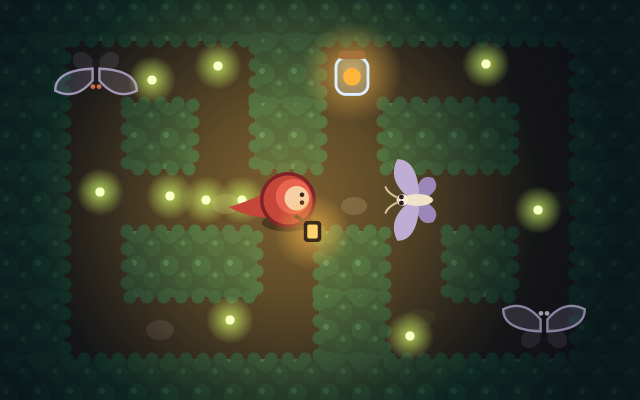
The aesthetic direction is a delightful marriage of retro-inspired pixel art textures and modern 3D lighting. It evokes a sense of nostalgia—reminiscent of the DS era—while maintaining a crispness that should look excellent on high-resolution displays. The character models are expressive despite their simplicity; Smushi’s little waddle is a triumph of character animation. A 2D-flavored game of this modest scope is light on hardware, so performance concerns should be minimal. The soundtrack deserves special mention: its soft, acoustic arrangements provide a perfect ambient backdrop that never intrudes on the “peace and quiet” the game strives to cultivate.
Platform nuances
On Steam, the game benefits from precise keyboard/mouse controls, though a controller is highly recommended for the smoothest traversal. However, the Nintendo Switch feels like the “natural” home for Smushi. The ability to take this portable forest into a real-world park or garden enhances the immersion in a way a desktop setup cannot. The stylized graphics are well suited to the Switch’s hardware.
Final verdict
Smushi Come Home is an easy recommendation for anyone who values craft over quantity. It doesn’t try to reinvent the wheel; instead, it polishes a very specific kind of wheel until it shines. By focusing on the simple joys of being small in a big world, SomeHumbleOnion has delivered a cohesive and heartwarming experience with real reservations—chiefly its brevity and a few undercooked puzzles. It’s a reminder that sometimes, the best way to move forward is to just slow down and look at the mushrooms.
Reviewed by the Rankeno RPG & Adventure Desk. Scores are out of 10; the overall score is the desk’s editorial judgement, informed by the four sub-scores above. How we review