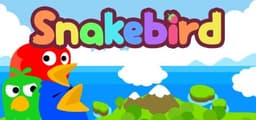
Bottom Line: Don't let the primary colors and chirping birds fool you; Snakebird is a punishing, brilliantly designed logic engine that will leave your brain bruised and begging for more.
The core of Snakebird’s genius—and its primary source of frustration—is the way it weaponizes length. In the classic arcade game, growing longer was your primary obstacle to avoid. Here, growth is both a requirement to reach the exit and a physical burden that complicates every rotation. Because the game operates on a rigid grid, every move you make is a commitment. If you eat a piece of fruit and grow a segment longer, you might suddenly find yourself unable to turn around in a narrow corridor, or worse, your new tail might be dangling over a spike trap, preventing you from shifting forward.
The Physics of the Coil
What elevates Snakebird above its peers is the introduction of gravity. This isn't just about navigating a maze; it’s about structural engineering. Your snakebird’s body is a physical object that obeys the laws of weight and balance. To cross a wide gap, you might need to coil your body into a specific shape that allows you to "lean" across the void without tipping over. You often find yourself using one part of your body as a bridge or a counterweight to reach a fruit, only to realize that the act of eating that fruit has shifted your center of gravity, sending you plummeting to your death. This creates a fascinating tension where the solution to a puzzle requires you to think three or four steps ahead about how your body will be positioned once it grows.
The Satisfaction of the "Eureka" Moment
The difficulty curve in Snakebird is notorious, but it serves a specific psychological purpose. Because the game is so punishing, the eventual "eureka" moment is immensely rewarding. There are levels in the mid-to-late game that look genuinely impossible at first glance. You will stare at the screen for twenty minutes, convinced that the developer made a mistake. Then, a single realization about how to use a tail-segment as a platform clicks into place, and the entire solution unravels. This is the hallmark of elegant puzzle design: the rules are simple, but the implications of those rules are incredibly complex.
Minimalist Friction
Noumenon Games has stripped away everything that isn't the puzzle itself. The interface is sparse, the reset button is instant, and there are no timers or move counters to penalize your experimentation. This lack of friction is essential because you will fail hundreds of times. The game encourages a "guess and check" methodology that eventually matures into rigorous logical deduction. While some might find the lack of a hint system exclusionary, it preserves the integrity of the challenge. To solve a Snakebird level is to know, with absolute certainty, that you have mastered that specific set of spatial constraints. It is a pure, unadulterated intellectual victory.