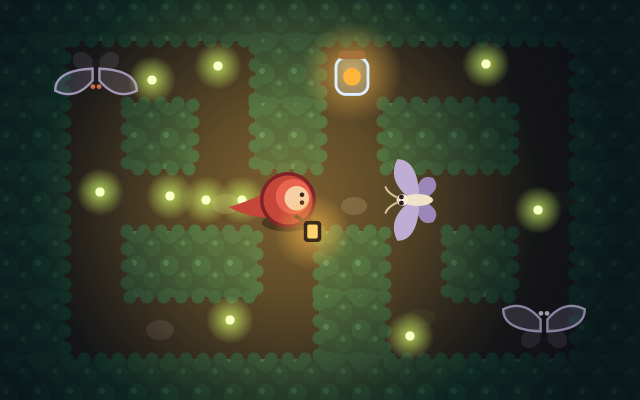
Overview
In an industry often obsessed with graphical fidelity and bombastic set pieces, “Superbrothers: Sword & Sworcery EP” makes a poignant counter-argument, one for deliberate artistic vision over raw processing power. Developed and published by Capybara, with the distinctive aesthetic brought to life by Superbrothers Inc. and the resonant soundscape composed by Jim Guthrie, the game arrived on Steam on April 16, 2012, at a paid price of $7.99, and quickly established itself as a touchstone for what adventure games could aspire to. Its arrival on PC was not a mere porting exercise but a careful re-engineering, particularly for mouse input, reflecting a commitment to preserving the integrity of the original design while broadening its reach.
In “Sword & Sworcery,” players take on the role of The Scythian, a warrior monk embarking on a quest through a mystically charged Bronze Age wilderness. This is not a hack-and-slash affair; rather, it’s an exploratory action-adventure that prioritizes atmosphere and discovery. The game’s market positioning has always been niche yet influential, appealing to players who value art direction, experimental mechanics, and narrative depth over traditional genre conventions. It deliberately eschews mainstream trends, cultivating a unique identity reflected in strong critical reception, including a Metacritic score of 83. Its enduring appeal lies in its audacious blend of archaic storytelling and cutting-edge interactive art, making the case that video games can be profound cultural experiences.
Key features
- Distinctive Audiovisual Synthesis: A singular fusion of pixel art graphics and Jim Guthrie’s atmospheric, dynamic soundtrack creates a striking sensory experience.
- Real-World Moon Phase Integration: The in-game world dynamically responds to the player’s local moon phases, a subtle yet profound mechanic that blurs the lines between digital and physical realities.
- Enigmatic Narrative & Exploratory Gameplay: An unfolding, poetic narrative steeped in myth, complemented by a gameplay loop that encourages careful exploration and environmental interaction.
Analysis
To analyze “Superbrothers: Sword & Sworcery EP” is to dissect a carefully constructed ecosystem of design choices, each serving to reinforce the game’s core ethos. The gameplay itself is simple on the surface, oscillating between periods of serene exploration and turn-based combat encounters. Exploration is paramount; the world of “Sword & Sworcery” is not one to be rushed through. Every screen, every pixel, reads as handcrafted, inviting pause and contemplation. Players navigate The Scythian through a sparse yet evocative landscape, uncovering secrets not through aggressive action, but through observation, interaction, and a deep, almost meditative, engagement with the environment.
Combat, when it occurs, is a deliberate affair. It’s less about twitch reflexes and more about timing and pattern recognition. The Scythian’s sword is an instrument of precision, and victory often hinges on understanding enemy tells and executing well-timed blocks and attacks. The “sworcery” mechanic, however, is where the game truly differentiates itself. These musical puzzles require players to manipulate the environment using specific auditory cues, often involving the game’s dynamic soundtrack. This integration of sound as a core gameplay component is genuinely inventive, transforming a passive medium into an active tool for progression.
The narrative structure, delivered through a wry, self-aware narrator and fragmented visual storytelling, feels more akin to an interactive graphic novel or a performance art piece. It’s not spoon-fed; instead, it demands interpretation and rewards players who piece together its mythic allusions and cryptic pronouncements. This approach creates significant narrative depth, inviting prolonged contemplation long after the credits roll. The game’s deliberate pacing, often criticized by those seeking instant gratification, is in fact a feature, not a flaw. It asks players to slow down, absorb the atmosphere, and inhabit the world, fostering a sense of connection rarely achieved in faster-paced titles. The transition to PC, especially with mouse control re-engineering, largely preserved the tactile interaction, offering a precise method of engaging with the world’s subtleties. However, the game’s initial conception for touch interfaces imbued it with a certain intuitive intimacy that a mouse, for all its precision, struggles to fully replicate.
User Experience Flow
The user experience in “Sword & Sworcery” is characterized by its intentional friction and moments of profound clarity. The deliberate minimalism of the interface keeps players focused on the visual and auditory design unfolding before them. While some might find the scarcity of immediate guidance frustrating, it’s a calculated decision that encourages self-discovery. Onboarding is gradual, built to acclimate players to the unique control scheme and the game’s distinct rhythm. The integration of real-world moon phases, while subtle, acts as an overarching environmental factor, adding an almost ceremonial weight to certain in-game events, deepening immersion and fostering a unique connection to the game’s mythos. This mechanic, in particular, speaks to the title’s commitment to transcending the typical confines of digital interaction.
Visuals & performance
The visual aesthetic of “Superbrothers: Sword & Sworcery EP” is an immediate and defining characteristic. Its chunky, expressive pixel art is a highly stylized form of abstraction that communicates vast emotional depth with minimal detail, rather than a retro pastiche. Every frame reads like a carefully composed painting, drawing the eye and guiding focus. Character designs are iconic, environments are imbued with a sense of ancient mystery, and the animations, though sparse, are fluid and impactful. This visual style pairs naturally with Jim Guthrie’s melancholic and expansive original score. The music is an active participant in the narrative, guiding mood, signifying important events, and forming the very fabric of the “sworcery” puzzles. As a 2D game of modest scope, it is light on hardware, and the re-engineering for mouse input was critical, allowing for precise interaction, particularly in combat and puzzle-solving, so that the charm of the original touch-based release was not lost in translation.
Platform nuances
The Steam version of “Superbrothers: Sword & Sworcery EP” is the definitive way to experience the title outside of its original touch-based incarnation. The transition from touch input to mouse control was handled with evident thoughtfulness. While the direct, tactile sensation of swiping and tapping on a screen is inherently different from mouse clicks and drags, the re-mapped interactions are designed to feel intuitive and precise. Combat, in particular, benefits from the mouse’s accuracy, allowing for quick, decisive actions. Exploration, too, translates well, with the cursor acting as an extension of the player’s intent. The game’s minimalist UI carries over effectively to a desktop environment, maintaining its visual integrity and focus. It retains all the core charm and mechanics while offering a familiar control scheme for PC players, making it accessible without compromising its artistic integrity.
Final verdict
“Superbrothers: Sword & Sworcery EP” remains, more than a decade after its debut, a high-water mark in interactive storytelling and artistic execution. It’s a game that demands presence, rewarding players not with explosive action or endless skill trees, but with a strong sense of place and a narrative that lingers long after the credits roll. Its distinct audiovisual identity, coupled with bold experimental mechanics like the moon phase synchronization, makes it a distinctive work. While its deliberate pace and minimalist combat might deter those accustomed to more conventional genre fare, for the discerning player, “Sword & Sworcery” offers an experience that is both deeply moving and intellectually stimulating — a rare and rewarding presence in the digital landscape, recommended with reservations worth knowing about going in.
Reviewed by the Rankeno RPG & Adventure Desk. Scores are out of 10; the overall score is the desk’s editorial judgement, informed by the four sub-scores above. How we review