Overview
In an industry saturated with procedurally generated worlds and photorealistic aspirations, Joe Richardson’s “The Procession to Calvary” carves out a defiant, singular niche. This indie point-and-click adventure arrives not with a bang, but with a wry, unsettling smirk, stitched together from the hallowed halls of Renaissance art. It’s a game that doesn’t just borrow from art history; it vivisects it, reassembles the fragments with a gleefully unhinged aesthetic, and then drapes it in a narrative so steeped in “Pythonesque” absurdity that it often feels like a lost Terry Gilliam animation brought to interactive life. Players step into the blood-soaked boots of Marquis Juliano, a character whose moral compass is less a guide and more a broken fidget spinner, tasked with tracking down the tyrant Heavenly Peter in the wake of a “holy war” – a premise ripe for the game’s particular brand of satirical deconstruction. This is a critique, a parody, and a bizarre love letter to a bygone era of adventure gaming, all wrapped in an artistic package that demands attention, whether for its audacious creativity or its sheer, unadulterated strangeness. Richardson works as both artist and satirist, and “Calvary” is his canvas, defaced and re-imagined with a vision few would attempt, let alone execute with such bizarre finesse.
Key features
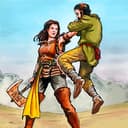
- Renaissance Pastiche Art Style: The game’s most immediate and striking feature, visuals are constructed entirely from cut-and-pasted elements of historical Renaissance paintings, creating a distinct, anachronistic, and often surreal aesthetic unlike anything else in the genre.
- “Pythonesque” Absurdist Humor: A defining characteristic, the narrative and dialogue are imbued with a dry, often dark, and genuinely witty brand of humor reminiscent of Monty Python, targeting historical, religious, and literary tropes.
- Consequential NPC Murder Mechanic: Players possess the option to murder non-player characters, an act that can bypass challenging puzzles or alter the game’s progression and overall length, introducing a tangible layer of moral ambiguity and player choice.
Analysis
“The Procession to Calvary” isn’t interested in holding your hand; it’s more likely to offer you a rusty sword and ask you to figure out which limb to sever. The game operates on classic point-and-click adventure mechanics: a ‘verb coin’ interaction menu, an inventory system where objects are often used in unexpectedly bizarre ways, and environmental puzzles that range from charmingly clever to frustratingly obscure. The interface is deliberately anachronistic, a nod to early adventure titles, yet it’s built with a lean efficiency that rarely impedes progress, assuming players grasp its inherent logic – or lack thereof.
The narrative, following Marquis Juliano’s quest for Heavenly Peter, is less a tightly woven epic and more a series of increasingly ludicrous vignettes. It’s here that Richardson’s “Pythonesque” humor truly shines. The dialogue is sharp, often irreverent, and consistently committed to its absurdist tone. It’s a world where talking animals discuss philosophy, where holy wars end with a whimper and a quest for petty revenge, and where every interaction carries a delightful undertone of the ridiculous. This isn’t humor for everyone; it’s niche, cerebral, and occasionally dark, designed to elicit a specific kind of intellectual chuckle rather than broad guffaws. But for those attuned to its wavelength, it’s some of the sharpest comedic writing the genre has seen.
Where “Calvary” truly distinguishes itself, however, is in its audacious “murder mechanic.” Many point-and-click games present puzzles as inviolable barriers; “Calvary” often presents a shortcut: eliminate the puzzle’s gatekeeper. This isn’t a mere cosmetic choice. Killing an NPC can alter the course of a journey, shortening the game or removing entire puzzle chains. This decision carries a surprising amount of weight, adding a darkly humorous ethical dimension to otherwise standard gameplay. It’s a mechanic that actively encourages replayability, inviting players to explore the ramifications of a more, or less, sanguinary path. Does bypassing an obscure, frustrating puzzle by an act of violence diminish the experience, or enhance the player’s agency in this bizarre world? The game seems to suggest the latter, relishing in the moral murkiness.
The game’s brevity is both a feature and a minor point of contention. For a traditional adventure game, it might seem short, yet for a focused, highly idiosyncratic experience like “Calvary,” it feels just right. It avoids overstaying its welcome, delivering its peculiar vision with precision rather than padding. Multiple endings further bolster its replay value, rewarding players who experiment with the murder mechanic or simply wish to spend more time in its unique universe. The criticism of “obscure puzzles” is valid; some solutions require a leap of logic that can feel less like a challenge and more like a guess. However, this often aligns with the game’s overall absurdist philosophy, where conventional logic is frequently abandoned in favor of the bizarre.
Visuals & performance
“The Procession to Calvary” could not exist without its visuals. The art style, a direct lift from Renaissance masterpieces, transforms its borrowed figures into something new by pasting them into jarring modern contexts. By isolating figures, backgrounds, and objects from their original contexts and pasting them into new, often jarring, compositions, Joe Richardson creates a world that is simultaneously familiar and deeply unsettling. This pastiche technique generates a visual language steeped in art history yet entirely modern in its execution and intent. Characters move with a stilted, puppet-like animation, a deliberate choice that enhances the comedic timing and surreal atmosphere, rather than detracting from it. This is not a technical showcase of graphical fidelity but an artistic statement, and it lands with real impact. The classical music soundtrack, far from being a mere accompaniment, acts as a crucial counterpoint, lending an air of mock solemnity to the unfolding madness. The juxtaposition of high culture audio with the visual and narrative absurdity is inspired, grounding the chaotic visuals in an almost reverent soundscape. As a 2D game built from static collage elements, it’s also light on hardware by design, with no technical demands that would trouble a modern PC.
Platform nuances
Exclusively available on Steam, “The Procession to Calvary” is perfectly at home on the PC platform. The point-and-click genre, at its purest, is inherently tied to mouse and keyboard interaction, and “Calvary” embraces this without compromise. Precise cursor control is essential for uncovering interactive elements and navigating its detailed, albeit flat, environments. There are no touch-screen concessions or controller-specific optimizations, nor should there be. The experience is tailored for the desktop, where the contemplative pace of puzzle-solving and the often pixel-perfect interaction with elements are best served by a mouse, allowing players to fully absorb the visual eccentricities without input-method friction.
Final verdict
“The Procession to Calvary” is a work of genuine idiosyncratic vision. It’s a game that operates on its own terms, refusing to conform to genre expectations or modern graphical trends. What it lacks in length, it compensates for in creative audacity, intellectual wit, and memorable moments. Joe Richardson has crafted a work that simultaneously lampoons and reveres the past, delivering an experience that is as thought-provoking as it is funny. It’s a carefully constructed, often unsettling, and thoroughly engaging piece of interactive art. We recommend it without hesitation to those drawn to its surreal landscape – with the caveat that its obscurity and niche humor demand a specific kind of player.
Reviewed by the Rankeno RPG & Adventure Desk. Scores are out of 10; the overall score is the desk’s editorial judgement, informed by the four sub-scores above. How we review