Overview
House House’s Untitled Goose Game, published by Panic, arrived as a delightful anomaly, quickly capturing the zeitgeist with a premise that seems simple until its depth becomes apparent. Stepping into the webbed feet of a particularly impudent goose, players are unleashed upon an idyllic, unsuspecting English village, tasked with nothing more—and nothing less—than orchestrating pure, unadulterated chaos. This award-winning title resists typical genre classifications, weaving elements of slapstick comedy, stealth mechanics, and sandbox freedom into a cohesive, irresistibly charming whole. Its market positioning is distinct; it’s not vying for esports supremacy or narrative profundity, but rather carving out a niche as an accessible, laugh-out-loud experience that prioritizes emergent gameplay and pure fun.
The game’s appeal lies in its uncanny ability to tap into a primal human desire for mischief, amplified by the absurd vessel of a goose. House House has crafted a world that feels both comforting and ripe for disruption, a delicate balance few games achieve. Every villager, every pristine garden, every carefully arranged pub table is a potential canvas for the feathered antagonist. The game doesn’t just ask players to complete tasks; it encourages them to experiment, to push boundaries, and to revel in the sheer audacity of a goose stealing a farmer’s hat or tripping a child. It plays as a commentary on the fragility of order, delivered with a wry smile and an infectious honk. It demonstrates that unique mechanics, a strong aesthetic, and a clear vision can resonate far beyond traditional gaming demographics.
Key features
- Feathered Anarchy Mechanics: Embody a mischievous goose with a dedicated “honk” button, allowing for expressive, disruptive interactions with the environment and villagers. The core gameplay loop revolves around observation, subtle manipulation, and perfectly timed acts of petty larceny and annoyance.
- Slapstick-Stealth-Sandbox Hybrid: Navigate open-ended village areas with a unique blend of stealth and physical comedy. Objectives encourage creative problem-solving within dynamic, reactive environments, rewarding ingenuity in causing delightful havoc.
- Co-operative Mayhem (2-Player): Extend the chaos with an optional two-player cooperative mode, allowing a pair of geese to double the trouble and synchronize their disruptive efforts, adding a fresh layer of strategic annoyance.
Analysis
Untitled Goose Game doesn’t merely present a series of puzzles; it offers a lesson in emergent narrative, where the player’s actions, however small, ripple through the quaint, hand-painted world. The core gameplay loop, centered around a “to-do” list of objectives, initially seems straightforward: steal a gardener’s keys, make someone drop their rake, get into the pub. Yet, the brilliance lies in the execution. Each task acts as a prompt for creative problem-solving, demanding players not just to perform an action, but to understand the delicate ecosystem of the village and exploit its vulnerabilities. The game rarely holds a player’s hand, instead fostering an environment where observation and experimentation are paramount. This design philosophy imbues even the simplest objectives with a real sense of accomplishment and humor.
The game’s “slapstick-stealth-sandbox” moniker is apt. Stealth is less about remaining unseen and more about timing interventions for maximum comedic effect. Ducking under a table to avoid a frustrated shopkeeper, only to emerge moments later to snatch another item, creates a theatrical tension that resolves in satisfying physical comedy. The sandbox element is crucial; while there’s a list, the means to achieve each goal are often multifaceted, inviting players to devise their own mischievous strategies. This open-ended approach supports replayability, as different approaches yield different, equally funny outcomes. One might bait a villager by honking incessantly, drawing them away from a critical object, while another might carefully set up a chain reaction of annoyance.
The design is built around accessibility. Controls are simple and intuitive, boiling down to movement, a grab action, and the iconic “honk.” This ensures that players of all skill levels can immediately grasp the mechanics, allowing the game’s intrinsic humor to shine through without the friction of complex inputs. The interface, too, is minimal, letting the charming visuals and sound design take center stage. The humor derived from embodying a mischievous goose is broadly appealing, sidestepping the need for dialogue or complex character development. The game crafts its narrative through action and reaction, the exasperated shouts of villagers serving as the primary feedback mechanism.
A common point of critical discussion revolves around the game’s runtime. The main story can be completed in a few hours. However, to frame this as a significant “con” misses the point. Untitled Goose Game is designed to “never outstay its welcome.” Its brevity ensures that the core mechanics remain fresh, and the humor doesn’t grow stale. Furthermore, the game offers substantial post-completion challenges, including speedrunning options and an expanded “to-do” list that encourages deeper exploration and more elaborate pranks. The inclusion of a two-player cooperative mode further extends its longevity, transforming the solo experience of petty annoyance into a synchronized ballet of avian delinquency. This mode, in particular, adds a great deal to the game, allowing for complex, collaborative mischief and more chaotic, memorable moments. It transforms a singular act of rebellion into a shared, joyous conspiracy.
Visuals & performance
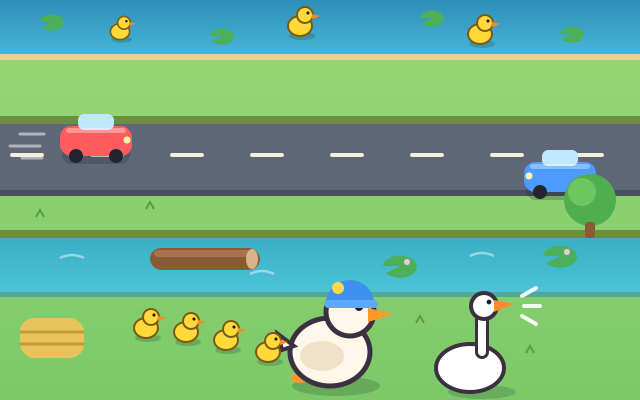
Untitled Goose Game employs a distinct, almost storybook-like visual aesthetic that complements its whimsical premise. The clean lines, muted color palettes, and charmingly exaggerated character designs evoke a sense of nostalgic British countryside, making the acts of goose-induced vandalism all the more comically jarring. The UI is virtually nonexistent during gameplay, allowing players to fully immerse themselves in the pristine, yet vulnerable, world. A 2D-styled game of this modest scope is light on hardware demands, and the efficient art direction suits that approach. The game’s whimsical piano soundtrack, a reactive and dynamic score, swells and ebbs with the player’s actions, escalating tension during a stealth sequence and bursting into playful arpeggios with each successful prank. It’s an auditory highlight that enriches the entire experience, turning simple acts of mischief into grand theatrical events.
Platform nuances
On Steam, the game benefits from precise mouse and keyboard controls, offering a crisp, almost surgical feel to grabbing objects and maneuvering the goose. The ability to quickly snap to objects should make some of the more intricate timed puzzles feel highly responsive. On Nintendo Switch, the game retains its inherent charm, with the tactile feedback of the Joy-Cons adding a layer of immediacy to the honk and waddle. While perhaps not as pinpoint precise as a mouse for object interaction, the portability of the Switch enhances the game’s pick-up-and-play appeal, making it an ideal companion for short bursts of mischief on the go. The co-op mode, especially, suits the Switch, enabling impromptu local multiplayer with ease. The game’s fundamental design appears robust enough to translate well across diverse input methods.
Final verdict
Untitled Goose Game proves the power of a simple, brilliant idea executed with precision and charm. While its core campaign is brief, its impact is lasting, providing a welcome dose of irreverent joy in an industry often too serious for its own good. It subverts expectations with every stolen item and every exasperated villager, proving that chaos, when delivered by a charmingly obnoxious goose, can be utterly delightful. We recommend it wholeheartedly to anyone after something different—just don’t expect it to fill a whole weekend.
Reviewed by the Rankeno Action Desk. Scores are out of 10; the overall score is the desk’s editorial judgement, informed by the four sub-scores above. How we review