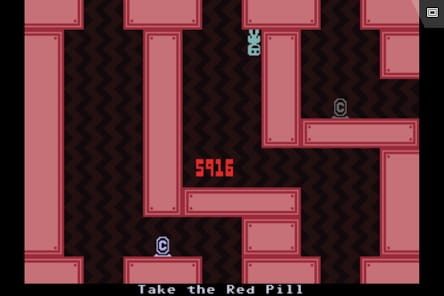
Bottom Line: Terry Cavanagh's VVVVVV remains a masterclass in elegant game design, proving that mechanical purity, paired with intentional retro aesthetics, can forge a challenging yet profoundly rewarding experience that transcends its seemingly simple premise.
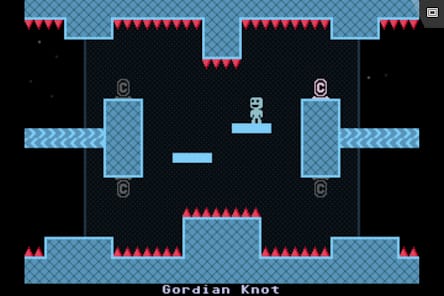
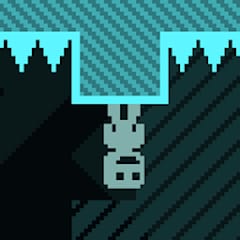
VVVVVV's brilliance lies in its ruthless dedication to a single, central mechanic. The gravity inversion isn't a gimmick; it's the entire design paradigm, explored with an exhaustive creativity that borders on academic. Cavanagh understood that a limited toolkit, when leveraged fully, can produce more depth than a sprawling one. The game continually introduces variations on its core theme: moving platforms that require precise mid-air flips, conveyor belts that demand quick reversals, enemies whose patterns necessitate strategic gravity shifts. What begins as a simple up-or-down movement evolves into a complex ballet of timing and spatial awareness.
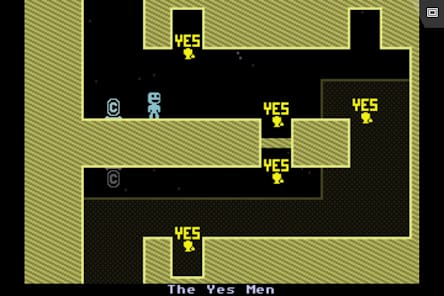
The architectural design of the world itself is a marvel. VVVVVV presents an open-world environment, a term often associated with vast, unguided spaces. Here, it’s a series of interconnected rooms, each a self-contained puzzle or obstacle course, yet contributing to a larger, navigable map. This structure encourages exploration and allows players to tackle challenges in a non-linear fashion, lending an emergent quality to the progression. Finding a path through a particularly thorny gauntlet often feels less like brute-force memorization and more like an intuitive, spatial problem-solving exercise. The game’s difficulty is legendary, a fact that would typically relegate it to niche appeal. However, Cavanagh’s genius shines in his counter-intuitive approach to player death. Instead of lengthy loading screens, experience point penalties, or lost progress, Viridian simply reappears at the nearest checkpoint, often mere seconds after his demise. This rapid iteration cycle transforms death from a punishing failure into a learning opportunity. Each spike-induced splat becomes less a setback and more a data point, an invitation to refine timing or discover a new route. This design choice, in effect, lowers the cost of failure, allowing players to experiment boldly and push their limits without the psychological burden of lost progress.
Beyond the main quest of rescuing the crew, VVVVVV offers substantial replay value. The collection of 20 "trinkets" scattered throughout the dimension acts as optional, often extremely demanding, side-challenges. These trinkets are frequently located in rooms that push the gravity-flipping mechanic to its absolute extreme, requiring pixel-perfect precision and intricate sequences of movements. The inclusion of Time Trials and a "No Death Mode" caters directly to the speedrunning and masochistic segments of the player base, offering further avenues for mastery. These additional modes aren't tacked-on; they organically extend the core gameplay loop, inviting players who have conquered the main story to truly perfect their understanding of Viridian’s capabilities and the environment's intricacies. The approximate two-hour main story, while seemingly brief, is densely packed, feeling neither rushed nor padded. It's a game that respects the player's time, delivering a concentrated, high-impact experience rather than diluting its core strengths across an unnecessarily long runtime.