
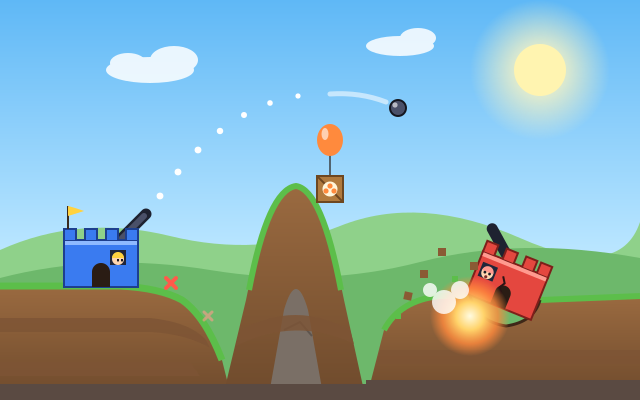
Overview
For over a decade, fans of the turn-based tactical genre lived in a drought. Intelligent Systems had moved on from the bite-sized military strategy of Advance Wars to the more character-driven (and commercially dominant) Fire Emblem. This left a gaping void in the market—a hunger for unit-based, grid-focused combat that prioritized terrain and positioning over dating sims. Enter Chucklefish. With Wargroove, the developer behind the publishing success of Stardew Valley and the creation of Starbound set out to fill that void — and largely succeeded.
Positioned as a spiritual successor, Wargroove transports the familiar mechanics of classic handheld strategy into the vibrant, high-fantasy world of Aurania. The setup is classic: the Cherrystone Kingdom is pushed to the brink after a political assassination, forcing the young Queen Mercia to flee and gather allies across a continent populated by plant-tribes, undead legions, and technologically advanced empires. While the narrative serves its purpose—anchoring the missions with a sense of urgency—the real draw is the mechanical weight behind every move. Chucklefish hasn’t just mimicked the aesthetic of the 2000s; they have engineered a deep, challenging strategy title that refuses to hold your hand. By including a comprehensive creative suite—the exact same tools the developers used—they have made Wargroove more than a 20-hour campaign: it’s a platform for community-driven tactical puzzles. This is a calculated, professional revitalization of a dormant genre that understands exactly what made its predecessors great while discarding their limitations.
Key features
- Commanders and Grooves: Over 12 playable commanders who act as powerful units on the field, each possessing a unique “Groove” ability that can shift the momentum of a battle.
- The Creative Suite: An exhaustive map and campaign editor that allows for custom scripting, cutscene creation, and branching narrative paths.
- Faction Diversity: Four distinct factions—Cherrystone, Heavensong, Felheim, and Floran—each with unique visual identities and mirrored unit types to ensure competitive balance.
- Cross-Platform Multi-Play: Robust online and local multiplayer support, including cross-platform play between PC and Nintendo Switch, keeping the community connected.
- Double Trouble DLC: A roguelike-inspired expansion that introduces new commanders and a co-op focused campaign, significantly boosting the endgame value.
Analysis
The Mechanical Pulse of Aurania
Wargroove operates on a foundation of “easy to learn, brutal to master.” Every unit, from the humble soldier to the dragon, operates on a strict rock-paper-scissors hierarchy. However, Chucklefish adds a layer of sophistication through Critical Hits. Unlike many strategy games where crits are randomized, Wargroove makes them deterministic. A Spearman will always crit if it is adjacent to another Spearman; a Knight crits if it has moved its full distance. This shifts the focus from “hoping for luck” to “optimizing formation.” It turns the grid into a dance of precise positioning where a single misstep can cost an expensive unit.
The economy is equally vital. Capturing villages provides the gold necessary to replenish ranks at barracks, towers, or docks. The friction here is intentional: do you spend your gold on a swarm of cheap units to clog the front lines, or do you save for a single aerial powerhouse that might be easily countered by a cheap archer? This constant tension between resource management and tactical aggression defines the gameplay loop.
The Commander’s Gamble
The inclusion of the Commander on the battlefield is the game’s boldest deviation from its inspirations. In Advance Wars, the CO was a portrait in the corner providing passive buffs. In Wargroove, Mercia, Valder, or Caesar are physical entities. They are your strongest units, capable of carving through enemy squads, but their death is an instant “Game Over.” This creates a fascinating risk-reward scenario. Do you keep your Commander in the rear to build their Groove, or do you send them to the front lines to break a stalemate? When a Groove finally charges—be it a healing aura or a shield that redirects damage—it plays like a legitimate event. It’s a powerful tool that rewards aggression without functioning as an “I win” button.
A Platform, Not Just a Game
The Creative Suite deserves its own spotlight. Most games offer a “map maker” that is a neutered version of the dev tools. Chucklefish did the opposite. The editor is intimidatingly deep. You can script events, create “if-this-then-that” logic for unit spawns, and write your own dialogue. The community has already used these tools to recreate entire campaigns from other franchises and original stories that rival the main game’s quality. This isn’t a bolted-on feature; it’s the game’s heart. It transforms Wargroove from a static experience into a living ecosystem of content.
The Difficulty Friction
Wargroove is not an easy game. The AI is competent and rarely makes mistakes. Early missions are built to run 30 to 45 minutes, and a single oversight in the final turns can force a complete restart. While there are difficulty sliders to adjust damage taken and gold earned, the “standard” experience is a test of patience. The pacing can occasionally feel sluggish, particularly in larger maps where units spend multiple turns just traveling to the front. The “Fast Forward” button helps, but the deliberate pace is a design choice that won’t appeal to everyone.
Visuals & performance
The pixel-art aesthetic is gorgeous. It avoids the “low-effort” retro look in favor of highly detailed animations and expressive character portraits. Each unit has a distinct personality in its movement, and the combat transitions are fluid and charming. Technically, the game is built light: a 2D strategy game of this scope is undemanding on PC hardware, and the Switch version is designed to hold steady even when the screen is cluttered with units. The UI is clean, though the deeper menus in the editor are built for larger displays and can feel cramped on smaller screens.
Platform nuances
On Steam, the experience is defined by precision. A mouse is vastly superior to a controller for navigating the map and the editor. The ability to quickly hover over units to check their range and stats makes the high-stakes strategy feel more manageable.
On the Nintendo Switch, the game finds its natural home. The turn-based nature is perfect for handheld play, allowing short bursts of a mission during a commute. While the editor is more cumbersome with Joy-Cons, the trade-off is the portability of the “Double Trouble” co-op mode, which is built for a local tabletop setting.
Final verdict
Wargroove is a work of focused design. It knows exactly what it wants to be and executes that vision with professional polish. By blending nostalgic mechanics with a deep creative suite, Chucklefish has built a title that respects its ancestors while carving out its own identity. We recommend it to anyone who believes that the smartest person in the room should be the one who wins the war — with the caveat that its difficulty and pacing demand real patience.
Reviewed by the Rankeno Strategy & Sim Desk. Scores are out of 10; the overall score is the desk’s editorial judgement, informed by the four sub-scores above. How we review