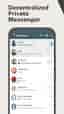

Bottom Line: Delta Chat is a brilliant act of digital defiance that transforms the aging infrastructure of email into a modern, decentralized fortress for private communication.
The core genius of Delta Chat lies in its subversion of expectations. We have been conditioned to believe that "chat" requires a proprietary backend to be fast and "email" is a clunky medium for long-form correspondence. Delta Chat shatters this dichotomy. The UX flow is remarkably close to Signal or iMessage, masking the complex dance of fetching and parsing IMAP folders behind the scenes.
The Protocol as a Platform
The implementation of Autocrypt is the app’s technical highlight. Encryption has historically been the bane of email, a UX nightmare involving keyrings and handshakes. Delta Chat handles this with a level of transparency that feels almost illicit. By exchanging keys in the background through standard email headers, it builds a secure mesh network of contacts without the user ever seeing a "Public Key." This is how security should work: invisible until it’s needed.
However, building a house on the foundation of email protocols introduces inevitable latency. Unlike proprietary binary protocols used by Telegram, which can push bits with millisecond precision, Delta Chat is at the mercy of your email provider's IMAP implementation. While modern "Push IMAP" (IDLE) makes this feel nearly instantaneous, you will occasionally encounter the "synchronization lag" that is the ghost in the machine of all email clients. It’s a trade-off: you exchange a fraction of a second in speed for a lifetime of digital sovereignty.
Interactive Evolution: Webxdc
If Delta Chat were just a secure email skin, it would be a niche tool for PGP enthusiasts. The inclusion of Webxdc changes the calculus. By allowing mini-apps to run within the chat, merlinux has created a "silent" platform. These aren't "bots" in the traditional sense; they are sandboxed applications that share state between participants via small, encrypted email attachments. Whether it’s a shared to-do list or a simple game, the fact that these functions work without a central server is a massive win for extensibility. It points toward a future where the chat thread is not just a stream of text, but a collaborative workspace that no one can shut down.
The Friction of Freedom
The skepticism comes in the onboarding experience for specific email providers. While Gmail and Outlook dominate the market, they are also the most hostile to third-party clients, often requiring "App Passwords" or specific security toggles. For a casual user, this is a significant hurdle. Delta Chat does its best to automate this, but the friction is inherent to the "no-server" model. You are responsible for your own plumbing. For the target audience, this is a badge of honor; for the average consumer, it may be the point where they give up and go back to the centralized comforts of Meta.


