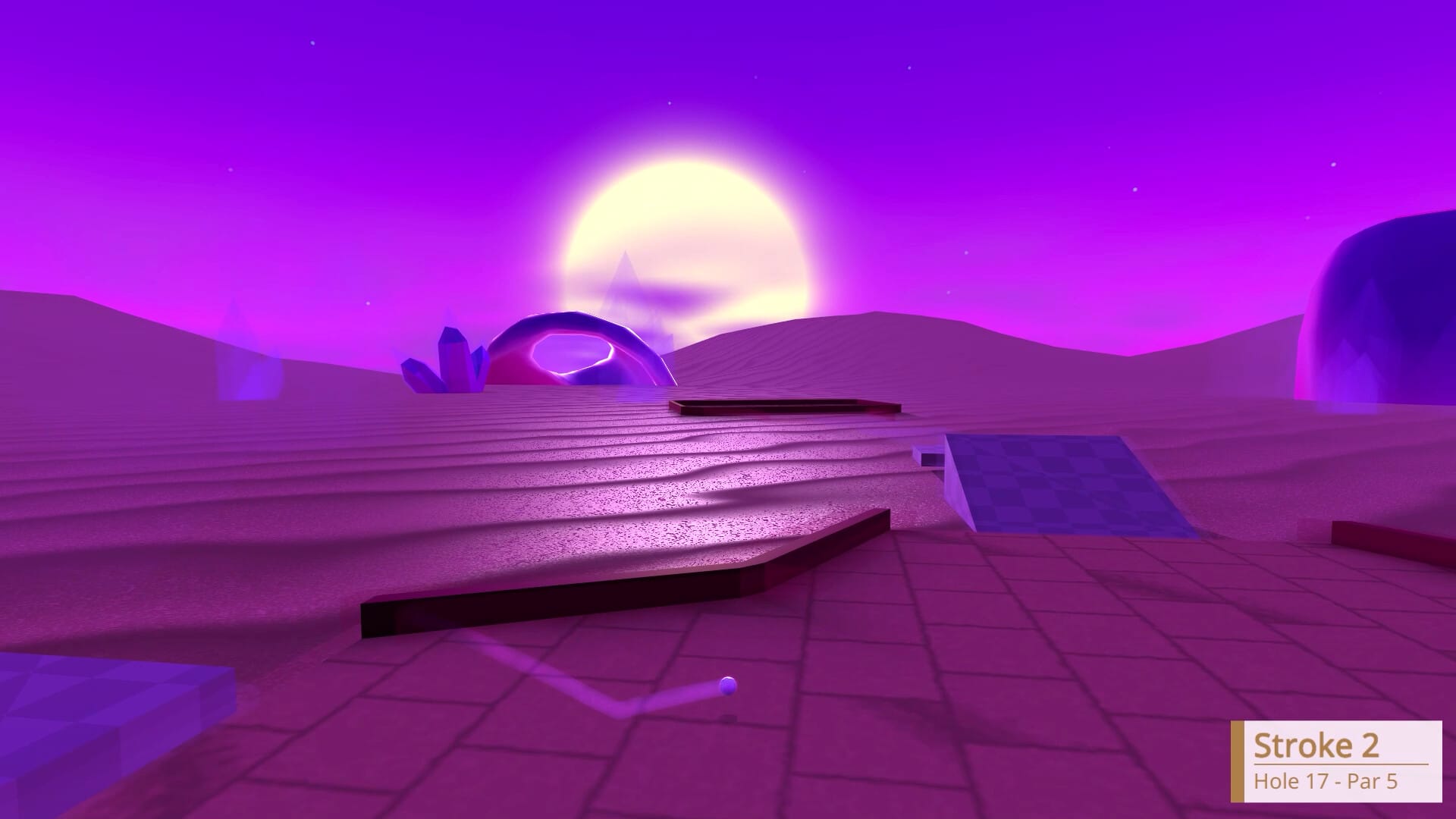

Bottom Line: A rare triumph of mathematical rigor and playful design that turns the familiar into the incomprehensible—and then, brilliantly, back again. 4D Golf isn't just a puzzle game; it’s a cognitive software update for your brain's spatial reasoning.
To understand 4D Golf, you first have to accept that your eyes are lying to you. In a traditional 3D game, if there is a wall in front of you, you go around it. In 4D Golf, that wall might only exist in your current 3D slice. By rotating your view into the W-axis, that wall might simply vanish, replaced by a lush fairway that was "hidden" behind the fourth dimension. It sounds like academic nonsense until you’re three over par on a forest level, staring at a floating island that seems unreachable from every conceivable angle.
The Learning Curve as Curriculum
The genius of the game lies in its onboarding strategy. It doesn't throw you into a hyper-cube on minute one. Instead, it slowly introduces the concept of the fourth dimension as a series of "what if" scenarios. The first few levels feel like standard minigolf, perhaps a bit too simple for the veteran player. But soon, the game asks you to find a hole that isn't on the screen. You learn to "look" along the W-axis, and suddenly the map shifts, revealing a parallel path.
This creates a unique gameplay loop of hypothesis and verification. You look at a 4D landscape, form a mental model of where the hole should be in 4D space, and then manipulate the visualization tools to see if you’re right. It is a slow, methodical process that values patience over twitch reflexes. The friction here isn't in the controls—which are remarkably fluid—but in the mental translation of 4D geometry into 3D action.
The Visualization Interface
Without its suite of visualization tools, 4D Golf would be an exercise in frustration. CodeParade has implemented a Volumetric View that essentially renders the 4D objects as translucent 3D clouds, allowing you to see the "density" of the path ahead. It’s a masterclass in UI design for complex data. The cross-section toggle is equally vital, acting as a scalpel that lets you dissect the world one slice at a time. The interface manages to be data-rich without being cluttered, a difficult balance when you’re asking the player to track four independent coordinates simultaneously.
Spatial Disorientation and Satisfaction
There is a specific kind of "aha" moment in 4D Golf that is unlike anything else in the genre. It occurs when you finally stop trying to visualize the 4D shape and start feeling the logic of the W-axis. You begin to understand that "moving left" in the fourth dimension is just as valid as moving left in the second. When this clicks, the 120+ levels transform from frustrating puzzles into elegant playgrounds.
However, the game doesn't shy away from its difficulty. Some of the later levels—particularly those involving lava and complex gravitational shifts—will cause genuine spatial vertigo. The mental load is heavy. Playing for more than an hour at a time can feel like taking a mid-term exam in topology. This isn't a "relaxing" game, despite the chill soundtrack and the golf theme. It is an intellectual gauntlet.