Overview
Most roguelike deck-builders are content to be Slay the Spire with a new coat of paint. 9 Kings isn’t. Brazilian-American studio Sad Socket has done something more interesting: it welded deck-building to tower defense and territory control, then compressed the whole thing into runs short enough to finish between meetings.
The premise is clean. Pick one of nine rival kings — the gold-hoarder who buys mercenaries by contract, the nature mage, the time manipulator, the dark sorcerer, the imp-swarming menace — and defend a shrinking patch of land against escalating waves. Each turn you play cards onto a grid. Villages become citadels. Towers rise. Knights, warlocks, wizards, bombers, and sentient mushrooms fill the gaps. Then the invaders come, and you watch whether the machine you built holds.
What separates it from the pack is the looting. Beat a rival king and you strip cards from their deck and splice them into yours. This isn’t a cosmetic reward — it’s the whole thesis. The synergies that actually win runs are the ones no single king can reach alone, which means the game is constantly pushing you away from your starting identity and toward heretical hybrids. Nature magic stacked on top of mercenary economics. Time manipulation feeding an imp horde. The explicitly stated design goal is to let you break the game’s math and become King of Kings, and Sad Socket means it literally.
The market has responded. The game sold strongly out of the gate and drew a large audience through its Steam Next Fest appearance, where it was among the most-played strategy titles. That early momentum tells its own story, and one worth returning to.
This is a small game punching several weight classes above itself. It should not be this solid this early.
Key features
- Nine Asymmetric Kings: Not palette swaps. Each king reshapes the economy, the card pool, and the win condition you’re chasing — the gold king plays a fundamentally different game than the imp king.
- Grid-Based Card Placement: Cards go onto a physical map, not into an abstract queue. Position is half your build. Overlapping auras and adjacency effects are where the damage multipliers actually live.
- Deck Looting Between Battles: Defeat a king, take their signature cards. This is the engine of variance and the reason two runs with the same starting king diverge wildly by wave ten.
- Compounding Combo Math: Stacked effects don’t add, they multiply. The best runs end in absurd, screen-clearing numbers that feel like you found an exploit — because functionally, you did.
- Asynchronous PvP: Your built kingdom faces other players’ without either of you sitting in a lobby. Smart, low-friction competitive design for a game this short.
- Quest Mode & Endless Mode: Bespoke challenge scenarios on one side, unbounded difficulty scaling on the other. Endless is where the theorycrafters live.
- The Housekeeping: A full achievement set, cloud saves, Steam trading cards, and localization across dozens of languages — unusually thorough for an indie still in Early Access.
Analysis
The Gameplay Loop
The loop is metronomic: draft, place, defend, loot, repeat. Each cycle takes maybe ninety seconds. A full run runs twenty to thirty minutes. That compression is the game’s most underrated design decision, because it changes the emotional math of failure. When a run dies at wave twelve to a card you couldn’t answer, you don’t lose an hour. You lose twenty minutes. That’s a failure cost low enough to make experimentation rational — and it’s where the “one more run” pull comes from, not from addictive tricks.
The draft-and-place rhythm has real tension in it. You’re solving two problems simultaneously with one resource. A card is both a what and a where, and the correct answer to one is often the wrong answer to the other. That warlock wants to sit behind the line. The tile behind the line is the only spot left that extends your territory toward the citadel upgrade you need. Pick one. Most deck-builders let you sidestep this by making card selection the entire decision; 9 Kings refuses, and the design is substantially richer for it.
Where the Depth Actually Lives
The looting system is doing the heaviest lifting. In a conventional roguelike deck-builder, your card pool is a fixed set gated by rarity rolls. Here it’s adversarial — the pool expands based on who you beat, which means your build’s trajectory is partly a consequence of your own combat performance. Kill the time king early and your run becomes a different run. This creates something most games in the genre never achieve: a mid-run identity crisis that’s productive rather than frustrating.
And the ceiling is genuinely high. The game really does break its own math. Certain overlapping aura stacks produce multipliers that turn wave forty into a formality. Discovering one of these is the payoff the entire structure is built to deliver, and Sad Socket has resisted the obvious temptation to patch the fun out. The multipliers are the point. The game wants you to cheat it.
The Cracks
Now the honest part.
The balance between kings is not there yet. Some kings enter the run with a coherent engine already half-assembled; others need three specific loots to become functional. A run’s outcome can be substantially determined before you’ve made a meaningful decision — early card luck deciding runs is baked into the current design, and in a game this short, a bad opening draft doesn’t create an interesting comeback story. It creates a twenty-minute run you already know you lost at minute four.
The content thins for veterans. The synergy space is finite, and the discovery engine — which is what makes the early hours so compelling — has less fuel the deeper you go. Endless Mode is the intended answer. It’s a partial one. Unbounded difficulty scaling tests execution, not creativity, and this is a game whose soul is creativity.
Onboarding is terse. The interface explains what cards do. It doesn’t explain what cards mean — that adjacency compounds, that positioning is a multiplier and not a modifier. Strong players figure this out in run three. Weaker ones bounce off thinking it’s a shallow tower defense with cards. That’s a teaching failure, not a design one, and it’s fixable.
None of this is disqualifying. All of it is exactly what Early Access is for. But the game is being received as if it’s finished, and it isn’t.
Visuals & performance
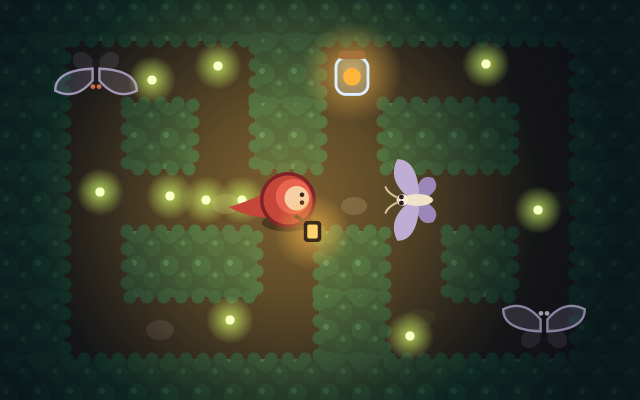
The art direction is minimalist by conviction, not by budget — or at least it wears that convincingly. Flat, readable, high-contrast, with a clarity that matters enormously when you have forty units and six overlapping auras on a grid the size of a postcard. This is functional aesthetics. You can parse the board state at a glance, which in a game about spatial stacking is not a nice-to-have.
The tradeoff is that it’s visually quiet. The moment your build finally goes critical and the numbers detonate, the presentation doesn’t rise to meet it. There’s no crescendo. A screen-clearing multiplier chain and a routine wave clear look broadly similar, and the game loses some of the euphoria it’s earned. The spectacle is in the spreadsheet, not on the screen. For a certain kind of player that’s a feature. For most, it’s a missed opportunity.
Performance should be a non-issue. The scope is modest and the systems are lightweight — a 2D game of this size is light on hardware, which suits a game whose ideal session is fifteen minutes on whatever machine is nearest.
Platform nuances
On Steam, this is the definitive version. Mouse-and-keyboard is the right input for grid placement — precision matters, hover-to-inspect matters, and reading a dense board benefits from a monitor. Cloud saves and the trading cards are Steam-native furniture.
On Android, the case is more interesting and the evidence is thinner. Architecturally the game is built for mobile whether or not that was the intent: turn-based, no reflex demands, twenty-minute runs, a grid that maps to touch input naturally. This is a commute game by structure. Tap-to-place is arguably a more direct interaction than click-to-place.
But the concerns are obvious ones. Board density is the enemy of small screens. The whole design depends on reading overlapping effects across adjacent tiles, and what’s legible on a monitor is a smudge at six inches. Whether Sad Socket has done the work on touch-target sizing, pinch-zoom, and effect inspection is the question that determines if the Android build is the real thing or a compromise. Buy on Steam if you have the choice; treat mobile as a promising second screen until proven otherwise.
Final verdict
9 Kings is a small studio’s very large idea, executed with more discipline than most funded studios manage. Sad Socket identified the one thing that makes deck-builders sing — the moment your build stops being a deck and starts being a machine — and rebuilt the entire genre scaffold around delivering that moment faster and more often. Twenty-minute runs. Adversarial card acquisition. Positioning as a multiplier. It works.
It isn’t finished. The kings need a balance pass, the early-luck variance needs a floor under it, and the endgame needs an answer better than “the numbers get bigger.” The early enthusiasm is deserved, but the rough edges are real, not a death knell — this is what Early Access is for.
We rate it a solid, flawed-in-ways-that-matter recommendation for the right audience: buy it if the loop described above sounds like your kind of puzzle, and let Sad Socket finish the job. The core is already better than its Early Access label suggests.
Reviewed by the Rankeno Strategy & Sim Desk. Scores are out of 10; the overall score is the desk’s editorial judgement, informed by the four sub-scores above. How we review