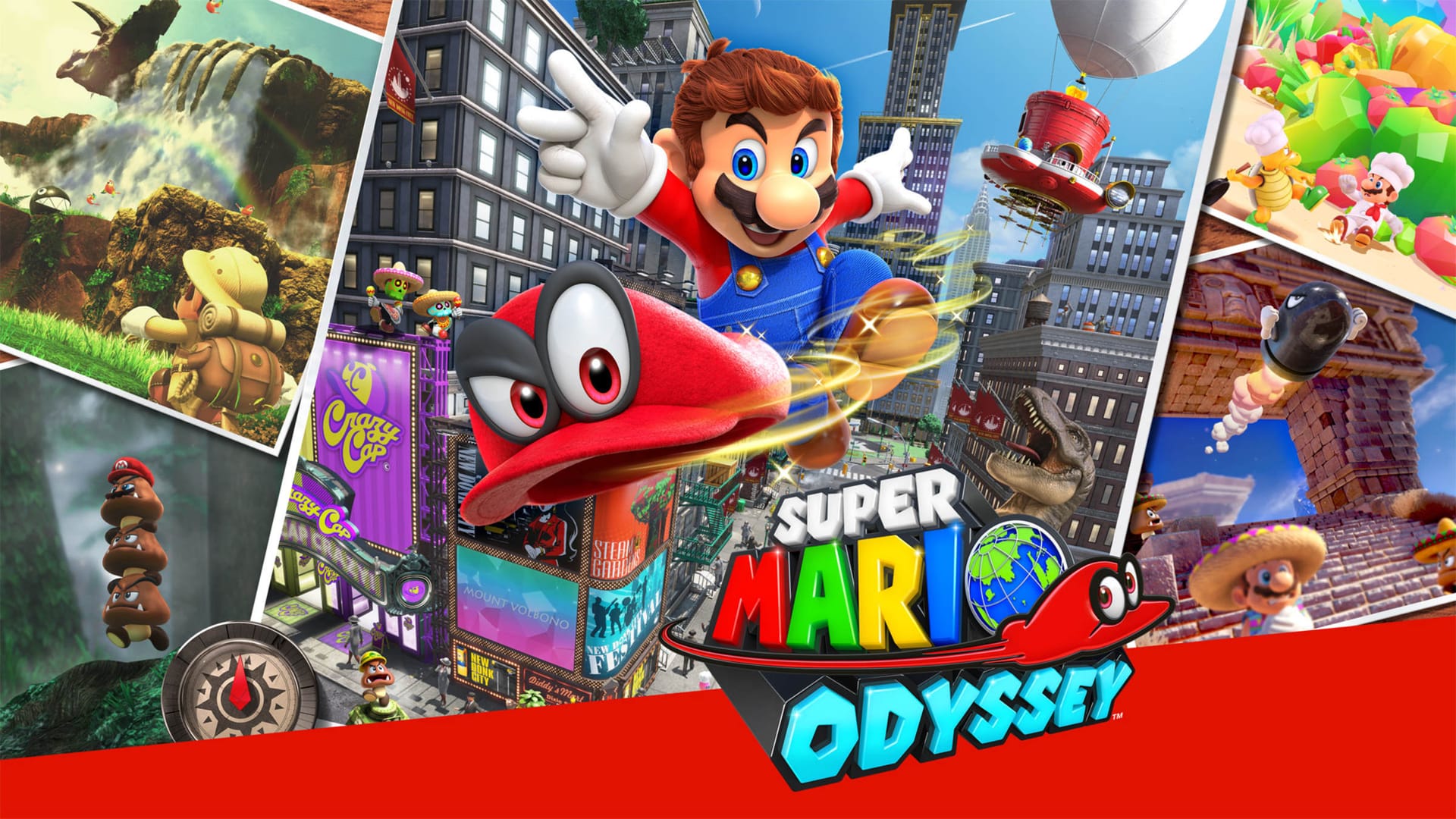
Bottom Line: Nintendo took the 3D platformer, a genre it invented, and detonated it. Super Mario Odyssey is the rare sequel that makes everything before it feel like a rough draft — a joyous, mechanically dense playground undermined only by the sheer volume of collectibles it eventually asks you to hoover up.
The Gameplay Loop
Mario has never controlled this well. That's the foundation everything else stands on, and it deserves to be said plainly before we get to the clever stuff. The base moveset — the triple jump, the long jump, the dive, the ground pound, the wall kick — carries more nuance than any Mario before it, and Cappy layers a throw-and-vault on top that turns traversal into something closer to improvisation. You can chain a dive off a cap-bounce off a wall-kick and cover ground that looks, on paper, unreachable. The controls have almost no latency and near-zero onboarding friction. A child can move Mario. An expert can make him dance.
Then Capture arrives and blows the loop wide open.
The genius of Capture isn't the novelty of becoming a T-Rex — though stomping through Cascade Kingdom as one is a genuine thrill. It's that each possession is a self-contained verb. Capturing a Bullet Bill turns a platforming problem into a flight problem. Capturing a Cheep Cheep turns it into a swimming problem. Capturing an electrical wire — the "Spark Pylon" — turns Mario into a current racing along a line. Every Kingdom introduces new capturable entities, which means Nintendo is effectively teaching you a new mechanic every hour or two, then combining them in ways that never feel arbitrary. This is design discipline most studios can't touch. The mechanic could easily have been a bag of one-off tricks. Instead it's a coherent language.
The Kingdoms themselves are the other half of the equation. Each is a compact sandbox stuffed with Power Moons — the collectible that fuels the airship and unlocks the next destination. And here's the smart part: Moons are the reward for curiosity, not grinding. See a suspicious ledge, capture the right creature, solve the micro-puzzle, get a Moon. The density is intoxicating early on. You cannot look at a corner of New Donk City without spotting three things worth investigating.
Where the Loop Strains
That density is also the game's one real structural flaw, and it's worth being honest about it. The main story requires a reasonable number of Moons. But Odyssey holds hundreds more, and once the credits roll, the collect-a-thon reveals its bloat. Some post-game Moons are inspired. Many are filler — a Moon for ground-pounding a random spot, a Moon for existing near a thing. The line between "rewarding exploration" and checklist padding gets blurry, and completionists will feel the game's respect for their time thin out around the 500-Moon mark. It's the difference between a game that trusts your curiosity and one that's just counting on your compulsion.
The local co-op deserves a similar dose of realism. A second player can control Cappy independently, and it's a lovely on-ramp for a parent playing with a kid. But it's shallow — Player Two is a helper, not a partner, and no one is buying Odyssey for its multiplayer.