

Bottom Line: A masterclass in party-based synergy that turns the solitary deck-builder into a high-stakes social marathon. It is brilliant, dense, and occasionally exhausting.
The Complexity of Coordination
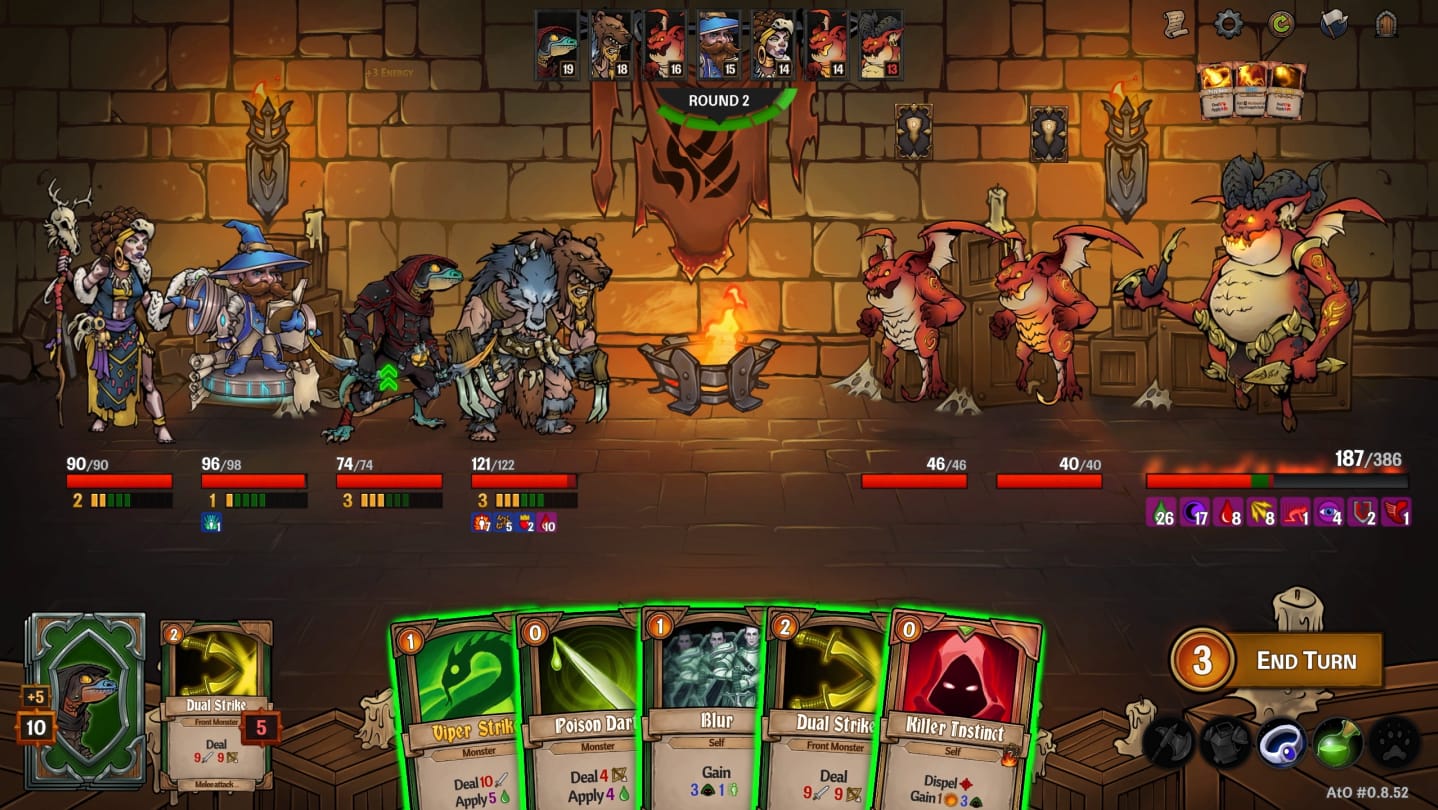
The "Aha!" moment in Across the Obelisk doesn't come from drawing a single powerful card; it comes from realizing how a Warrior’s "Taunt" can set up a Mage’s "Fireball" while a Cleric prepares a "Sanctuary" for the following turn. This is archetypal synergy at its most refined. Because you are always dealing with a party of four, the game introduces a layer of cognitive load that single-character roguelites lack. You have to track four energy pools, four discard piles, and the status effects of an entire battlefield.
The depth here is staggering. With over 16 unlockable characters and hundreds of cards, the build variety is functionally infinite. You might build your Rogue as a poison-stacking assassin in one run and a high-evasion utility support in the next. The game rewards this experimentation, but it also punishes sloppy planning. If your deck-thinning isn't synchronized across the party, you'll find your healer drawing nothing but dead cards when your tank is one hit away from the graveyard.
The Marathon Problem
While the strategic depth is a triumph, it comes at a significant cost: time. A successful run in Across the Obelisk can easily stretch to four hours. This is a radical departure from the 45-minute loops the genre is known for. The game attempts to mitigate this with a "Madness" difficulty system and an "Obelisk Mode" for faster play, but the core campaign remains a slog.
This length creates a friction point for the cooperative experience. Finding three friends who can commit to a four-hour block of uninterrupted tactical combat is a tall order. The game saves progress, allowing you to stop and start, but the momentum of a well-oiled deck often dissipates if the session is split across multiple days. Furthermore, the early-game grind is real. Until you’ve invested enough in the town upgrades and perk trees, certain biomes feel mathematically insurmountable, forcing a "lose-to-win" loop that might frustrate those looking for a more skill-reliant onboarding process.
The Economy of Senenthia
We also need to address the Paradox influence. The game is excellent, but it is already being surrounded by a constellation of DLC packs. While the base game is feature-complete, the constant prompts for unowned content and the realization that some of the most interesting characters are locked behind additional paywalls can leave a sour taste. It’s a familiar model for Paradox fans, but it feels particularly aggressive in a genre where "everything in the box" is the standard.
Despite these gripes, the core loop is addictive. The branching narrative map offers genuine agency; choosing to travel through the frozen wastes of the north instead of the swampy south isn't just a visual change—it fundamentally alters the types of enemies you face and the equipment you’ll find. This keeps the fourth hour of a run feeling as tense as the first.