
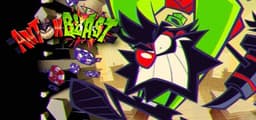
Bottom Line: Antonblast is a masterclass in kinetic momentum, stripping the mascot platformer of its politeness and replacing it with a sledgehammer and a gallon of high-proof aggression. It’s the spiritual successor the Game Boy Advance era deserved.
The Kinetic Loop
The brilliance of Antonblast lies in its refusal to let the player sit still. In most platformers, the environment is a series of static hurdles; in Antonblast, the environment is a suggestion. The Mighty F’n Hammer defines the entire experience. It provides a sense of tactile impact that is rarely achieved in 2D spaces. When you strike an object, the screen shakes, the audio cracks with a satisfying crunch, and Anton’s momentum carries him forward with a weight that feels earned.
Movement isn't just about pressing "right." It’s about managing inertia. Anton has a heavy, deliberate feel that transitions into a terrifying blur of speed once you find your rhythm. This is where the game demands precision. If you miss a jump, it isn't because the physics are "floaty"—it's because you failed to respect the weight of the character. The learning curve is steep, but the payoff for mastering the dash-and-smash rhythm is a flow state that few modern titles can replicate.
"Happy Hour" and Level Inversion
The Happy Hour mechanic is the game’s structural masterstroke. Most platformers suffer from "end-of-level fatigue," where the tension dissipates as you approach the goal. Antonblast solves this by making the goal the beginning of the real challenge. Triggering the detonator changes the music, shifts the visual palette, and puts a literal timer on your life.
This forces you to view the level design in reverse. A platform you used to climb is now a drop you have to time perfectly; a wall you ignored is now a barrier that must be smashed in seconds. It turns every stage into a high-stakes escape room. This mechanic creates a frantic tension that punishes hesitation and rewards players who took the time to "read" the level during the initial exploration phase. It's a brilliant way to ensure that every square inch of the developer's work is utilized to its maximum potential.
Mechanical Friction and Aggression
The game encourages, and often requires, extreme aggression. Boss fights aren't patterns to be memorized as much as they are problems to be hammered into submission. The bosses are screen-filling behemoths that challenge your ability to maintain speed while dodging complex bullet patterns.
However, this aggression comes with a trade-off. At high speeds, the visual fidelity of the game can occasionally work against it. The environments are so detailed and the animations so expressive that "visual noise" can become a legitimate hurdle during the more chaotic escape sequences. There were moments where I lost track of Anton amidst a sea of debris and particle effects. While this adds to the "explosive" feel of the game, it introduces a layer of unintended friction that requires a few hours of eye-training to overcome.


