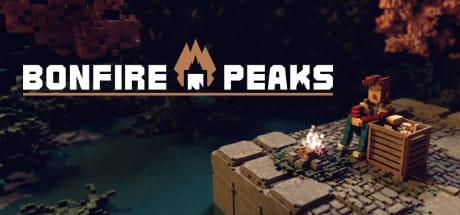


Bottom Line: A masterclass in spatial economy that proves restricted movement is the ultimate canvas for puzzle-solving brilliance. It is intellectually honest, mechanically pure, and utterly unforgiving.
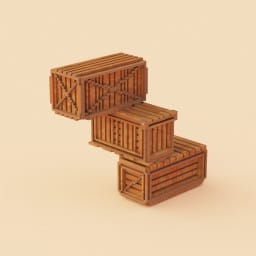
The brilliance of Bonfire Peaks lies in its mechanical austerity. In most 3D games, movement is an afterthought—a fluid means to an end. Here, movement is the enemy. The player’s inability to sidestep turns every 1x1 crate into a cumbersome physical extension of the self. When you pick up a box, you aren't just "holding an item"; you are changing your character's dimensions. You become a 2x1 rectangle in a world built for 1x1 squares.
The Geometry of Frustration
The gameplay loop is a rhythmic cycle of observation, failure, and eventual epiphany. Because the rules are so static—you can move forward, backward, and rotate—the solution is always "visible," yet maddeningly out of reach. Martin’s level design utilizes verticality better than almost any of his peers. You’ll spend ten minutes staring at a three-step staircase, trying to figure out how to rotate a crate without clipping into a wall, only to realize that the solution required you to back up the stairs while facing away from your goal. This is spatial reasoning at its most clinical.
There is no "fluff" here. Every level feels like a bespoke argument for a specific mechanic. Whether it’s using crates to bridge gaps, navigating around water that resets your progress, or managing the shifting center of gravity when stacking items, the game never repeats itself. The introduction of long crates or "sticky" surfaces later in the game doesn't just add variety; it fundamentally re-contextualizes everything you thought you knew about the grid.
User Flow and Accessibility
Despite its high difficulty ceiling, the user experience is remarkably frictionless. The undo button is instantaneous, an essential feature given that a single misstep can ruin a twenty-move sequence. The decision to allow players to skip puzzles is equally vital. It prevents the "wall effect" common in linear puzzle games, where a single particularly obtuse level can end a playthrough. In Bonfire Peaks, you can simply walk around a frustrating bonfire and find another one, often returning later with a fresh perspective or a newly learned technique.
The overworld itself is a triumph of design. It isn't just a menu; it’s a tiered, vertical island that you must navigate using the same rules as the puzzles. Reaching a new set of levels often requires solving a mini-puzzle in the hub, making the entire experience feel like a cohesive, singular challenge rather than a collection of disparate stages. This creates a sense of environmental storytelling that is rare in the genre; you aren't just solving puzzles, you are climbing a mountain of your own past.