Overview
There’s a particular kind of genius in games that fit entirely in your palm and still refuse to let go. Card Crawl, developed by Arnold Rauers of Tiny Touch Tales, is one of them. Released on February 7, 2018 and still quietly commanding a devoted following, it’s a game that understood something most mobile developers still don’t: constraint is the point, not the compromise.
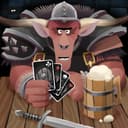
The premise is deceptively humble. You sit across a wooden tavern table from a hulking, oddly affable dealer. Between you rests a modified deck of 54 cards — a bastardized version of the standard playing deck you’d find in any drawer. Your job is to survive it. Every card must be dealt with, literally, before the deck runs dry. Monsters attack. Potions heal. Coins line your pockets. Shields and swords are your only means of not dying face-down on the felt.
Rauers isn’t a household name, but among the small, obsessive world of solo mobile designers he’s something close to royalty. Card Crawl kicked off a whole micro-genre of “single-screen deck crawlers” — you can trace a direct line from this game to Card Thief, Miracle Merchant, and a wave of imitators that never quite matched the original’s economy. This is the ur-text.
Its market positioning is refreshingly honest. This is not a free-to-play slot machine dressed up as a card game. At $2.99, it’s a premium experience built for short, punishing, replayable sessions — the kind of thing designed to fill eight minutes at a bus stop and stick in the head all afternoon. The 35 unlockable ability cards, of which you draft five per run, give it a build-crafting depth that belies its tiny footprint. It looks like a toy. It plays like a puzzle box with teeth.
Key features
- Single-Screen Deck Management: The entire game unfolds on one static tavern table. Four cards face-up, two hand slots, one backpack. Everything you need to win or lose is visible at all times — no menus, no fog of war.
- Draftable Ability Deck: Before each run you select five special ability cards from a pool of 35 unlockables, letting you tailor a run toward aggression, economy, or defensive survival. This is where the game’s strategic replayability actually lives.
- Four Distinct Modes: Normal for the core loop, Constructed for tuned deck-building, Daily for a shared global seed and leaderboard competition, and Delve for a longer, escalating challenge.
- Score-Chasing Economy: Survival isn’t enough. Gold is the real currency of mastery, forcing a constant tension between playing safe and playing greedy.
- Hand-Drawn Art by Max Fiedler: A warm, tactile, storybook aesthetic that anchors the whole experience.
Analysis
The Gameplay Loop
The loop is the whole game, so let’s be precise about it. Four cards are dealt face-up. You have two hand slots — think of them as your left and right hands — and one backpack slot for stashing a single card. To advance the deck, you must clear cards off the table: kill a monster, drink a potion, pocket a coin. Once you’ve dealt with enough of them, the dealer replenishes the row.
Sounds simple. It is not.
Here’s the friction that makes it sing: a sword in your hand can only strike so many times before it shatters — its durability is printed right on the card. A shield blocks damage, but only against monsters weaker than its value, and only if you play it before the blow lands. That single backpack slot becomes the most agonizing real estate in mobile gaming. Do you stash the healing potion for the crisis you know is coming? Or the sword you’ll need in three turns? You can’t hold both. Every decision is a trade, and every trade compounds.
This is the game’s masterstroke. Inventory management — usually the most tedious verb in gaming — becomes the entire tactical surface. There’s no combat animation to hide behind, no dice to blame. When a run ends in death, the losing card is always identifiable in hindsight.
The RNG Question
Let’s be honest about the elephant in the tavern: luck. Card Crawl is, at its foundation, a game of the shuffle. Some runs deal a merciful curve of potions and weak goblins. Others front-load three fat monsters and no way to answer them. Newcomers will lose runs that feel genuinely unfair, and they’ll be right — some of them are.
But here’s where Rauers earns his reputation. The ability draft is the pressure-release valve. A well-chosen loadout — say, a card that lets you convert monsters to gold, or one that boosts shield efficiency — transforms variance from a death sentence into a puzzle. The deeper the understanding, the clearer it becomes that “bad luck” was usually a play that wasn’t seen. Mastery here isn’t about winning; it’s about minimizing the runs where luck gets a vote at all. That’s a sophisticated design philosophy, and it’s why the game rewards long-term play rather than a quick fling.
Onboarding and Friction
The learning curve is steep and largely unguided. The tutorial covers the mechanics but not the strategy, and the gap between “understanding the rules” and “understanding the game” is a canyon players cross alone. For some, that opacity is the appeal. For the impatient, it’s a wall. This is not a game that holds your hand — fitting, given your hands are usually full of swords.
Visuals & performance
Max Fiedler’s artwork is the soul of this thing. The style is warm, chunky, and hand-drawn, all rounded edges and expressive little monsters. The dealer — a friendly hulk of a creature — gives the whole affair a cozy, bedtime-story warmth that cuts against the mechanical cruelty underneath. It’s skeuomorphism done with actual taste: real cards, real wood grain, a real sense of sitting at a table. There’s no visual clutter because the design doesn’t allow for any.
Technically, the game is built to be light, and it is. A static, turn-based card game of this scope asks almost nothing of the hardware — even a decade-old phone should run it comfortably. The design keeps storage demands minimal and input response immediate by nature. Card animations are crisp and satisfying without ever slowing down a fast player. In an era of bloated mobile games that demand gigabytes and a graphics card, Card Crawl’s technical restraint feels almost radical.
Platform nuances
On iOS and Android, this is the definitive version. The game was born for touch. Dragging a sword onto a monster, flicking a coin into your pocket, dropping a card into the backpack — the tactile, physical grammar of the interface maps naturally onto a touchscreen, mimicking the handling of actual cards. This is the version to buy, and the one to play in short bursts where the format thrives.
The Steam release is a more complicated proposition. Mouse-and-keyboard works — click-and-drag translates the touch logic faithfully enough — but something is lost in the abstraction. A cursor doesn’t have the intimacy of a fingertip. On a large monitor, the single-screen tavern that feels cozy on a phone can look sparse, even a little lonely, marooned in the middle of a widescreen display. It’s a competent port, not a reimagining. If you own both a phone and a PC, we recommend the phone. The mouse version is for completists and Steam-achievement hunters.
Final verdict
Card Crawl is a small game with an enormous amount of confidence. Rauers took the most solitary, mechanical card game imaginable and found the tension, the drama, and the heartbreak hiding inside it. The RNG will occasionally rob you, and the cold open of its onboarding will lose some players before the hooks sink in. Those are real flaws, not quibbles — and they’re why this lands as a strong recommendation rather than an unqualified one.
But what remains is a superb distillation of the “one more run” impulse — a game that fits in a coat pocket and lives rent-free in your head. Years after release, little in the single-screen genre has surpassed it. It didn’t just do the format first. It did it remarkably well.
Reviewed by the Rankeno Puzzle & Casual Desk. Scores are out of 10; the overall score is the desk’s editorial judgement, informed by the four sub-scores above. How we review