Overview
Let’s get the disclaimer out of the way, because it’s the whole story: HoloCure - Save the Fans! is free. Not free-with-an-asterisk. Not free-to-start. There is no store page hawking cosmetic bundles, no energy timer nudging anyone toward a wallet, no premium currency dressed up in confusing exchange rates. A single developer operating as KayAnimate built a game that borrows the “gacha” vocabulary of the mobile-monetization industrial complex and then strips out the one thing that makes gacha profitable — the money. Every character, every unlock, every pull is paid for with currency earned by playing. That decision reframes everything else here.
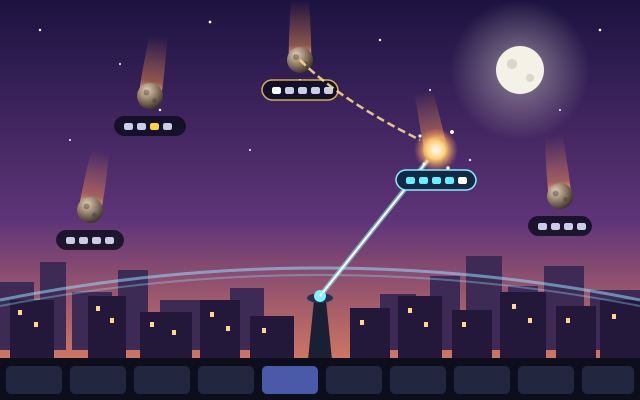
What’s on offer is a top-down roguelite bullet heaven, the sub-genre that Vampire Survivors dragged into the mainstream and Magic Survival prototyped before it. Players pick a Virtual YouTuber from the Hololive agency, drop into an arena, and try to survive a lengthy timed run against thickening swarms of mind-controlled fans. It’s less fighting than accretion — leveling up, stacking weapons and passives, and watching a modest starting attack metastasize into a screen-clearing light show. It is comfort food for the reptilian brain.
The market positioning is unusual precisely because there’s no market transaction. HoloCure lives on Steam as a promotional love letter, officially sanctioned by Cover Corp, aimed squarely at the enormous Hololive fandom. That audience-capture would excuse mediocrity from most fan games, which coast on affection all the time. HoloCure refuses the excuse. With a large roster of playable idols, each with distinct weapons, ultimates, and passives, it offers more mechanical variety than survivor-likes charging fifteen dollars. It is a fan game that competes on merit, and largely wins.
Key features
- A Deep Bench of Distinct VTuber Characters: Every idol arrives with her own starting weapon, unique passive skill, and a special ultimate ability. These aren’t reskins — playstyles diverge hard, from glass-cannon burst to grinding attrition builds.
- The Collab System: Fully upgrade two compatible weapons, haul them to a golden anvil, and fuse them into a devastating Collab or Super Collab. This is the strategic spine of every run — build planning, not just build luck.
- Fully Free Gacha & Meta-Progression: Earn HoloCoins in-game to buy permanent stat upgrades and roll for new characters. All the dopamine architecture of gacha, zero microtransactions.
- Holo House: A surprisingly complete life-sim mode — farming, cooking, fishing, pet-raising, worker management, home decoration — bolted onto the side, plus a platforming tower and a casino.
- Manual Aiming & Stamp Customization: Optional manual targeting rewards skill, while a stamp system lets players rewire individual weapon behaviors.
Analysis
The Gameplay Loop
The survivor-like loop is now well-worn: kill things, collect XP gems, pick one of three upgrades on level-up, repeat until the screen is a wall of numbers and particles. HoloCure understands the assignment and then does something most imitators don’t — it adds decisions with consequences.
The Collab system is where the design earns its keep. Weapons cap out at a fixed max level, and once two compatible ones are maxed, the golden anvil lets players fuse them into a single, far stronger Collab weapon — freeing up a slot in the process. That means a good run isn’t a matter of grabbing whatever the game offers. It’s reverse-engineering a recipe: which weapons combine, whether it’s worth holding a slot open while both halves mature, whether the RNG will even hand over the components before the difficulty curve outpaces the damage. It turns passive accretion into active drafting. Two runs with the same character can diverge completely based on which Collabs get chased.
The manual aiming option deserves specific praise because it’s the sort of thing survivor-likes usually refuse to offer. The genre’s whole comfort proposition is that nobody aims — you position, and the game shoots for you. HoloCure honors that default but lets skilled players opt into directional control, and for characters whose kits reward precision, that’s the difference between passive and expressive play. It respects that its audience contains both the relaxed and the tryhard, and it doesn’t force either into the other’s mode.
Meta-Progression Without the Guilt
Here’s where the free model quietly changes the feel of the progression. In a monetized game, permanent upgrades and character unlocks are the pressure points — the places designers introduce friction to make spending look attractive. HoloCure earns nothing from the grind, so the grind is tuned to be pleasant rather than punishing. HoloCoins flow at a generous clip. The gacha exists as a reward pacing mechanism, not a revenue funnel. The pull of “one more run to afford the next pull” comes without the sour aftertaste of knowing a credit card would skip the whole thing.
That’s not a small design point. It’s the entire reason the progression feels good instead of manipulative. Strip the exploitation out of a gacha loop and what remains is just... a good loop.
The Kitchen Sink That Actually Works
Holo House should be a disaster. Fan games routinely over-reach, bolting on half-baked side modes that dilute the core. HoloCure’s life-sim wing — farming, cooking, fishing, pets, worker management, decorating — reads on paper like scope creep that should have been cut. In practice it’s designed as a genuine tonal release valve: a long stretch of escalating bullet-hell chaos is intense, and a quiet fishing session or a round of crop-tending is built to reset the pace before the next run. The extra minigames — a platforming tower, a casino — are lighter, but they extend the “just one more thing” gravity that gives the game far more staying power than a survivor-like has any right to.
The connective tissue is that everything feeds the core. Fishing and cooking produce items and buffs. The side content isn’t a walled garden; it’s an economy that loops back into combat runs. That integration is what separates a feature from a distraction, and HoloCure lands on the right side of that line.
Visuals & performance
The pixel art is the good kind — deliberate, characterful, and animated with obvious affection for its source material. Each idol is instantly recognizable in sprite form, and the design keeps the screen-filling chaos of a late-game run readable, which is a harder achievement than it sounds. When hundreds of projectiles, enemies, and XP gems occupy the same space, legibility is a real engineering problem. HoloCure keeps its silhouettes clean and its damage numbers parseable even when the arena descends into glorious visual noise.
The soundtrack is original, catchy, and does the heavy lifting on mood — driving during combat, cozy in Holo House. It’s the rare game score worth seeking out on its own.
Performance should be a non-issue on modern hardware; this is a 2D game with a light technical footprint, built to stay legible even in the most crowded end-game screens. The controls are designed around tight, responsive input — the manual aim in particular would fall apart with any input lag, and the design clearly accounts for that.
Platform nuances
On Steam, HoloCure is a keyboard-and-controller affair, and both are well supported. Movement wants precise, twitchy directional input, and a controller’s analog stick or crisp WASD both suit it. Manual aiming is a natural fit for a controller’s right stick — twin-stick shooter muscle memory maps onto it cleanly — while mouse aim gives keyboard players comparable precision. The menu-heavy meta-layers (the shop, gacha, Holo House management) are marginally snappier with a mouse, but nothing is gated behind an input method. Steam Cloud saves and the platform’s overlay round it out. Given its history as a fan project before arriving on Steam, the storefront version is its natural home.
Final verdict
HoloCure - Save the Fans! commits the one sin the games industry never expects from free content: it’s too generous. There’s no catch. No paywall lurking an hour in. No second shoe waiting to drop. What players download is a mechanically dense, attractively presented, remarkably content-rich roguelite that treats a fandom’s affection as a reason to try harder rather than an excuse to coast.
Its flaws are real but minor — it assumes fluency in Hololive it doesn’t teach, and its side modes flatter more than they satisfy. Neither dents the core proposition. KayAnimate built something that stands alongside paid competitors while charging nothing, and did it with the polish of a studio many times the size. For anyone with a PC and any curiosity about the genre, we recommend it without hesitation — with the caveat that the fandom-specific framing will land differently depending on who’s playing. Fan games are supposed to be a step below the real thing. This one is a rebuke to it.
Reviewed by the Rankeno Action Desk. Scores are out of 10; the overall score is the desk’s editorial judgement, informed by the four sub-scores above. How we review