Overview
Most JRPGs treat exploration as decoration. You walk the corridor the designers built, fight the fights they scheduled, and watch the cutscene they wrote. Crystal Project tears that contract up. This is a game built almost single-handedly by developer Andrew Willman, and it plays like the work of someone who studied the genre’s golden age obsessively, then asked a dangerous question: what if the world came first, and everything else had to earn its place around it?
The pitch sounds like a contradiction. It’s a turn-based JRPG with a rigorous, transparent combat engine lifted from the tactical school—and it’s also a 3D platformer where you jump, climb, and vault across a voxel landscape with no invisible walls. Those two design instincts rarely share a room. Here they’re welded together, and the seam is the whole point. You don’t grind toward the next story beat. You spot a distant plateau, wonder if you can reach it, and go find out.
Positioned squarely against the comfort-food JRPG—the kind that respects your time by wasting none of it—Crystal Project does the opposite. It respects your time by handing you the keys and walking away. There is a class system with over twenty unlockable jobs, an economy of discovery where equipment and secrets are hidden in the geometry rather than gated behind quest markers, and a combat model that shows you every number, every threat, every probability before you commit.
The game has found a devoted audience on Steam, and the fault lines in that reception are telling. The people who love it don’t just like it—they evangelize. The people who bounce off it usually cite the same three things: the graphics, the near-total absence of narrative, and platforming that occasionally fights the camera. This is not a game engineered for universal appeal. It’s engineered for a specific player, and it finds them.
Key features
- Non-Linear Open World: A vast voxel-based 3D map with full vertical traversal—jump, climb, and clamber anywhere the geometry allows. No invisible walls, no locked corridors, no “come back later” gating beyond your own capability.
- Final Fantasy V–Style Job System: Over twenty unlockable classes you discover in the world, then mix, customize, and combine across a four-person party. This is the theorycrafting engine that keeps players up at night.
- Fully Transparent Tactical Combat: An MMO-style threat-management system where enemy targeting, turn order, damage ranges, and hit probabilities are all visible. No hidden dice. No random encounters. Every fight is a puzzle with its cards face-up.
- No Missables, No Punishment: Nothing is permanently lost. High but adjustable difficulty means the challenge is a choice, not a cage.
Analysis
The Gameplay Loop
The loop here is unusual because it isn’t handed to you—you assemble it yourself. You arrive somewhere new. You survey the terrain. You notice a ledge, a suspicious gap, a monster tougher than the ones around it. Then you decide: are the tools in hand to deal with this yet? Sometimes the answer is no, and the game trusts you to figure that out and route around it. That single act of self-directed judgment—strong enough, skilled enough, curious enough?—is the beating heart of the experience.
Compare this to the standard JRPG rhythm, where progression is a treadmill and the world exists to funnel you forward. Crystal Project inverts the relationship. The world is the content. Combat, loot, and class unlocks are things you find because you explored, not rewards dispensed to keep you exploring. The distinction matters. It changes exploration from a chore between fights into the primary verb.
Combat as an Open Book
The combat deserves its own paragraph because it’s genuinely radical in its honesty. Most turn-based systems hide their math—damage variance, hit chance, aggro—behind a curtain, and half the “strategy” is guesswork about what the engine is actually doing. Willman rips the curtain down. You see the threat table. You see who the enemy will hit and roughly how hard. You see the turn order laid out ahead of you like a chessboard.
This does something clever to the difficulty. When you lose, you can’t blame the dice, because there are no hidden dice. You lost because you misread the board. That accountability is exactly what a certain kind of player craves, and it turns each encounter into a solvable problem rather than a coin flip. Paired with the deep job system, the result is a combinatorial playground. Twenty-plus classes, subclass abilities, party composition—the space of viable builds is enormous, and the game is confident enough to let you break it.
The Cost of Freedom
Freedom is not free, and Crystal Project pays for it in two currencies. The first is onboarding friction. The game is not interested in explaining itself. Systems open up with minimal fanfare, and the early hours can feel like standing in a field with no compass. For the right player, that disorientation is the thrill. For others, it reads as a game that forgot to introduce itself.
The second cost is the story—or the lack of one. There is a narrative scaffold here, but it is deliberately thin, atmospheric rather than dramatic. If you play JRPGs for character arcs and emotional payoffs, you will find this world beautiful and empty. That’s not an accident or a shortcoming of ambition; it’s a design choice that says player-authored discovery is the story. Whether that satisfies you is the single biggest predictor of how you’ll feel about the whole package. The platforming compounds this—when it works, vertical exploration is exhilarating; when the camera or a finicky jump gets in the way, it briefly reminds you that a tactical RPG engine wasn’t originally built to be a 3D platformer.
Visuals & performance
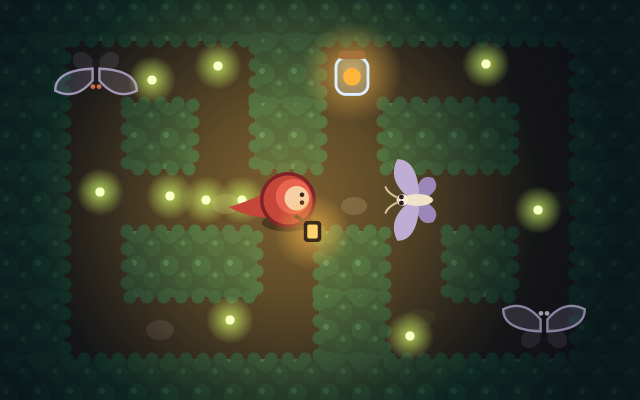
The elephant in the render: the voxel-and-pixel-sprite aesthetic is polarizing, and no amount of critical goodwill changes that. Blocky 3D terrain paired with charming 2D character sprites is a bold, cohesive art direction—but “cohesive” isn’t the same as “beautiful.” Some players see a distinctive, readable style with real charm. Others see something that looks unfinished. Both are looking at the same screenshots.
Where the visuals earn their keep is legibility. The blocky geometry makes traversal readable—you can eyeball a jump because the world is built from honest, gridded shapes. The UI extends that philosophy of transparency: threat, order, and damage information is surfaced cleanly, which is essential given how much the combat leans on it. And a game of this modest technical footprint is built to be light on hardware by design—a virtue for anyone not running a powerhouse rig.
Platform nuances
On Steam, mouse-and-keyboard or controller both work, but the platform’s real gift is the community—build guides, world maps, and the theorycrafting forums that a game this systems-deep practically requires. The larger screen also flatters the exploration; you want real estate to read the terrain.
On Nintendo Switch, Crystal Project becomes something different and arguably better suited to its own strengths: a portable open world you can get lost in on the couch or the commute. The transparent combat is a natural fit for handheld pacing—you can pick up a fight, read the board, and put it down without losing the thread. The tradeoff is the smaller screen working against the voxel platforming, where precise jumps and camera reads are less forgiving without the desktop’s clarity. Docked, it splits the difference. Handheld, it’s a sensible way to nibble at a massive world in bite-sized sessions.
Final verdict
Crystal Project is not for everyone, and that is precisely what makes it interesting. In a genre increasingly optimized for frictionlessness, here’s a game that puts friction back where it belongs—between you and a world that won’t explain itself, daring you to master it anyway. It asks more of you than most JRPGs and, in return, offers one of the rarer things in the genre: the feeling of genuine discovery, unscripted and earned.
The compromises are real. The art will divide players, the story barely exists, and the platforming can stumble. But these are the fingerprints of a singular vision, not the failures of a committee. Andrew Willman set out to marry tactical combat to an open, vertical world and let player agency drive everything—and the result largely holds together. For the player it’s built for, this is a solid, distinctive JRPG worth the entry price; everyone else should temper expectations accordingly.
Reviewed by the Rankeno Strategy & Sim Desk. Scores are out of 10; the overall score is the desk’s editorial judgement, informed by the four sub-scores above. How we review