Overview
For decades, virtual pinball has suffered from an identity crisis. On one side of the coin lie hyper-realistic simulators, obsessively replicating the mechanical friction, physical bounce, and licensed intellectual properties of real-world tables. On the other lie casual, abstract interpretations that treat the ball as a mere projectile rather than a heavy metallic sphere subject to gravity and momentum. In 2019, developer WIZNWAR and publisher FLARB LLC rejected this dichotomy entirely by delivering Demon’s Tilt—a striking, occult-themed virtual pinball game that acts as the spiritual successor to Compile’s legendary 16-bit classic, Devil’s Crush.
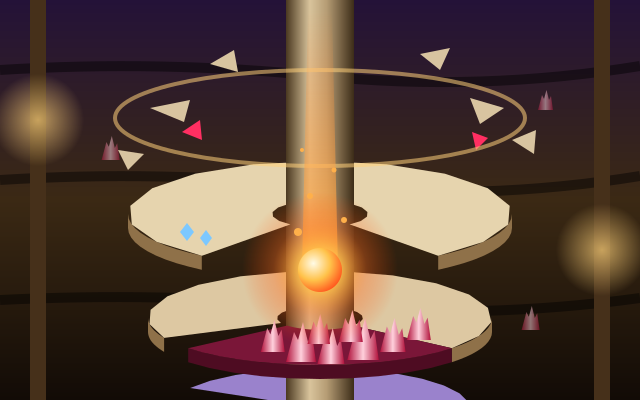
Rather than trying to capture the sterile, physical reality of an arcade machine, the game leans heavily into the impossible possibilities of software. It presents players with a single, massive, three-tiered vertical playfield styled as a gothic cathedral. It is a playground of dark fantasy, populated by skeletal warriors, demonic priests, and a massive, shifting sorceress boss at the table’s apex. Yet, instead of merely updating a classic formula with high-definition assets, the developers fused traditional silverball mechanics with the frantic, overwhelming patterns of a Japanese shoot-‘em-up (SHMUP) and subtle hack-and-slash scoring loops.
Positioned in the market as both a love letter to the Sega Genesis era and a modern mechanical evolution, the game represents a highly focused, premium arcade experience. It does not waste time with dozen-table packs or nickel-and-diming downloadable content. Instead, it places all its bets on a single, hyper-focused vertical gauntlet that challenges reflexes, spatial awareness, and endurance.
Key features
- Three-Tiered Gothic Cathedral Table: A single, massive vertical playfield divided into distinct zones, each featuring its own bumper arrangements, ramps, drop targets, and unique bosses that require specific tactical approaches to defeat.
- Shoot-‘Em-Up (SHMUP) and Magic Systems: Enemies and bosses actively fire intricate bullet hell patterns across the playfield. Players utilize an offensive magic system to absorb or convert these hazardous energy spheres into homing projectiles and high-value gold multipliers.
- Cryptic Dark Rituals and Multiball: A complex scoring system built around completing hidden objectives—such as lighting specific runes, chaining ramp shots, and surviving intense multiball modes that escalate the table’s difficulty to feverish heights.
Analysis
Demon’s Tilt is not a game about passive survival; it is an active, aggressive combat sport where the ball is the primary weapon. Standard pinball rules still apply—flipping, aiming for ramps, managing ball-save timers, and nudging the table to alter the ball’s trajectory. However, the minute-to-minute gameplay loop operates on a plane of intensity that traditional pinball cannot touch.
The Gameplay Loop
The three-tiered structure of the cathedral behaves like a multi-stage boss gauntlet. The bottom tier acts as a high-stakes survival zone where mistakes are punished by immediate drain, but it also hosts minor targets that feed the table’s overall multiplier. The middle tier introduces complex ramp networks and secondary bumpers, while the top tier serves as the primary arena for boss encounters. Ascending these tiers requires precise, deliberate shots, and staying there demands an intuitive understanding of the game’s physics engine. WIZNWAR has built a physics model designed to feel heavy, tactile, and predictable. The ball does not slide or glide floatily; it rolls with convincing friction, rebounding off rubber posts and metal guides with mechanical accuracy. That reliability is critical, because Demon’s Tilt asks players to perform split-second micro-adjustments while dodging a screen filled with glowing hazards.
Risk, Reward, and Bullet Deflection
The defining idea of Demon’s Tilt is how it integrates bullet-hell mechanics. Bosses and roaming enemies do not just block shots; they actively retaliate, spewing dense rings of magenta and cyan bullets across the board. If the ball strikes these bullets, it slows down, losing momentum and threatening to drop down an unpredictable trajectory. To counter this, the game introduces a unique magic system. By activating specific targets, players charge an offensive aura. This aura converts enemy fire into homing missiles that damage bosses, or into lucrative gold bonuses that skyrocket the multiplier.
This mechanic completely upends traditional pinball strategy. In a standard machine, the eyes are glued to the ball. In Demon’s Tilt, players must develop a form of tactical strabismus—tracking the high-speed ball with one eye while evaluating the encroaching bullet patterns and boss vulnerability states with the other. The cognitive load is immense, but the payoff of executing a perfect sequence is substantial. A single multiball mode, a “Dark Ritual” lighting the runes across the entire table, and a shield devouring a cluster of enemy bullets can send the score tally ballooning by hundreds of millions of points in a matter of seconds.
The Friction of High-Score Obsession
The game’s scoring system is deeply cryptic. The instructions provided within the menus offer only superficial explanations of the “Dark Rituals.” For casual players, achieving a high score is likely to feel like an exercise in accidental trigger-pulling rather than calculated execution—the design invites massive score multipliers and multiball modes to trigger without a clear indication of which sequence of ramp shots or target completions initiated them. While this mystique mirrors the enigmatic design of 1990s arcade cabinets, modern players accustomed to transparent design patterns may find the onboarding ramp needlessly steep.
Visuals & performance
Visually, Demon’s Tilt is a triumph of modern retro design. The game employs gorgeous, hyper-detailed pixel art that evokes an idealized memory of a high-end Amiga or Sega Genesis title, augmented by modern particle systems, dynamic lighting, and screen-shake effects. The dark, occult aesthetic is beautifully realized, with every gargoyle, sigil, and skeletal warrior animated with fluid precision.
The audio design is equally impressive. Composer Sam “Hypnospace” LGL delivers a driving, FM-synth heavy metal soundtrack that channels the best of the Yuzo Koshiro era. The screeching synths, thumping basslines, and crisp percussion match the breakneck speed of the gameplay.
But this aesthetic fidelity introduces the game’s most significant flaw: visual noise. With three balls on the screen, dozens of enemy bullet patterns, exploding particle effects, and flashing neon runes all triggering simultaneously, tracking the silver ball becomes an exercise in visual triage. The design allows moments where a ball can be completely obscured by an explosion of gold coins or a cluster of enemy projectiles. It is a frustrating compromise where aesthetic maximalism actively collides with mechanical precision.
Platform nuances
On PC (Steam), Demon’s Tilt is a 2D game of modest scope, and its high-speed motion is well suited to high refresh rate displays, which aid in tracking target alignments. Keyboard controls are supported, but a gamepad is the natural choice for trigger-based flipper control and analog table nudging.
The Nintendo Switch port, however, is where the game finds its most natural home, primarily due to one critical feature: TATE mode (portrait orientation). By rotating the console 90 degrees, Switch players can view the entire three-tiered vertical table on a single screen without the camera needing to aggressively scroll up and down to follow the ball. This vertical layout completely transforms the gameplay experience, offering spatial awareness that makes tracking boss fights and predicting ball trajectories significantly easier. The Switch version makes minor visual compromises in particle density and resolution compared to its PC counterpart, but the structural advantage of portrait play more than compensates for the loss of graphical fidelity.
Final verdict
Demon’s Tilt is a formidable piece of design. It takes a niche, historically conservative genre and injects it with the adrenaline of a bullet hell shooter, all while maintaining the strict physical discipline that makes pinball so enduring. While its visual clutter can occasionally feel like a flashing neon flashbang, and its rules are shrouded in occult mystery, the mechanical loop delivers constant, fast-paced satisfaction. It is a beautifully crafted tribute to the 16-bit era that stands tall as a strong, distinctive arcade achievement on its own merits—and one we recommend with real reservations about its readability and onboarding.
Reviewed by the Rankeno Action Desk. Scores are out of 10; the overall score is the desk’s editorial judgement, informed by the four sub-scores above. How we review