

Bottom Line: A punishing, ultra-low-resolution odyssey that demands absolute mastery and rewards the curious with some of the deepest secrets in modern gaming.
To understand Environmental Station Alpha, you have to understand the tension between its movement mechanics and its world design. The "loop" follows the standard genre tenets—find a barrier, find a power-up, return to the barrier—but the execution is significantly more friction-heavy than its peers. The grapple hook is the standout tool here. It isn't a simple tether; it’s a pendulum. Mastering the swing—knowing exactly when to release to clear a spike pit or reach a hidden ledge—becomes a second language. This isn't "quality of life" movement; it’s a mechanic you have to fight until you eventually harmonize with it.
The Gatekeeper: Difficulty as Design
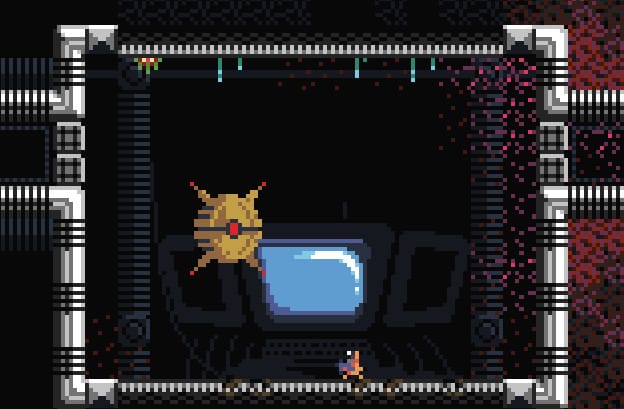
The difficulty in ESA isn't a byproduct of poor balancing; it is the core design philosophy. The game employs a "show, don't tell" approach to its hazards. You will die because you didn't see a trap, or because you didn't realize a specific enemy had a second phase. While some might call this unfair, it builds a genuine sense of vulnerability. In a genre where you eventually become a god-like engine of destruction, ESA keeps you grounded. Even with late-game weaponry, the environment remains hostile. The bosses act as hard gates, requiring dozens of attempts to parse their logic. If you lack patience, the frustration will be terminal. However, the feeling of finally downing a boss that has killed you 40 times is a rush that few modern "accessible" games can replicate.
The Secret War
Beyond the combat lies the game's true brilliance: its secrets. ESA is obsessed with the hidden. It starts with invisible walls and breakable tiles, but it eventually evolves into a complex web of cryptography and environmental manipulation. There are entire zones, bosses, and story beats that 90% of players will never see without a guide. This isn't just "bonus content"; it's a parallel narrative. Teikari challenges the player to look past the low-res pixels and interpret the station's glitches as clues. It turns the player into a digital archaeologist.
The soundtrack by Roope Mäkinen is essential to this experience. It’s an ambient, haunting score that prioritizes mood over melody. It reinforces the isolation of the station, shifting from oppressive silence to frantic, pulse-pounding synths during boss fights. It avoids the "chiptune" cliches, opting instead for a soundscape that feels truly alien.