Overview
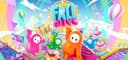
Some games win you over with mastery. Fall Guys wins you over with failure. Developed by Mediatonic and released on August 3, 2020, now firmly under the Epic Games umbrella, this is a massively multiplayer party royale that took the battle-royale template — dozens of players in, one player out — and stripped it of everything grim. No guns. No loot tables. No sweaty tactical crouching. Just wobbly, jellybean-shaped avatars pinballing through candy-colored obstacle courses until, through some combination of skill and pure slapstick luck, one of them grabs a crown.
Launched as a paid title, Fall Guys made a big splash on release, becoming a streaming phenomenon almost overnight. The reason wasn’t depth — it was legibility as entertainment. Watching someone eat a giant rotating beam and cartwheel off a platform is funny from either side of the screen. That’s a rare property. The later pivot to free-to-play, coupled with full cross-platform support, was the smart structural move: it removed the price of admission from a game whose entire pitch is “come mess around with your friends.”
Market-wise, Fall Guys occupies a specific and valuable niche. It’s the anti-tryhard live-service game. Where Fortnite and Warzone demand reflexes and commitment, Fall Guys demands a minute of attention and a tolerance for chaos. It sits comfortably in the same social slot as Mario Party or Jackbox — the game you boot up on a voice call when nobody wants to think too hard. Mediatonic has kept the machine fed with seasonal content, battle passes, limited-time events, and a steady drip of franchise collaborations, plus a Creative mode that hands course-building tools to the community. It’s a lighthearted, accessible, replayable package. It’s also, increasingly, a storefront wearing a game costume — and that tension defines the current experience.
Key features
- Party Royale Format: Dozens of players compete across successive elimination rounds — races, survival gauntlets, team games, and a nerve-shredding final showdown — until a single winner claims the crown.
- Physics-Driven Chaos: The intentionally floppy, unpredictable ragdoll physics are the whole point. Diving, jumping, and grabbing turn every round into slapstick, where a spectacular wipeout is as memorable as a win.
- Full Cross-Play & Cross-Progression: Play and shared progress across PC and Nintendo Switch via the Epic Games ecosystem — your beans and unlocks travel with you.
- Deep Cosmetic Customization: Costumes, colors, patterns, and emotes, refreshed constantly through battle passes and high-profile brand collaborations.
- Creative Mode: A course editor lets players design, publish, and share custom obstacle gauntlets, extending the game well past its stock round rotation.
Analysis
The Gameplay Loop
The core loop is almost aggressively simple, and that simplicity is engineering, not laziness. A match funnels a full lobby of beans through a shrinking sequence of rounds. Each round is a hard cut — qualify or go home — so the stakes ratchet with every stage. Matches are built to be brief, often only a few minutes. That short session length is the secret weapon. Lose in round one and there’s no time to get annoyed; you’re already queuing again. The failure state costs you almost nothing, which is precisely why the game is so easy to keep playing.
The rounds themselves split into recognizable buckets. Races are the purest test — courses like the iconic collapsing-tile runs reward memorization and clean movement. Survival rounds turn the floor into a threat, forcing you to stay upright while hammers, fruit, and swinging obstacles try to launch you into the abyss. Team games like Egg Scramble are the wild cards, and honestly the weakest link — your fate gets chained to strangers who may or may not understand which way to run. And then the finals, where a handful of survivors grab for a single crown, and the physics engine decides who gets to feel like a genius.
The grab mechanic is what makes these courses more than simple obstacle runs. You can seize other players, ledges, and objects — which means Fall Guys is quietly a game about interference. A well-timed grab can yank a rival off a moving platform at the finish line. It’s petty. It’s hilarious. It introduces just enough player-versus-player malice to keep the chaos from feeling scripted. This is where the game finds its emergent comedy: the systems collide in ways no designer fully authored.
Where the Loop Frays
The honest critique: variety has a ceiling. The round pool is large but finite, and the same courses recur. The novelty that makes round one delightful curdles into mild déjà vu with repetition. Fall Guys is a sprinter’s game masquerading as a marathon. In short bursts it shines; as a grind, the seams show — the RNG of team games starts to feel unfair rather than funny, and much of your success or failure was never really in your hands.
There’s also a control-skill paradox baked into the design. The floppy physics are the joke, but they’re also the frustration. When a loss comes from the engine hiccuping and a bean sliding off a ledge it should have cleared, the same chaos that generates the laughs generates the grievance. Mediatonic walks this line deliberately, and mostly successfully — but competitive-minded players, the ones chasing crowns rather than laughs, will feel the imprecision most acutely. It’s a party game that sometimes forgets it isn’t a precision platformer, and a precision platformer that keeps remembering it’s a party game.
The Live-Service Machinery
Underneath the fun sits a modern live-service engine, and this is where opinions fracture hardest. The onboarding friction is basically zero — free to download, instantly understandable, no manual required. But the retention systems that follow are relentless. Battle passes, seasonal grinds, event challenges, and a cosmetic store priced with real ambition. The costumes are genuinely charming and the collaborations are a real draw. The problem is the price of participation in the game’s own self-expression. More on that below, because it’s the single biggest asterisk on the whole experience.
Visuals & performance
The art direction is the game’s undersold strength. Fall Guys looks like a children’s game show as designed by someone with impeccable taste — soft gradients, bouncy proportions, a palette that pops without screaming. The beans are inherently expressive; a stumbling jellybean is funnier than any scripted animation could be. This is character design doing narrative work for free.
The UI is clean and readable, which matters when you’re parsing a full-lobby scramble at a glance. Round intros telegraph the rules quickly. Menus are bright and navigable, if increasingly crowded by store promotions.
A physics game synchronizing a lobby full of colliding bodies is a demanding netcode problem, and the design leans on fast, stable connections — when latency creeps in, a grab that doesn’t register or a rubber-banding rival can decide a final. That’s inherent to the genre rather than a flaw unique to Fall Guys, but in a game this twitchy, the exceptions sting.
Platform nuances
On Steam, Fall Guys is at its best. Mouse-and-keyboard or controller both work, and a 2D-scope game like this is light on hardware, so most PCs have headroom to spare — you’re rarely fighting the tech instead of the course. This is the reference experience.
On Nintendo Switch, the story is more compromised. The pick-up-and-play, short-session design is a perfect fit for handheld and couch play — this is arguably the most natural context the game has. But you pay for it in fidelity: a portable-class machine runs a physics-heavy lobby with a softer image and less responsive feel than a gaming PC. For a party game on the sofa with friends, that trade is easy to accept. For anyone chasing crowns competitively, the Switch is the casual seat, not the driver’s chair. Cross-play and cross-progression paper over the gap admirably — your beans and unlocks follow you between platforms — so most players will simply pick the screen that’s closest and not think twice.
Final verdict
Fall Guys understands something most live-service games forget: fun doesn’t have to be earned through suffering. It’s a game where losing is often as good a story as winning, where a wobbling jellybean carries more comedic charge than a photorealistic soldier ever could. Mediatonic built a nearly frictionless engine for shared, low-stakes joy, and the free-to-play pivot was the right call to get it in front of everyone.
The reservations are real and they’re structural. The monetization is pushier than the game’s cheerful surface lets on, the round variety can’t quite sustain marathon sessions, and the physics that generate the laughs also generate the losses that feel cheap. This is a game best consumed in doses — a sprint, not a lifestyle. We rate it a Good: recommend it to the right audience, on those terms, with the cosmetics store ignored — and Fall Guys remains a reliably fun way to fall on your face in front of a lobby full of strangers.
Reviewed by the Rankeno RPG & Adventure Desk. Scores are out of 10; the overall score is the desk’s editorial judgement, informed by the four sub-scores above. How we review