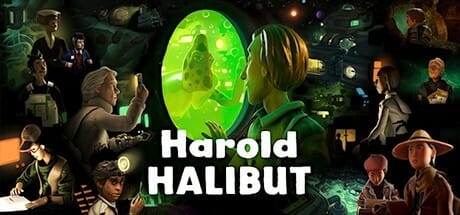

Bottom Line: A visually staggering achievement in digital stop-motion that often forgets to be a game, trading mechanical depth for a meditative, clay-sculpted soul.
To understand Harold Halibut, you must first reconcile with its glacial pacing. If your metric for a successful game is "actions per minute," you will find this experience agonizing. However, if you view it as a living gallery of art and character study, the friction changes.
The Harold Hustle
The core gameplay loop consists almost entirely of navigation and dialogue. Harold spends a significant portion of his day running—or more accurately, jogging at a polite pace—across the Fedora. You will spend hours traversing the "All-Tube" transit system, moving from the Central Station to the Social District to the Lab and back again. There are no traditional puzzles here. You won't be combining a rubber chicken with a pulley to bypass a guard. Instead, you are a participant in a social simulation.
This is where the game earns its "authoritative" badge and its most significant critique. The "fetch quest" is the backbone of the Fedora's economy. Harold is constantly sent to deliver a message, fix a filter, or find a person. While this reinforces his role as a low-level assistant, it creates a repetitive strain on the player’s patience. The game asks you to care about the journey more than the destination, but when the journey is your tenth trip through the same fluorescent hallway, the aesthetic wonder begins to fray at the edges.
Narrative Resonance vs. Mechanical Inertia
The writing is where the game finds its heartbeat. The dialogue is witty, idiosyncratic, and voiced with a level of care that puts most AAA titles to shame. The relationship between Harold and the alien he eventually discovers—a catalyst for the ship’s possible departure—is handled with a delicate touch. It avoids the "save the world" clichés, focusing instead on how this discovery disrupts the settled, comfortable malaise of the Fedora’s residents.
However, there is a distinct ludo-narrative dissonance in how Slow Bros. handles player agency. By removing mechanical challenge, the developers have streamlined the experience, but they’ve also stripped away the tension. When Harold is tasked with a "critical" scientific task, it usually involves holding down a single button or walking to a specific hotspot. There is no risk of failure, which means there is rarely a sense of accomplishment. The game is a passenger on its own rails.
The Social Fabric
Where Harold Halibut succeeds most profoundly is in its world-building. The Fedora feels lived-in. You’ll meet a family that runs a ski-shop in a world without snow, a lonely postmaster, and a troupe of performers clinging to the culture of a dead Earth. These interactions aren't just fluff; they are the point. The game excels at capturing the mundane beauty of a stagnant society. It asks heavy questions: Is it better to be safe in a cage or free in a toxic void? By the time the credits roll, you don't care about the physics of the Fedora; you care about whether Harold finally feels like he’s enough.