Overview
Demagog Studio has a specialty, and it is the beautiful end of the world. The Croatian outfit behind The Cost of Recreation and the eerie diorama-toy Golf Club: Wasteland clearly can’t stop picking at the scab of climate collapse—and the results render a drowned civilization with real melancholy charm. Highwater is their most ambitious swing yet: a story-driven road trip across a flooded near-future, refracted through turn-based skirmishes and a soundtrack that thinks it’s a late-night radio station.
The premise follows Nikos, a young survivor navigating the submerged region of Highwater by boat, assembling a ragtag crew as he chases a rumor with real teeth: that the wealthy are quietly fleeing the ruined planet for Mars. The destination is the fortified city of Alphaville. The journey is the point. Along the way, Highwater does what Demagog does best—it uses the wreckage of consumer civilization as a punchline and an elegy at the same time. Half-sunk billboards, waterlogged big-box stores, and the detritus of a species that shopped its way into extinction.
The game arrived first as a Netflix Games mobile exclusive before paddling onto Switch, PlayStation, Xbox, and PC, released March 14, 2023. That launch strategy matters. This is a title engineered, from the ground up, for the bite-sized, low-friction sensibility of mobile play—and its ambitions and its compromises both flow from that origin.
Market-wise, Highwater slots into the crowded but beloved lane of the cozy-adjacent narrative adventure: think Citizen Sleeper by way of Wilmot’s Warehouse, with a dash of The Flame in the Flood. It is not competing with XCOM. It never wanted to. Whether that’s a feature or a bug depends entirely on what a player came for.
Key features
- Story-First Climate Satire: A road-trip narrative about hope, community, and survival, built on sharp environmental satire and a cast of distinct, well-drawn characters.
- Light Turn-Based Combat: Puzzle-flavored, grid-based skirmishes designed to reward positioning and improvisation over raw stats—deliberately gentle, and rarely a real threat.
- The ‘Pirate Radio’ Soundtrack: An original, in-fiction radio station with live musical performances that functions as the game’s beating heart and its best world-building tool.
- Boat-Based Exploration: Drifting between rendered “urban islands,” scavenging supplies and unraveling the mystery behind the Mars exodus.
- Distinctive Low-Poly Art Direction: A hand-crafted, diorama-like aesthetic that turns catastrophe into something worth framing and hanging on a wall.
Analysis
The Gameplay Loop
Highwater’s rhythm is simple: sail, scavenge, talk, occasionally fight. Nikos’s boat crosses flooded expanses, docking at islands—the crowns of skyscrapers, the roofs of malls, the last dry inches of a world gone under. There are supplies to poke through, people to meet, banter to trade. Then, when the story demands friction, the game drops into a turn-based encounter.
That loop is where Highwater’s mobile DNA is most visible. Everything is built to be picked up, played for fifteen minutes, and put down. The exploration is breezy rather than deep—there’s no punishing survival management, no resource anxiety between fights. Scavenging is more about texture and discovery than mechanical stakes. It’s a stroll, not a grind, and it works because the world it strolls through is so worth looking at.
Combat: The Oar That Keeps Slipping
Here’s the honest part. The turn-based combat is Highwater’s most-discussed weakness, and the criticism is earned. On paper, the pitch is appealing: skirmishes that reward clever positioning, environmental interaction, and improvisation over brute damage output. The design asks players to think laterally—use the terrain, exploit an angle, solve the fight like a small puzzle rather than winning a stat war.
But the puzzle rarely bites back. The encounters are light, forgiving, and repetitive by design. The tactical vocabulary is thin—once the handful of enemy types and the tricks that beat them are on the table, most fights resolve on autopilot. There’s little escalation, little pressure, and almost no failure state to fear. For players raised on the exquisite cruelty of Into the Breach or the granular calculus of XCOM, this will read less like combat and more like a formality cleared to reach the next scene.
And that’s the crucial caveat: Demagog knows this. The combat isn’t the meal; it’s the palate cleanser. It exists to punctuate the narrative, to give hands something to do between story beats, not to test strategic mettle. Judged as a tactics game, it’s mediocre. Judged as narrative connective tissue, it’s passable, if forgettable. The verdict depends hard on which of those two rulers is applied.
Writing and Character: The Real Engine
Strip away the combat and Highwater’s true engine comes to life: the writing. The satire is dry, specific, and occasionally mean in the best way—it skewers the fantasy of billionaire escape-hatch survival with a wit that never tips into lecturing. Nikos’s crew are the standouts, a collection of distinct voices whose chemistry carries long stretches of downtime. The dialogue does the heavy lifting that the mechanics can’t, and it’s strong enough to justify the ride.
The narrative does hit pacing dips, though. The middle stretch sags as the road-trip structure repeats its beats, and the mystery’s momentum occasionally stalls between destinations. These are the seams of an ambitious indie reaching slightly past its grasp—forgivable, but real.
Interface
The UI is clean and mobile-legible, with large touch targets and an uncluttered HUD that keeps the art front and center. It’s functional to a fault—rarely elegant, never in the way. Built for small screens, it can feel a touch spartan on a 55-inch TV.
Visuals & Audio
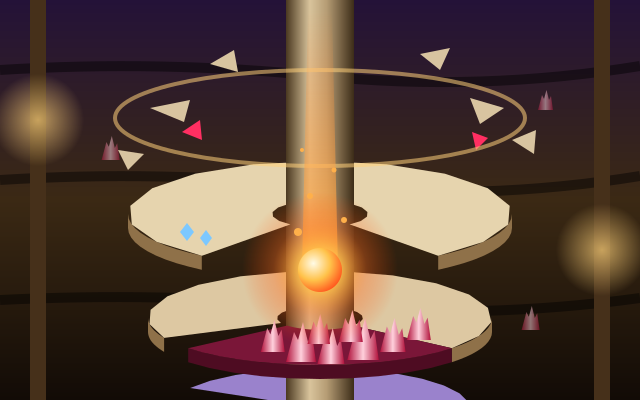
This is where Highwater stops being merely good and becomes special. The low-poly art direction is stunning—not “impressive for an indie,” just genuinely beautiful. Demagog builds its drowned cities like handcrafted miniatures, each island a self-contained diorama of decay lit with a soft, melancholy glow. There’s a painterly restraint here that makes the catastrophe feel intimate rather than spectacular.
The Pirate Radio soundtrack deserves its own paragraph. Original music, performed live within the fiction, threading through the whole experience like a signal worth tuning into. It does more world-building in a single track than a dozen lore dumps could manage. It’s the rare game score that would hold up in a playlist outside the game.
As for performance, a stylized 3D title of this scope is light on hardware by design—the low-poly aesthetic is a smart engineering choice that keeps the demands modest on everything from a phone to a mid-range PC.
Platform nuances
Highwater was born on mobile, and it shows in the best and most limiting ways.
- iOS / Android (Netflix Games): This is the native habitat. The touch controls for boat navigation and grid combat are designed for fingers first, and the bite-sized loop is tailor-made for commutes and couch sessions. The mobile versions carry the game’s strongest store rating—4.7 out of 5 from 479 ratings—and the design and the device are in sync. With a Netflix subscription, this is the frictionless, no-extra-cost way in.
- Steam (PC): Mouse-and-keyboard maps cleanly onto the point-and-click exploration and tactical grid—arguably the most comfortable way to appreciate the art on a big display. But on PC the thinness of the combat is more exposed; sitting down at a desk invites an expectation of depth the game doesn’t offer. The $6.99 price buys a story and a mood, not a tactics game.
- Nintendo Switch: A natural fit. Handheld mode recaptures the intimate, portable feel of the mobile original, and the docked option scales up the visuals nicely. Controller navigation of the grid is inherently less direct than touch, though the design accommodates it.
The through-line: the smaller and more casual the session, the better Highwater is built to feel. Sit down expecting a marquee console tactics experience and the seams show. Pick it up for twenty minutes on a phone and it’s close to ideal.
Final verdict
Highwater is a game to be experienced, not conquered. Demagog Studio has built a drowned world so lovely, so wickedly observed, and so beautifully scored that its mechanical shortcomings feel almost beside the point—almost. The combat is the price of admission, not the reward, and the sagging middle stretch tests patience along the way. For most players, that trade is too steep to recommend outright. But for those who prize story and mood over mechanics, what’s on the other side is one of the more atmospheric and quietly poignant road trips in recent memory. It doesn’t reinvent anything. It doesn’t need to. It just needs a slow pace, a tuned radio, and a willingness to drift. On mobile, that’s an easy case to make. On console and PC, go in knowing the money buys a story and a mood—and decide accordingly.
Reviewed by the Rankeno Action Desk. Scores are out of 10; the overall score is the desk’s editorial judgement, informed by the four sub-scores above. How we review