
Overview
There’s a familiar tell in indie RPG pitches: “It’s like Paper Mario meets Final Fantasy Tactics.” Nine times out of ten, that means someone bolted a timed button prompt onto a damage formula and called it innovation. Ikenfell is the tenth time. Happy Ray Games — led by Chevy Ray Johnston, a developer better known in dev circles for the Flashpunk framework than for shipping games — spent the better part of six years turning that elevator pitch into an actual design thesis, and it largely holds up.
Released October 8, 2020 into a crowded RPG window, Ikenfell landed in a strange critical position it still occupies. Professional critics were measured — Metacritic sits around 69 — and that lukewarm reception tells much of the story. Ikenfell is not built to impress someone playing it for eight hours on a review deadline. It’s built for the person who bounces off the third boss, comes back, learns the timing, and finds out the difficulty was the point.
The setup is comfort food. Maritte, an ordinary girl with no magic, discovers she has some anyway, and marches off to Ikenfell — a sprawling school of magic — to find her missing sister. You’ve read this before. What you probably haven’t read is where it goes: a twist-heavy story about friendship, trust, love and loss, told through a cast that is genuinely, casually inclusive rather than performatively so. The queer characters here aren’t a marketing bullet. They’re just people with problems, written by someone who bothered.
Positioned against the tactical RPG establishment, Ikenfell is a scrappy outsider with one novel mechanic and a soundtrack — from aivi & surasshu, the composers behind Steven Universe — that stands well above its budget. It also occasionally punches you.
Key features
- Timing-Based Combat, No MP: All 48 spells have their own individual timing challenge. Nail the input and your attack powers up. Nail the defensive input and you block incoming damage. There is no MP economy to hoard, which means there is nowhere to hide behind resource management — you either execute or you don’t.
- Isometric Grid Positioning: Movement and range matter. Every spell has a distinct footprint on the board, so turns become a negotiation between where you need to stand and what you can actually reach from there.
- Six Characters, Three Slots: You field a party of three from six playable characters, each with clearly divergent kits. The bench isn’t decoration — swapping is a real strategic lever, especially against the 22 boss battles.
- A Dense, Secret-Stuffed School: Over 100 collectible items hidden across the school’s twisted halls, plus 100+ enemies to catalogue. The exploration is old-school “poke every wall” design.
- The aivi & surasshu Soundtrack: The most consistently praised element of the package, and deservedly so.
Analysis
The Gameplay Loop
Strip Ikenfell down and you find a very deliberate argument: skill should be a resource, not mana.
Traditional turn-based RPGs are attrition puzzles. You have X magic points, the dungeon has Y encounters, and the “strategy” is arithmetic performed in advance. Ikenfell deletes that arithmetic entirely. Your spells are always available. What limits you is whether you can hit the timing window on each one — and every spell has a different window, a different rhythm, a different physical ask. The fire spell isn’t the ice spell with a recolor. It’s a different instrument.
This does something clever to the pacing of a turn. In most tactical RPGs, once you commit to an action, you’re a spectator; the animation plays and the number appears. Here, committing is where the work starts. You choose the tile, you choose the spell, and then you have to perform it. The result is a combat system with almost no dead air — the gap between decision and consequence, the latency that makes so many turn-based games feel like spreadsheet maintenance, is filled with actual input.
The defensive half is where the design earns its keep. Blocking incoming damage on a timed input means enemy turns aren’t downtime either. You’re reading tells, watching wind-ups, and tapping. A boss fight in Ikenfell keeps you engaged on both sides of the initiative order, which is more than can be said for a lot of far more expensive games in this genre.
Where It Bites
The design’s honesty is also its cruelty. Because timing replaces MP, there’s no “grind two more levels and tank through it” release valve — or rather, there is, but it doesn’t help nearly as much as muscle memory does. When players hit a wall in Ikenfell, the wall is usually themselves, and the game is not always gracious about telling them so.
The boss difficulty spikes are legitimate. Twenty-two bosses is a lot of bosses, and the curve between them is jagged rather than smooth. Some are exquisite: a positioning puzzle wrapped around a timing test, where the solution clicks. Others land as a check on whether you happened to build the right party twenty minutes ago, and the retry loop punishes experimentation more than it should.
The timing windows are tight enough to be unforgiving, and this is where the critic-versus-player split becomes legible. They demand attention. Played tired on a couch, half-watching something else, Ikenfell will feel like it’s fighting you — because it is. That’s a defensible design choice, but it’s a choice with a cost, and the cost is measured in bounce rate.
Pacing and Structure
The middle chapters sag. This tracks with the structure: Ikenfell front-loads its novelty (a new spell system! a mystery! a school!) and back-loads its emotional payoff (the twists, the resolutions), which leaves a stretch in the middle that’s mostly executing a loop you already understand in halls that blur together. It’s the classic mid-game problem of a game that has more story than it has mechanical escalation. The 100+ collectibles are clearly meant to be the connective tissue here, and for players who like combing rooms, they work. For everyone else, that’s the stretch where momentum drains.
Visuals & performance
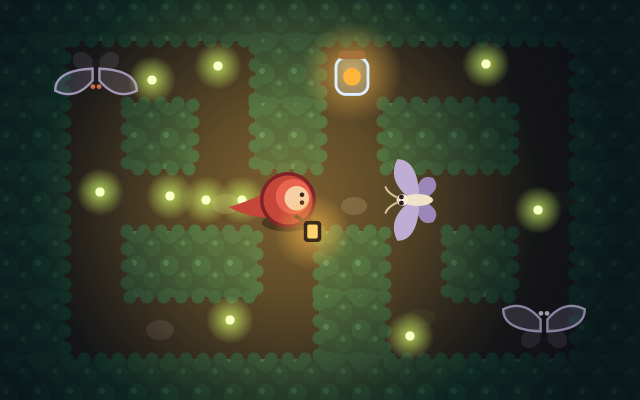
The pixel art is detailed and confident, which is not the same as being flashy. Happy Ray Games isn’t chasing the hyper-dense, particle-soaked pixel look that dominates the current wave — this is cleaner, warmer, more legible. That legibility is not an accident. In a game where you need to read an isometric grid, a spell’s footprint, and an enemy’s wind-up animation all at once, clarity is a mechanic. The art direction understands that.
The school itself is the standout environment work: Ikenfell’s halls twist, and the game is good at making a magic academy feel both cozy and quietly wrong. The cats — and there are many — do more for the tone than any amount of exposition could.
The soundtrack is the strongest element and it’s not close. aivi & surasshu bring the same jazz-inflected, emotionally precise chiptune-adjacent sensibility that made Steven Universe work, and their music carries scenes the pixel art alone couldn’t. This is a score that would be a selling point on a game with ten times the budget.
As a 2D indie RPG of this scope, it’s light on hardware by design, and the pixel-first art direction leaves little room for technical trouble on either platform. The UI is functional rather than beautiful; it stays out of the way, which for a timing-critical game is exactly the right ambition.
Platform nuances
Nintendo Switch is the definitive version, with an asterisk. Ikenfell is a controller game in its bones. The timing inputs are single, rhythmic button presses — a design that wants a d-pad and a face button, not a keyboard. Handheld play in a game with tight windows and a portable-friendly encounter length is close to ideal, and the chapter structure fits commute-sized sessions well.
The asterisk: display latency on Switch — and, docked on a TV with post-processing enabled, additional input lag — can make tight timing windows harder. If the timing feels unfair on Switch docked, check your TV’s game mode before you blame the game. That’s not Ikenfell‘s fault, but it’s Ikenfell‘s problem.
On Steam, we’d push anyone toward a controller. Keyboard timing works; it just doesn’t feel as good, and “feel” is most of this combat system. The PC version’s advantages are the ones you’d expect: higher resolution for the pixel art and the ability to alt-tab out and look up which spell timing you keep whiffing.
Final verdict
The gap between the critical reception and the game’s reputation deserves a straight answer, so here it is: this is a game that gets better the longer you stay with it, which is precisely the quality a review cycle is worst at measuring. Its combat system is a real idea — not a gimmick, not a garnish, but a load-bearing argument about what a turn should feel like — and it mostly works.
It is not flawless, and the flaws matter. The boss curve needed another pass, the middle third needed a trim, and the timing windows needed just a few more frames of grace for the players who wanted in but couldn’t get their hands to cooperate. These aren’t small complaints; they’re the difference between a good game and a great one.
But Happy Ray Games swung at something specific and mostly connected. In a genre where the safe move is to reskin a system that shipped in 1995, that counts for a great deal. We recommend it to players willing to meet it on its terms: play it on a controller, turn on your TV’s game mode, and give it until chapter three.
Reviewed by the Rankeno RPG & Adventure Desk. Scores are out of 10; the overall score is the desk’s editorial judgement, informed by the four sub-scores above. How we review