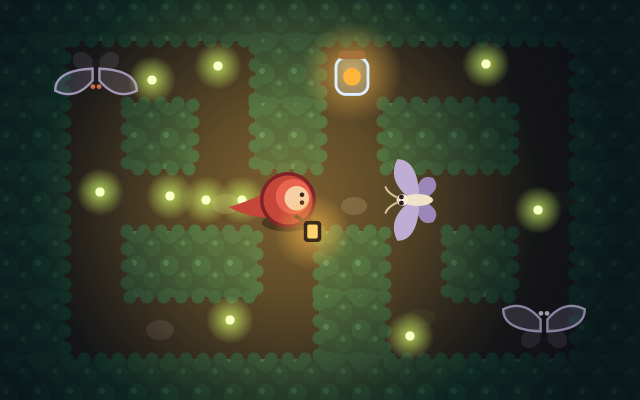
Overview
The “cat simulator” isn’t a new concept, but it has undergone a transformation in the last few years. The genre has moved past the janky physics memes of the early 2010s into something more refined. If BlueTwelve Studio’s Stray was the moody, cyberpunk meditation on feline isolation, Double Dagger Studio’s Little Kitty, Big City is its bright, caffeinated, and mischievous cousin. Developed by a team led by Valve veteran Matt T. Wood, this is a tightly scoped, mechanically sound exploration of a Japanese-inspired metropolis through the eyes of a black cat with a singular goal: get back to the high-rise apartment it just tumbled out of.
Market positioning here is clever. It taps into the “cozy game” zeitgeist without sacrificing the agency that makes sandbox games actually fun. You spend your time navigating a 3D space that treats every trash can, balcony, and unsuspecting human as a platform or a plaything. The developer understands that the appeal of being a cat comes down to the autonomy of being a jerk. You trip pedestrians, steal their bagels, and swipe their phones, all while wearing a frog hat. It’s a low-stakes power fantasy that replaces “game over” screens with a nap in a sunbeam. While the indie scene is currently crowded with wholesome simulators, Double Dagger Studio manages to stand out by focusing on kinetic satisfaction over mindless fetch quests. It’s a short experience, certainly, but one that values the player’s time, offering a dense, vertical playground rather than a sprawling, empty map.
Key features
- The Feline Sandbox: A fully traversable, Japanese-style city block built for verticality and exploration without the threat of combat or death.
- Kinetic Interaction: A physics-based system allowing you to swipe items, trip humans, and pounce into boxes with animations designed to feel weighted and intentional.
- The “Shiny” Economy: A progression system tied to gathering recycled cans and lost items for a crow, which in turn unlocks the “Gacha” machines stocked with a generous supply of cosmetic hats.
- Stamina Progression: A light RPG element where consuming fish—the city’s hidden treasures—permanently increases climbing ability, gated by exploration milestones.
Analysis
The core appeal of Little Kitty, Big City lies in its ludic loop: exploration leads to mischief, mischief leads to “shinies,” and shinies lead to hats. But to describe it so clinically does a disservice to the design. Most developers struggle with 3D platforming—making jumps feel precise while maintaining a sense of momentum. Double Dagger Studio addresses this by leaning into feline agility. The jumping isn’t floaty; it’s snappy. When you aim for a ledge, there’s a magnetic “snap” that prevents the frustration of missed jumps, a design choice that prioritizes the onboarding flow for casual players while keeping the pace brisk for veterans.
The Kinematics of Chaos
The game works best when it lets you inhabit the cat’s inherent selfishness. Tripping a human doubles as a tactical move to clear a path or steal a specific item. The physics interactions are built to feel tactile. Swiping a glass bottle off a wall produces a crash that alerts nearby NPCs, creating a reactive environment. This isn’t a complex AI simulation, but the feedback loops are consistent enough to make the city feel like a playground rather than a static backdrop.
The Narrative of Distraction
While the overarching goal is to return home, the narrative is secondary to the “distraction” mechanics. The cast of animals—the business-minded Tanuki, the dramatic Beetle, the laid-back Crow—act as quest-givers, but their dialogue is punchy and devoid of the “fluff” that plagues modern RPGs. They exist to push you into different corners of the map, forcing you to engage with the environment. One moment you’re trying to find a way to stop a gardener’s hose, and the next you’re hunting for birds to “pounce” on (don’t worry, they fly away unharmed).
The Constraints of Scale
The length deserves discussion. The main path can be finished in an afternoon. At $24.99, some may find the price steep for such a brief encounter. Still, this is a case of quality over volume. The map is dense. Every alleyway has a purpose; every rooftop has a secret. In an industry obsessed with 100-hour open worlds filled with repetitive icons, there is something refreshing about a game you can complete in a single sitting and feel like you’ve seen everything worth seeing. The camera design is the weak point: in narrow crevices, the collision handling gets wonky, with the kitty clipping into geometry. It’s a minor friction point in an otherwise polished experience, but enough to remind you that this is an indie production.
Visuals & performance
Visually, the game adopts a clean, stylized aesthetic that feels like a high-end animated feature. The color palette is vibrant, using the Japanese city setting to provide high-contrast environments—neon signs against dark asphalt, lush green ivy on gray concrete. The star, however, is the animation. The way the cat stretches after a nap, the slight wiggle of the haunches before a pounce, and the frantic “zoomies” are all captured with an authenticity that suggests the animators spent months studying actual felines. Technically, a game of this scope is light on hardware, with a physics engine that can juggle dozens of falling objects without demanding much from the machine.
Platform nuances
On Steam, the game’s bite-sized objectives make it a natural fit for handheld play, and a controller is the way to go; while mouse and keyboard work, the analog precision required for some of the tighter jumps feels more natural on a thumbstick. On the Nintendo Switch, a game of this scope is light on hardware, though handheld players should temper expectations for visual fidelity compared to PC. If you have the choice, the PC version offers the fidelity these animations deserve.
Final verdict
Little Kitty, Big City is a focused, joyful piece of software that knows exactly what it wants to be and refuses to overstay its welcome. It doesn’t revolutionize the open-world genre, but it refines the “nuisance simulator” into something heartwarming. If you can stomach the short runtime, we recommend it to cozy-game fans and cat lovers looking for a well-crafted afternoon of mischief.
Reviewed by the Rankeno Strategy & Sim Desk. Scores are out of 10; the overall score is the desk’s editorial judgement, informed by the four sub-scores above. How we review