
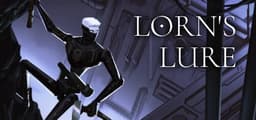
Bottom Line: A masterclass in atmospheric verticality that respects the player's intelligence by refusing to hold their hand through its gargantuan, industrial graveyard.
To understand Lorn's Lure, you must first understand the concept of spatial agency. Most first-person games treat the floor as the primary plane of existence and walls as boundaries. Rubeki Games flips this. In this world, the wall is your highway, and the floor is a distant memory. The core gameplay loop is centered entirely around your energy pickaxes. These aren't just gadgets; they are your lifeline. Scaling a kilometer-high ventilation shaft isn't a cutscene—it is a series of deliberate, precarious clicks.
The Mechanics of Verticality
The climbing mechanic is deceptively simple but grows increasingly complex as the structure’s geometry becomes more hostile. You aren't just sticking to walls; you are managing your momentum and planning your route. The "climb-anything" promise is legitimate, but it is tempered by the Mega-Structure’s indifference. You might spend ten minutes scaling a sheer face only to realize that the overhang at the top is impassable from your current angle. This is where the game’s uncompromising difficulty shines. It forces a level of environmental analysis rarely seen outside of dedicated immersive sims. You start looking for pipes, recessed panels, and structural struts not as decoration, but as vital rest stops.
Atmospheric Indifference
The narrative is sparse, delivered through environmental storytelling and the occasional "glitch" that serves as your only guide. This minimalism is critical. By stripping away the chatter of a typical AAA protagonist, Lorn's Lure amplifies the atmospheric dread of the structure. The sound design—filled with the distant groaning of metal and the hum of ancient machinery—complements the visual vastness. It captures that specific Nihei-esque feeling of being a small, biological-adjacent parasite living inside a machine that has forgotten its original purpose. The structure doesn't want to kill you; it simply doesn't know you are there.
The Traversal Evolution
As you descend (or ascend) deeper into the machine, the game introduces new tools: grappling hooks and air dashes. While some purists might argue these tools dilute the initial tension of the pickaxe-only sections, I found them to be a necessary evolution to prevent mechanical stagnation. These later stages shift the focus from slow, methodical climbing to high-stakes precision platforming. The grappling hook, in particular, adds a layer of vertical kineticism that makes the dizzying heights feel even more precarious. However, there is a legitimate critique to be made here: the introduction of these tools can occasionally lead to level designs that feel more like "traditional" platforming challenges, slightly undermining the "pure" exploration of the early chapters.
The Friction of Discovery
The "no yellow paint" philosophy is the game’s greatest strength and its most significant barrier to entry. In a market where games are often criticized for being too hand-holdy, Lorn's Lure is the corrective. It demands patience and observation. You will get lost. You will fall to your death because you misread a shadow. For the right player, this friction is the source of the game’s deepest satisfaction. Finding your own path through a seemingly impossible labyrinth provides a sense of accomplishment that a waypoint marker simply cannot replicate.


