
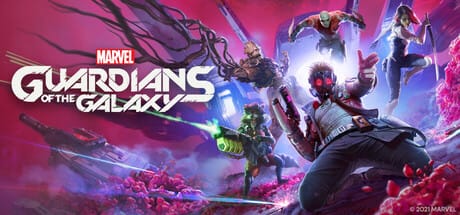



Bottom Line: Eidos-Montréal made a smart, funny, genuinely heartfelt single-player adventure that respects your time and your wallet—then watched it get buried by a market that had stopped believing in games like this. It's not perfect, but it's the rare licensed game with a soul.
The Gameplay Loop
Here's the honest truth about the combat: it takes a while to click, and some players will never fully warm to it. Early on, you're a single gun-toting Star-Lord flailing at bullet-sponge enemies, wondering where the promised depth is. Push through the first few hours and the system opens up. Once you've unlocked the full roster of teammate abilities and learned to read the color-coded enemy shields, the fights transform into a kind of frantic conducting. You're not the whole orchestra—you're the guy waving the baton, calling Groot to root a cluster of enemies, then triggering Gamora to carve through them while you reload.
It's a clever solution to a hard problem. Controlling five characters directly would be a mess; controlling none of them would be passive. By making you the field commander, Eidos-Montréal keeps you engaged with the entire squad without drowning you in inputs. When it works, it's genuinely satisfying. When it doesn't—and it sometimes doesn't—the combat leans repetitive, and later encounters recycle enemy types past the point of freshness.
Choice Without Consequence-Anxiety
The dialogue system is where the game's confidence shows. This is a talky game, unapologetically so, and the writing carries it. The branching decisions rarely fork the plot in dramatic ways—the narrative is linear, and it's honest about that—but they constantly reshape the character of your journey. Side with Rocket over Drax and you'll get a different flavor of resentment simmering across the next few scenes. Bluff your way through a negotiation and watch it pay off, or blow up in your face, later. It's low-stakes in mechanical terms but high-reward in emotional ones. You're not min-maxing an ending; you're deciding what kind of jerk Peter Quill is going to be today.
Exploration and Downtime
Between fights, the game slows into exploration—light puzzle-solving, environmental traversal, and using Star-Lord's visor to highlight paths and hidden collectibles. Let's be clear: this is the weakest pillar. The puzzles are rarely more than "find the object, point Groot at the gap." The traversal is corridor-linear dressed up in spectacular scenery. The visor-scanning is the same busywork it is in every game that borrows it from Batman's Detective Mode.
But the downtime earns its keep in a different currency: conversation. Wandering the Milano between missions, eavesdropping on the crew bickering, poking into their personal quarters—this is where the game builds the relationships that make the combat huddles land emotionally. The gameplay is the skeleton. The talking is the soul. Skip the optional banter and you're playing a lesser game.