
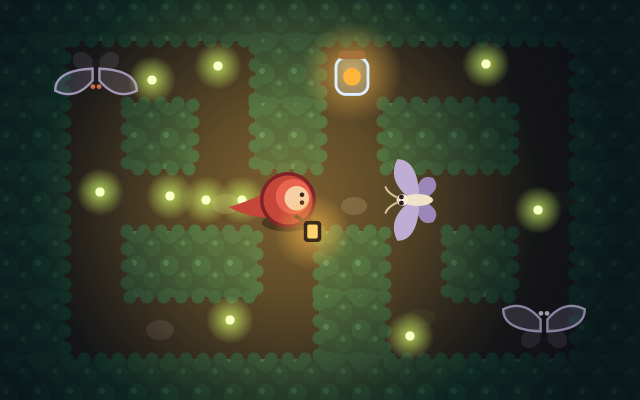
Overview
When Dene Carter, the co-creator of Lionhead Studios’ iconic Fable series, quietly released Moonring for free on Steam on September 28, 2023, it landed without fanfare. It is not a grand, high-budget cinematic production, but something far more audacious: a passion project masquerading as a long-lost Ultima-clone. Developed under the banner of Fluttermind, LLC, Moonring positions itself as a bold rejection of the modern, dopamine-fueled feedback loops that dominate today’s role-playing scene. There are no flashing quest markers, no compass lines guiding your footsteps, and no simplified talent trees designed to make players feel powerful without earning it.
Instead, Moonring plunges players into Caldera, a hand-crafted, dark-fantasy world trapped in perpetual twilight, ruled by five capricious moon gods. You play as a ‘Dreamless,’ a blank slate of a protagonist who is uniquely unburdened by the gods’ dictates. The game’s market positioning is fascinatingly hostile to modern trends: it is a free, highly complex, turn-based tile-crawler that demands patience, spatial awareness, and a willingness to take notes. Yet, far from being a dry exercise in nostalgia, Moonring acts as a striking bridge between old-school tabletop philosophy and modern roguelike design. It is a rare, uncompromising vision of what happens when a seasoned developer strips away decades of industry consensus to return to the raw, mechanical fundamentals of the genre.
In a market saturated with automated navigation and narrative handholding, Moonring stands out by refusing to apologize for its complexity. Carter has crafted a world that feels vast, indifferent, and genuinely mysterious. By releasing it entirely for free, Fluttermind bypasses the commercial pressures of monetization, delivering a pure, uncompromised artistic statement. It represents a deliberate, calculated throwback designed specifically for the disenfranchised RPG veteran who misses the thrill of genuine, unguided exploration.
Key features
- The Poise System: A tactical defense meter that completely changes the rhythm of turn-based bump combat. Players must shatter an enemy’s poise before they can inflict actual damage, turning encounters into a chess-like battle of positioning and resource management.
- A Dual-Layered World: A static, hand-designed overworld map rich with lore, secrets, and keyword-driven dialogue, paired with procedurally generated dungeons that reconfigure with every descent to keep players on edge.
- Dungeon Synth Atmosphere: A moody 50-track soundtrack that wraps the neon-on-black retro visual aesthetic in a dark, atmospheric acoustic layer, evoking a sense of dread and mystery.
Analysis
Gameplay Loop and World-Building
To understand Moonring is to understand the joy of being lost. The core gameplay loop is split between careful exploration of the hand-designed overworld of Caldera and high-stakes descents into procedurally generated dungeons. On the surface, the game behaves like a classic tabletop campaign. Players wander from town to town, speaking with NPCs who react to specific keywords typed or selected from conversations. Without quest logs telling you where to go, attention to the environment and the lore is essential. The game automatically updates a journal with clues, but the synthesis of those clues is entirely up to the player.
This makes discovery incredibly satisfying. Finding a hidden cave or decoding a cryptic rumor about one of the five moon gods feels like a personal victory, not a checklist item routed to by an algorithm. The procedurally generated dungeons below provide a stark contrast. They are lethal, claustrophobic, and demand absolute tactical focus. Descents yield loot and essence, but death is a constant, punishing threat that resets progress in that dungeon. This duality keeps the pacing fresh: the overworld offers narrative depth and safe contemplation, while the dungeons provide adrenaline-fueled tactical survival.
Combat and the Poise Mechanic
Combat in Moonring is turn-based and utilizes classic bump-combat, but it introduces an ingenious defensive layer: the poise system. Every combatant, including the player, has a poise meter that acts as a shield. As long as poise is intact, incoming damage is heavily mitigated. Once poise is broken, however, the character is vulnerable to devastating health damage. This simple twist turns the combat into a tense tactical dance instead of mindless stat-checking.
Brute force will not carry players through encounters. Success requires actively managing spacing, using the environment to break lines of sight, and deciding when to unleash powerful abilities that drain an opponent’s poise versus when to fall back and regenerate. Some weapons excel at breaking poise, while others deal massive direct damage once the shield is down. This mechanical depth forces thinking three moves ahead, turning even mundane encounters into engaging tactical puzzles.
Interface and Onboarding Friction
The interface of Moonring is a deliberate exercise in retro styling, but it avoids the archaic clunkiness that often makes vintage RPGs unplayable today. The keyboard-driven keyword dialogue system is an exceptional highlight. Instead of clicking through branch trees, players actively engage with the lore, asking NPCs about specific topics uncovered elsewhere. It requires active participation, turning dialogue into a form of puzzle-solving. The auto-updating journal acts as a smart compromise, capturing key terms so a physical notepad isn’t required—though keeping one certainly enhances the experience.
There is, however, some inevitable onboarding friction. For players accustomed to modern quality-of-life features, the lack of immediate direction can feel disorienting, even hostile. The early hours are punishing, and the game does very little to explain its deeper mechanics, relying on player curiosity to bridge the gap. While this skepticism toward handholding is the game’s greatest strength, it also serves as its highest barrier to entry. Those who persist will find a deeply rewarding experience, but some will undoubtedly bounce off the initial wall of complexity.
Visuals & performance
Moonring is visually striking, employing a neon-on-black aesthetic that feels like an alternate-universe game released for the Apple II or Commodore 64. The high-contrast color scheme gives the dark-fantasy world of Caldera an eerie, dreamlike quality. It is a shrewd use of technical limitation as artistic asset. Rather than aiming for high-fidelity realism, the game relies on minimalist tile art and stark lighting to stimulate the player’s imagination.
Performance demands are minimal by design: a turn-based, tile-based game of this scope is light on hardware, and the retro presentation leaves little room for technical overhead. What truly completes the atmospheric presentation is the moody, 50-track dungeon synth soundtrack. It is a haunting, synthesized score that matches the endless twilight of Caldera. The music shifts dynamically between eerie ambient tones in the overworld and tense, rhythmic sequences in the depths of the procedural dungeons, and its mood matches the retro visuals into a cohesive, immersive experience.
Platform nuances
On Steam, Moonring is in its natural habitat. The mouse-and-keyboard control scheme is precise, allowing for quick typing during keyword dialogues and efficient navigation of the grid-based world. Tactile keyboard shortcuts make managing inventory and checking the auto-updating journal feel natural.
The game is also available on Nintendo Switch, where the design introduces some inevitable trade-offs. The grid movement is mapped to the d-pad and analog sticks, which suits the turn-based dungeon navigation well. However, the keyword dialogue system suffers from the lack of a physical keyboard. Typing keywords using an on-screen virtual keyboard introduces friction, slowing the pace of investigations. Despite this hurdle, the game’s turn-based nature makes it a strong fit for portable play, allowing dungeon runs or exploration of Caldera on the go without reaction-time pressure.
Final verdict
Moonring is a model of design focus. Dene Carter and Fluttermind have delivered a polished, atmospheric, and intellectually stimulating retro RPG that respects your intelligence. By eschewing modern handholding and committing fully to its retro aesthetics and keyboard-driven mechanics, it achieves an immersion few high-budget modern titles can match. It is a sharp demonstration of how vintage design philosophies can be revitalized for a modern era. That this complete, substantial adventure is available entirely for free makes it an easy recommendation — provided the steep entry doesn’t turn you away at the door.
Reviewed by the Rankeno RPG & Adventure Desk. Scores are out of 10; the overall score is the desk’s editorial judgement, informed by the four sub-scores above. How we review